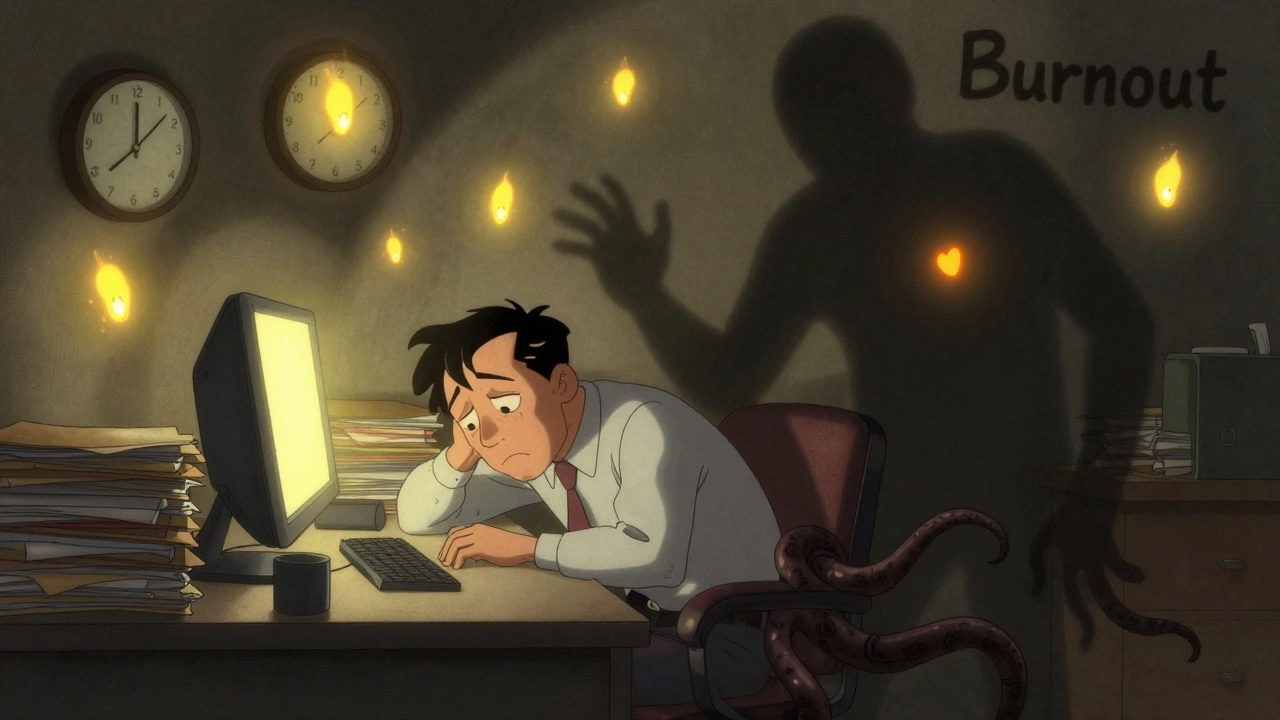
By 2025, nearly one in four workers globally will report being burned out at work most of the time. This isn’t just feeling tired after a long week. It’s a slow erosion of energy, motivation, and sense of purpose - so deep that even weekends don’t fix it. The World Health Organization labeled it an occupational phenomenon in 2019, and since then, the numbers have only climbed. Gallup’s 2023 data shows 23% of employees feel burned out very often or always. That’s not a small group. That’s your team. Your colleague. Maybe even you.
What Burnout Really Looks Like (Beyond Just Being Tired)
Burnout isn’t a personality flaw. It’s a reaction to unmanaged stress over months - sometimes years. The three signs are clear: you’re constantly exhausted, even after rest. You feel detached from your work, like you’re going through the motions. And you’ve lost confidence in your ability to do it well. You used to take pride in your output. Now, you just want to get through the day.
It shows up physically too. Sixty-three percent of burned-out workers report chronic fatigue. Forty-two percent struggle with sleep. More than half say they can’t focus - forgetting meetings, making small errors, staring at screens without absorbing anything. These aren’t random glitches. They’re your body’s alarm system screaming that something’s broken.
The Maslach Burnout Inventory, the gold standard tool used by psychologists since the 1980s, measures this through three core areas: emotional exhaustion, cynicism, and reduced accomplishment. If you’re checking off two or more of these, it’s not laziness. It’s a signal.
Why Burnout Happens: It’s Not Just Too Much Work
People assume burnout comes from long hours. But the real culprits are deeper. According to the Job Demands-Resources model, six workplace conditions drive burnout:
- Excessive workload (67% of employees cite this)
- Lack of control over how or when you do your work (49%)
- Not feeling valued or rewarded (42%)
- Isolation or poor team connection (38%)
- Perceived unfairness in decisions or treatment (34%)
- Misalignment between your values and company practices (29%)
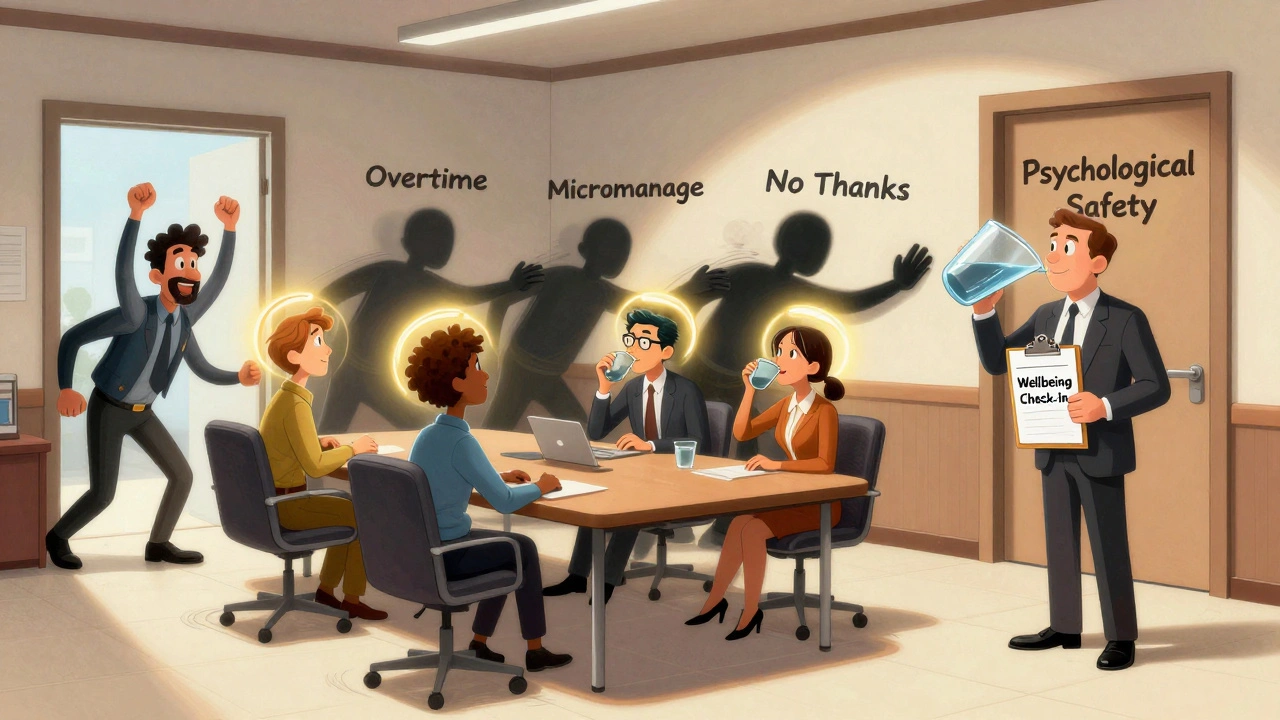
One person might burn out from constant overtime. Another from being micromanaged. A third from never hearing a thank-you. The pattern isn’t the same - but the root is always systemic. Dr. Christina Maslach, who created the MBI, says it plainly: “Burnout is not an individual failure. It’s a systems failure.”
How Managers Can Stop Burnout Before It Starts
Managers don’t cause burnout - but they’re the biggest factor in preventing it. Gallup’s research found managers account for 70% of the difference in team engagement. That means your manager’s behavior directly impacts your mental health.
Teams with managers who have five key conversations - focusing on strengths, purpose, wellbeing, growth, and recognition - see 41% lower burnout rates. These aren’t annual reviews. They’re weekly, honest check-ins where you’re asked: “How are you *really* doing?”
Simple changes make a big difference. Companies like Unilever and Johnson & Johnson saw 28% higher retention when 1:1s included mental health as a standard topic. Setting boundaries matters too. Teams that enforce “digital sunset” policies - automatic email and Slack shutdowns after hours - cut after-work communication by 31% and reduced burnout by 26%.
Psychological safety is the foundation. Google’s Project Aristotle found teams where people felt safe speaking up, admitting mistakes, and asking for help had 47% less burnout. That doesn’t mean coddling. It means trust. And trust is built by consistency, not slogans.
What You Can Do: Individual Strategies That Actually Work
Yes, organizations need to change. But you don’t have to wait. Small, daily habits can rebuild your resilience.
First, protect your time. Employees who set clear boundaries - like no emails after 6 p.m. - report 39% lower burnout. Use time-blocking. Schedule focused work, breaks, and personal time like appointments. A 2024 study of 1,200 knowledge workers found this improved task completion by 28% and cut burnout symptoms by 22%.
Micro-breaks aren’t optional. Taking 5-10 minutes every 90 minutes to walk, stretch, or just breathe increases productivity by 13% and lowers burnout markers by 17%, according to Harvard Business Review. You don’t need a meditation app. Just stand up. Look out the window. Let your eyes rest.
Move your body. Walking meetings are now standard at 68% of Fortune 500 companies. They cut sedentary time by 27 minutes per day. Even a 10-minute walk before and after work - called a “bookending routine” - dropped stress levels by 22% in a 2024 MIT study of remote workers.
Hydration and nutrition matter more than you think. Companies that provide protein-rich snacks and water stations saw 19% fewer fatigue-related absences. Your brain needs fuel. Don’t skip meals or live on coffee.
Recovering From Burnout: A Structured Path Back
Recovery isn’t a vacation. It’s a reset. Gallup’s three-phase model works: recognition, intervention, restoration.
Recognition means catching it early. Use tools like the Q12 engagement survey. If you’re feeling disconnected, exhausted, and ineffective, don’t wait. Talk to your manager. Use your company’s mental health benefits. Spring Health found employees who seek help within 14 days of noticing symptoms recover 82% faster.
Intervention means action. That could mean temporarily reducing your workload, shifting tasks, or taking a few days off. The APA recommends “strategic disengagement” - a full 48-72 hour digital detox. No work emails. No Slack. No checking in. Just rest. People who do this report a 63% drop in emotional exhaustion.
Restoration is about rebuilding slowly. Use “accomplished lists” instead of to-do lists. Write down what you *did* complete each day. It rewires your brain to see progress, not failure. Gratitude practices - writing down three things you’re thankful for - help too. Keystone Partners found these simple tools cut return-to-productivity time by over three weeks.
Why Most Burnout Programs Fail - And How to Fix Them
Eighty-three percent of companies launch wellness initiatives. Only 17% keep them going past a year. Why? They treat burnout like a checkbox, not a culture.
The biggest failure? Lack of accountability. Gallup found 68% of programs fail because managers aren’t held responsible. Successful companies make wellbeing part of performance reviews - at least 30% of a manager’s evaluation now ties to team mental health. That’s how you get real change.
Integration beats isolation. The most effective programs don’t add another app or seminar. They weave prevention into existing systems: onboarding, performance cycles, promotion criteria. One healthcare provider added 4.5 hours of burnout prevention training to new hire orientation. Adherence jumped 52%.
Timing matters. The fastest-moving companies hit three milestones: 30 days to build psychological safety, 60 days to run workload audits, 90 days to shift culture. Organizations following this timeline see 44% higher success rates.
The Future of Burnout Prevention: AI, 4-Day Weeks, and Predictive Tools
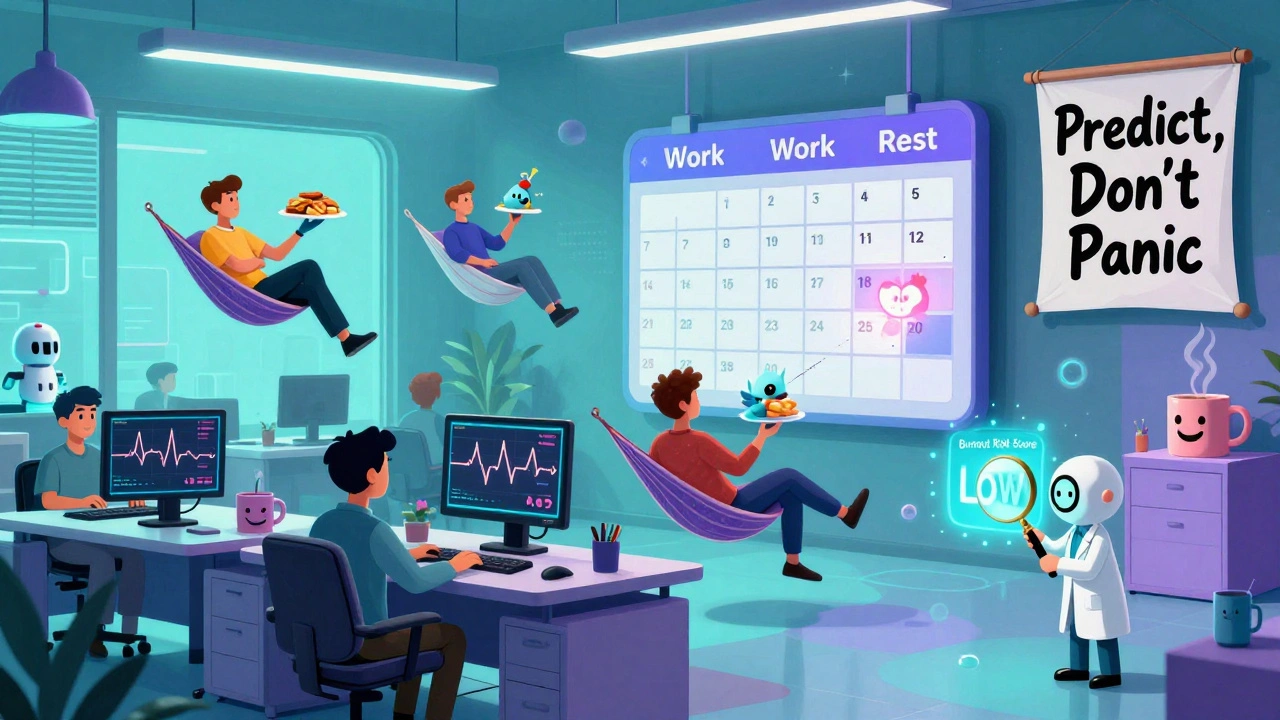
By late 2025, 65% of Fortune 500 companies will use AI to predict burnout before it happens. These systems analyze email patterns, calendar density, and after-hours activity to flag at-risk employees - with 82% accuracy.
Companies like Basecamp and Shopify are leading a “boundary economy” trend: 4-day workweeks. In 2023, only 12% of tech firms tried it. By 2025, that number is expected to hit 37%. Early results show no drop in output - just better sleep, lower stress, and higher loyalty.
Neuroscience is entering the mix. Neurobloom Colorado’s pilot programs at Google and Intel use Heart Rate Variability (HRV) monitors to track stress levels in real time. Teams using this saw 29% greater burnout reduction than those using traditional wellness apps.
The biggest shift? Moving from reactive to predictive. Companies like American Express and Procter & Gamble now combine data from sick days, EAP usage, and productivity metrics to create individual burnout risk scores. They don’t wait for someone to crash. They intervene before it happens. And burnout rates there have dropped by 38%.
Final Thought: This Isn’t About Self-Care Alone
Dr. Adam Grant put it best: “Permission to say no” reduces burnout by 34%. But fewer than 15% of companies give that permission. Self-care - yoga, journaling, mindfulness - helps. But it only fixes 20% of the problem. The rest? That’s on leadership.
Burnout isn’t your fault. It’s the result of systems that demand more than humans can sustain. The solution isn’t better coffee or free massages. It’s fair workloads, real autonomy, meaningful recognition, and leaders who care more about people than productivity stats.
If you’re burned out, you’re not weak. You’re human. And you deserve better than a system that treats exhaustion as normal.
What are the first signs of workplace burnout?
The earliest signs are persistent exhaustion that doesn’t improve with rest, feeling emotionally detached from your work, and a growing sense of ineffectiveness - like no matter how hard you try, nothing you do matters. You might also notice trouble focusing, irritability, or trouble sleeping. These aren’t temporary dips. They’re patterns that last weeks or months.
Can burnout be fixed without changing jobs?
Yes - but only if the root causes are addressed. If burnout comes from excessive workload, poor management, or lack of control, changing your mindset won’t help. You need structural changes: adjusted responsibilities, clearer boundaries, better support. Many people recover within their current role by working with their manager to redesign their job. But if the culture is toxic or unchanged, staying may only make things worse.
How long does it take to recover from burnout?
Recovery varies. For mild cases, with proper rest and boundary-setting, people start feeling better in 4-8 weeks. For moderate to severe burnout, it can take 3-6 months or longer. The key is not rushing back. Spring Health’s data shows those who return too soon - without protected time or reduced pressure - often relapse. Recovery isn’t linear. Some days feel better. Others don’t. Be patient.
Are mental health apps effective for burnout?
They can help with symptoms - reducing anxiety, improving sleep, offering guided breathing - but they don’t fix the cause. If your job is overwhelming or unsupportive, an app won’t solve that. The American Psychiatric Association found self-care tools alone address only 20% of burnout causes. They’re useful as part of a broader plan - not as the main solution.
What should I say to my manager if I’m burned out?
Be direct but solution-focused. Try: “I’ve been feeling overwhelmed and disconnected lately, and I’m concerned it’s affecting my performance. I’d like to talk about how we can adjust my workload or responsibilities to help me get back on track.” Bring specific examples - not just feelings. Suggest options: redistributing tasks, delaying a project, or taking a short break. Most managers want to help - they just need to know how.
Is burnout the same as depression?
No - but they can overlap. Burnout is work-specific: exhaustion tied to job stress, cynicism about work, reduced efficacy. Depression is broader - affecting mood, sleep, appetite, and self-worth across all areas of life. Someone can be burned out without being depressed. But prolonged burnout can lead to depression. If you’re feeling hopeless, worthless, or having thoughts of self-harm, seek professional help immediately. Burnout is manageable. Depression requires clinical support.
Workplaces don’t have to be places where people break down. They can be places where people thrive - if we choose to build them that way.
Kathy Haverly
December 10, 2025 AT 08:29Also, AI predicting burnout? That's just surveillance with a pretty name. Next they'll be monitoring your heart rate to see if you're 'too stressed' to type. Welcome to dystopia, folks.
Chris Marel
December 10, 2025 AT 12:01Don't get me wrong-this advice is good for those lucky enough to have a job with boundaries. But let's not pretend burnout is a first-world problem we can fix with 'micro-breaks' and protein snacks. The real issue is global inequality disguised as workplace culture.
Maria Elisha
December 11, 2025 AT 17:07Also, ‘bookending routine’? Sounds like a yoga class I paid for and never used.
Richard Eite
December 12, 2025 AT 07:22AI tracking your stress? Good. I want to know who’s slacking.
Stop treating adults like children. Get. Back. To. Work.
Katherine Chan
December 13, 2025 AT 04:16We’re redesigning my workload next week. I’m not fixed yet but I’m hopeful. If you’re reading this and feel like you’re drowning-you’re not alone. Ask for help. You deserve to breathe.
Philippa Barraclough
December 14, 2025 AT 11:01One might argue that the proliferation of wellness apps and mindfulness training functions as a form of neoliberal co-optation, where organizations outsource responsibility for workplace harm onto the individual, thereby absolving themselves of accountability. The data on managerial accountability being tied to performance reviews is promising, but without enforcement mechanisms or penalties for noncompliance, it remains performative. I’d be curious to see longitudinal studies comparing organizations that implement these changes versus those that merely publish blog posts about them.
Olivia Portier
December 15, 2025 AT 18:29Also, my boss started doing weekly ‘how are you really’ check-ins and I cried the first time. Not because I was sad-because someone finally asked.
you’re not weak. you’re human. and you’re not alone.
ps: i still drink too much coffee but now i also drink water. progress not perfection.
Taya Rtichsheva
December 16, 2025 AT 02:48Also ‘digital sunset’? That’s just corporate speak for ‘we’re not paying you enough to care about your life outside work.’
Meanwhile I’m over here deleting Slack notifications and pretending I’m on vacation even though I’m still answering emails. #modernlife
Christian Landry
December 17, 2025 AT 09:48Also I’m gonna stop saying ‘I’m fine’ when I’m not.
thx for the real talk 💪