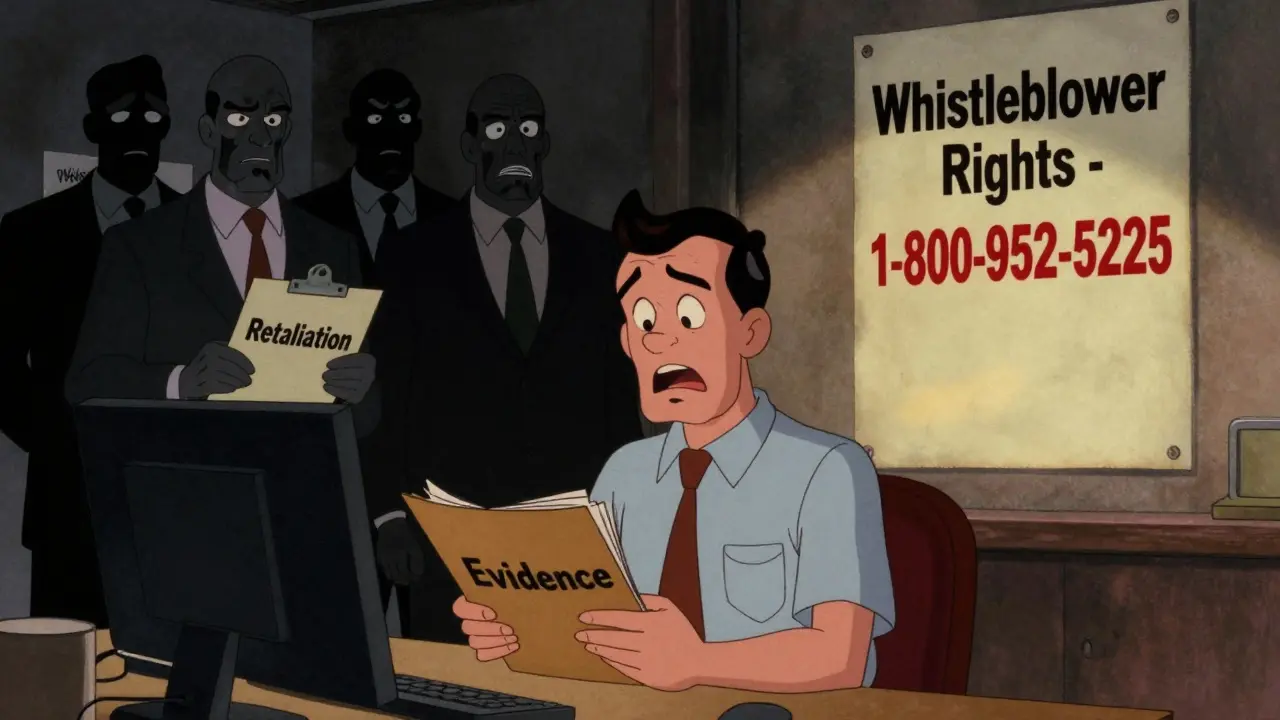
What happens when you see something wrong at work-something illegal, unsafe, or dishonest-and you decide to speak up? You might expect to be thanked. But too often, you’re punished instead. That’s why whistleblower laws exist. They’re not just paperwork. They’re your legal shield against retaliation when you report violations. And if you’re in California, the rules just got stronger-starting January 1, 2025.
What Counts as Protected Reporting?
You don’t need to be a lawyer or an auditor to be protected. If you have a reasonable belief that your employer is breaking a law-state or federal-you’re covered. That includes reporting safety violations, financial fraud, environmental damage, patient neglect, or even shady AI practices. You can tell your boss, file a report with a government agency, or even talk to the media in some cases. The key is that your report must be about a violation of law, not just a personal grievance.California’s Labor Code Section 1102.5 is one of the broadest protections in the country. It covers any violation of state or federal law, whether it’s falsifying payroll records, ignoring OSHA rules, or hiding toxic waste. Federal laws are more narrow. For example, the Sarbanes-Oxley Act only protects employees of public companies who report securities fraud. The False Claims Act covers fraud against government programs, like Medicare billing scams. So if you work in healthcare and report billing fraud, you’re protected under federal law. If you report unsafe staffing ratios, you’re protected under California law.
What Kind of Retaliation Is Illegal?
Retaliation doesn’t just mean getting fired. It’s any action meant to punish you for speaking up. That includes:- Getting fired, demoted, or forced to resign
- Having your hours cut or pay reduced
- Being denied promotions or training
- Being given impossible workloads or unfair performance reviews
- Being isolated, mocked, or threatened by managers or coworkers
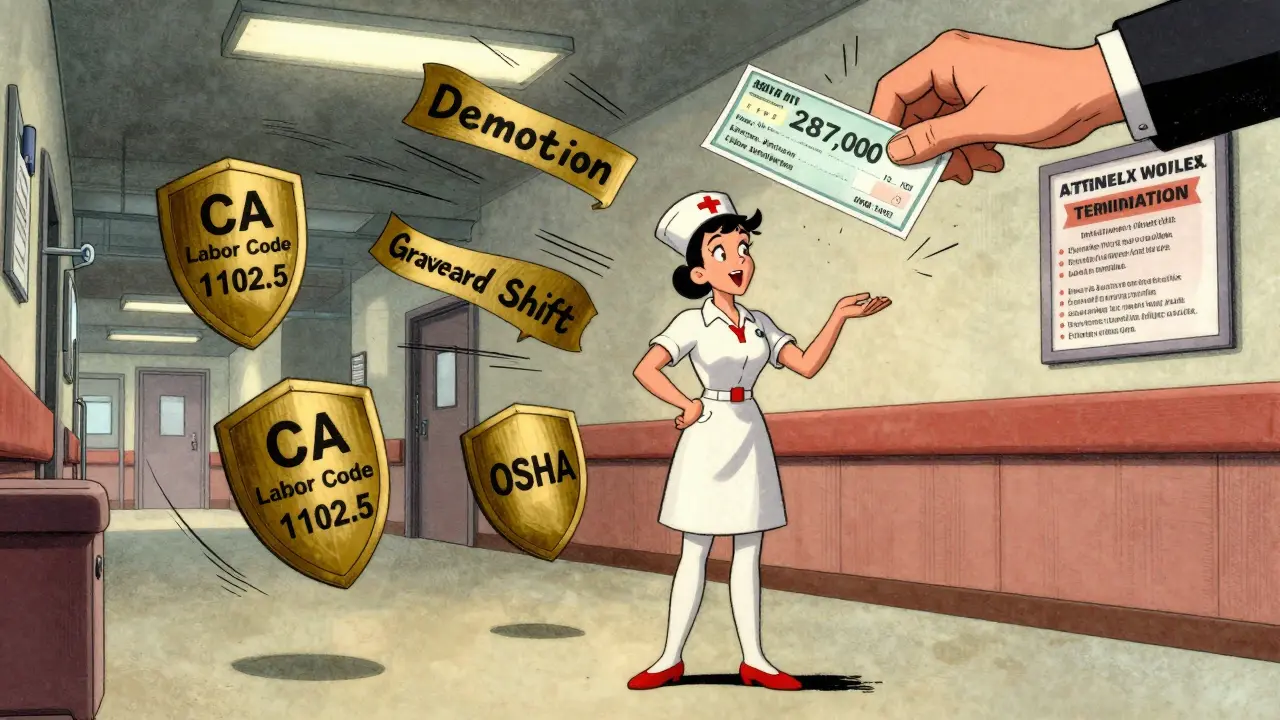
- Being reassigned to a dangerous or undesirable shift (like graveyard hours after reporting safety issues)
One nurse in California was terminated after reporting that her unit was understaffed, leading to preventable patient falls. She won her case and got $287,000 in back pay. But she spent 22 months fighting it. That’s the average length of a whistleblower case in California, according to the Division of Labor Standards Enforcement. Most people can’t afford to wait that long without income.
California’s 2025 Rule Change: The Posting Requirement
Starting January 1, 2025, every employer in California-no matter how small-must post a clear notice about whistleblower rights in a visible place, like a break room or HR office. The notice must include the Attorney General’s Whistleblower Hotline: 1-800-952-5225. It has to be in at least 14-point font. If you don’t post it, you can be fined up to $10,000 per violation.This is a big deal. Before, many employers didn’t even know they had to inform workers of their rights. A survey by the California Chamber of Commerce found 65% of small business owners were unaware of the new requirement as of October 2024. Now, every employee has a right to see it. It’s not just a legal formality-it’s a signal that reporting violations is not just allowed, it’s protected.
Federal vs. State: What’s Stronger?
California’s law is broader. It protects you for reporting any law violation. Federal laws are more limited. But federal law has two advantages: financial rewards and access to federal courts.The Dodd-Frank Act gives whistleblowers 10% to 30% of the money recovered if their tip leads to a successful enforcement action over $1 million. In fiscal year 2023, the SEC paid out $637 million to 131 whistleblowers-up 27% from the year before. That’s real money. But you can only claim this if you report securities fraud to the SEC directly.
On the flip side, California employees can’t sue in federal court under Section 1102.5. They’re stuck in state court. Federal laws like Sarbanes-Oxley let you file in federal court, which some lawyers say offers better outcomes. But federal agencies like OSHA are slow. In 2024, OSHA missed its 90-day deadline to investigate whistleblower complaints in 63% of cases. Meanwhile, California’s DLSE has a faster track for labor code violations, though delays still happen.
Who’s Protected?
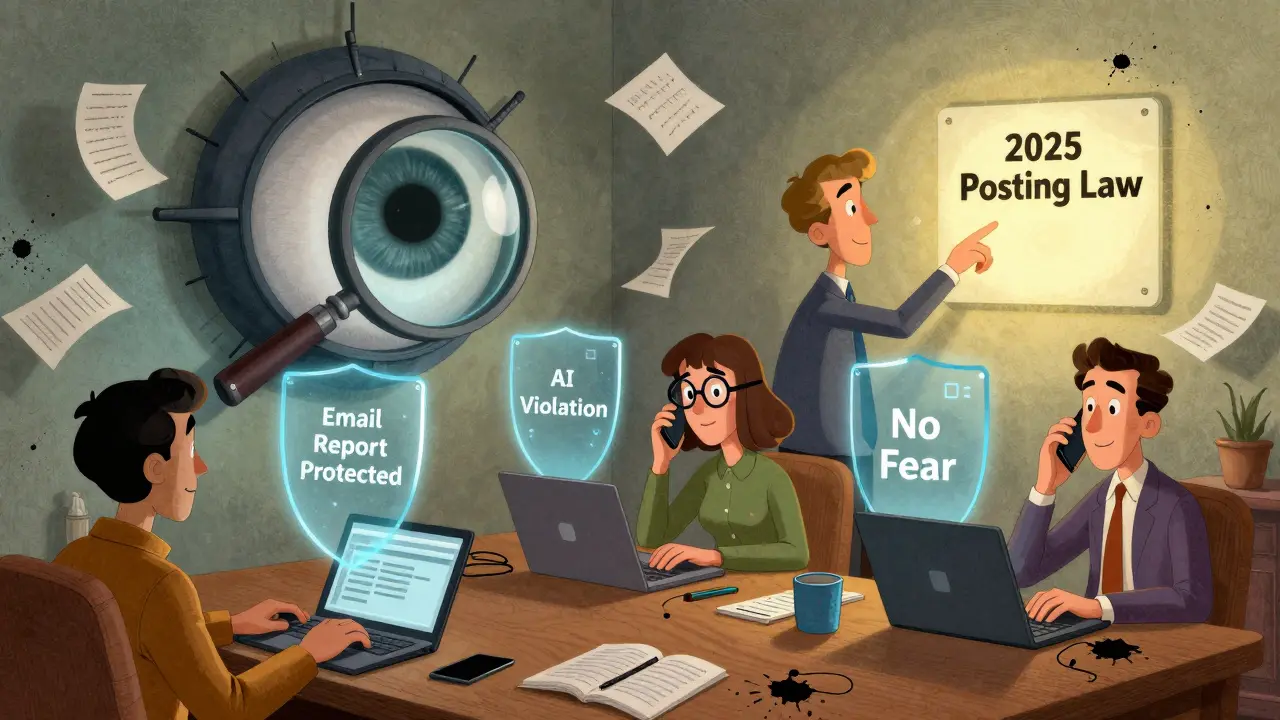
You don’t have to be a current employee. Job applicants, contractors, and even people who are just suspected of planning to report are protected. That means if your boss thinks you’re going to report safety violations-even if you haven’t yet-and they start treating you differently, that’s illegal.Remote workers are a gray area. California’s law says notices can be emailed, but it doesn’t say how remote employees should report violations without fear of being tracked. A 2025 advisory from Littler Mendelson warns this creates confusion. If you’re working from home and report misconduct over email, your employer might try to argue you didn’t follow internal procedures. That’s why documenting everything matters.
What You Need to Do to Protect Yourself
Legal protections only work if you use them correctly. Here’s what you should do:- Document everything. Save emails, texts, performance reviews, shift schedules, and any communication about your report. California’s DLSE requires “clear and convincing evidence” of retaliation.
- Know your deadlines. Federal claims have strict time limits: 30 days for Clean Air Act violations, 90 days for money laundering, 180 days for financial fraud. Miss the deadline, and you lose your case.
- Report internally first, if safe. Some laws require you to give your employer a chance to fix the issue. But if you fear retaliation, go straight to a government agency like OSHA or the Labor Commissioner.
- Call a lawyer before you report. The National Whistleblower Center says 78% of successful cases had legal representation. Free help is available through nonprofits, but time is critical.
What’s Coming Next?
The biggest change in 2025 isn’t just California’s posting rule. It’s the AI Whistleblower Protection Act, introduced by Senator Grassley in May 2025. It would give legal protection to employees in tech companies who report unsafe AI practices-like biased algorithms, hidden surveillance, or misuse of personal data. Right now, AI workers have no federal protection. This could be the first step toward covering new industries.The European Union already has a strong whistleblower law since 2019. The U.S. still doesn’t. That’s why states like California are leading the way. The National Whistleblower Center is pushing for seven reforms in 2025, including letting federal whistleblowers sue in federal court and making National Whistleblower Day permanent.
Real Stories, Real Consequences
On Reddit’s r/antiwork, users describe being pushed out after reporting violations. One user, u/SafetyFirstCA, said after reporting OSHA violations, they were moved to midnight shifts, forced to quit, and then denied unemployment. “The law says I’m protected,” they wrote. “But HR just shrugged.”A 2024 survey of 500 whistleblowers found 68% still faced retaliation. In 42% of cases, HR told them their report didn’t meet the legal threshold. That’s a red flag. The law doesn’t require you to prove the violation happened-just that you reasonably believed it did.
Still, there are wins. A warehouse worker in Los Angeles reported unsafe forklift conditions. After being demoted, he filed a claim. He was reinstated, got back pay, and the company had to install new safety training. His story didn’t make the news. But it changed his workplace.
Where to Get Help
You don’t have to go it alone:- California Attorney General’s Whistleblower Hotline: 1-800-952-5225 (free advice, no judgment)
- OSHA Whistleblower Protection Program: 800-321-6742 (for federal safety violations)
- National Whistleblower Center: Offers free legal referrals and support to over 1,200 whistleblowers in 2024
Whistleblower laws aren’t perfect. They’re slow, confusing, and sometimes ignored. But they’re the only thing standing between you and being punished for doing the right thing. If you’re thinking about reporting a violation, know your rights. Document everything. Get help early. And remember-you’re not alone.
Can I be fired for reporting a violation at work?
No. Federal and state whistleblower laws make it illegal to fire, demote, punish, or retaliate against someone for reporting violations they reasonably believe are illegal. If you are fired after reporting, you may have a legal claim for wrongful termination. You must prove the retaliation was connected to your report, which is why documenting everything is critical.
Do I need to report internally before going to the government?
Not always. Some laws, like the False Claims Act, require you to report internally first if possible. But if you fear retaliation, you can go straight to a government agency like OSHA, the SEC, or the Labor Commissioner. California’s Labor Code 1102.5 protects you even if you report directly to authorities without telling your employer first.
How long do I have to file a whistleblower claim?
Deadlines vary by law. For California labor code violations, you have one year from the retaliation to file with the Division of Labor Standards Enforcement. For federal laws, deadlines range from 30 to 180 days. For example, you have 30 days for Clean Air Act claims and 180 days for financial fraud under the Consumer Financial Protection Act. Missing the deadline means losing your case.
Can I get paid for reporting fraud?
Yes-if you report fraud against the government or securities fraud to the right agencies. Under the False Claims Act, you may get 15% to 30% of the money recovered. Under Dodd-Frank, if your tip leads to a successful SEC enforcement action over $1 million, you can receive 10% to 30% of the penalties. In 2023, the SEC paid out $637 million to whistleblowers.
What if I’m not sure if what I saw is illegal?
You don’t need to be 100% certain. The law protects you if you have a reasonable belief that a violation occurred. You’re not expected to be an expert. If you saw something that seemed wrong-like falsified records, unsafe conditions, or hidden hazards-and you reported it in good faith, you’re protected. The burden is on your employer to prove you acted maliciously.
Julie Chavassieux
December 22, 2025 AT 22:20Sam Black
December 24, 2025 AT 01:56Cara Hritz
December 26, 2025 AT 01:07Art Van Gelder
December 26, 2025 AT 21:10Kiranjit Kaur
December 27, 2025 AT 21:47Johnnie R. Bailey
December 29, 2025 AT 10:59Kathryn Weymouth
December 29, 2025 AT 16:06Ajay Brahmandam
December 30, 2025 AT 07:23Jamison Kissh
December 31, 2025 AT 06:26Herman Rousseau
January 1, 2026 AT 19:32Vikrant Sura
January 3, 2026 AT 09:19Jeremy Hendriks
January 5, 2026 AT 01:07Candy Cotton
January 6, 2026 AT 20:10Sai Keerthan Reddy Proddatoori
January 7, 2026 AT 01:46Johnnie R. Bailey
January 9, 2026 AT 00:05