Have you ever picked up a prescription and noticed the medicine looked different from what your doctor prescribed? Or maybe you’ve heard that hospital visits are being replaced by home care or video calls? If so, you are seeing UK substitution laws in action. These rules govern how the National Health Service (NHS) can swap medications for cheaper equivalents or move care from hospitals to local communities. For years, these policies were stable, but as of 2026, they are undergoing their biggest shake-up in decades.
The changes are not just about saving money. They are part of a massive structural overhaul of the NHS designed to handle rising demand and an aging population. The Department of Health and Social Care (DHSC) has taken direct control of pharmaceutical services, abolishing the previous oversight by NHS England. This shift means new regulations are hitting pharmacies and hospitals faster than ever before. Understanding these laws is crucial for patients, pharmacists, and healthcare providers who need to navigate the new reality of remote dispensing and community-based care.
The Basics of Pharmaceutical Substitution
At its core, pharmaceutical substitution allows a pharmacist to replace a branded drug with a generic version. This practice is rooted in the Medicines Act 1968, which established the legal foundation for drug regulation in the UK. Over time, this evolved into specific NHS rules, primarily governed by the NHS (Pharmaceutical Services) Regulations 2013.
Under Regulation 33 of these 2013 regulations, pharmacists are permitted to dispense a generic equivalent unless the prescriber explicitly writes "dispense as written" (DAW). This simple rule saves the NHS billions of pounds annually because generics are significantly cheaper to produce than brand-name drugs. However, the system relies on trust. Patients must trust that the generic pill works exactly like the brand name, and doctors must trust that pharmacists will only substitute when it is safe to do so.
In 2026, this framework is getting stricter. The government is pushing for higher generic substitution rates. Currently, the average substitution rate hovers around 83%, but the 2025 reforms aim to push this to 90% for eligible medications. This isn't just a suggestion; it is a contractual obligation embedded in the new NHS Standard Contract for 2025/26. Pharmacists who fail to meet these targets may face penalties, while those who succeed help keep the NHS financially viable.
The Rise of Digital Service Providers (DSPs)
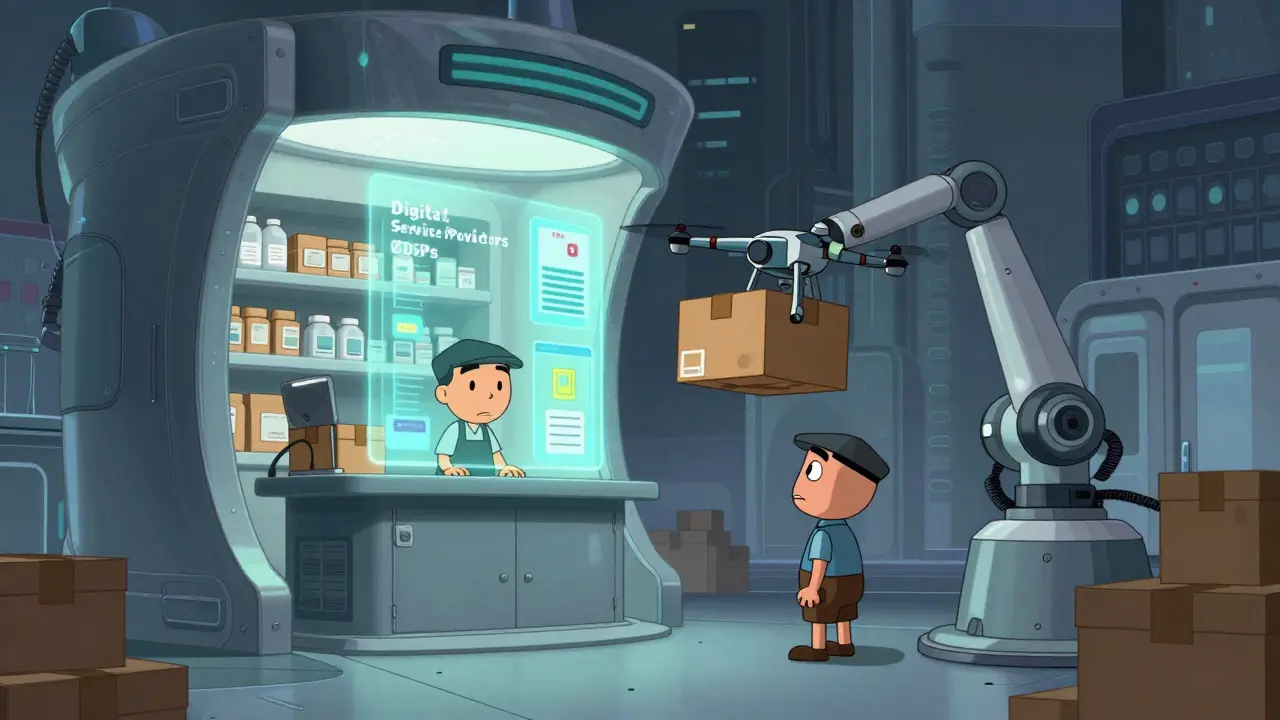
If you thought pharmacy was just about counter service, think again. The most disruptive change in recent UK substitution laws involves the introduction of Digital Service Providers (DSPs). Under the Human Medicines (Amendment) Regulations 2025, DSPs are now required to deliver all NHS pharmaceutical services remotely. This means no more face-to-face consultations at physical pharmacy premises for certain types of prescriptions.
This regulation, specifically Statutory Instrument 2025 No. 636, came into force in June 2025, with key provisions taking effect in October 2025. It fundamentally alters how dispensing works. Instead of walking into a shop, patients might receive their medication via mail or through automated pickup lockers, managed entirely by digital platforms. The goal is efficiency and accessibility, allowing medicines to be distributed without the overhead costs of high-street retail spaces.
However, this shift has raised eyebrows. A survey by the British Pharmaceutical Industry revealed that 79% of community pharmacies are concerned about these remote dispensing requirements. Many report needing between £75,000 and £120,000 in technology investments to comply. For smaller independent pharmacies, this financial burden is significant. The law removes exemptions from the normal market entry test for new DSPs, meaning big tech players can enter the market more easily, potentially squeezing out traditional family-run pharmacies.
| Feature | Traditional Community Pharmacy | Digital Service Provider (DSP) |
|---|---|---|
| Interaction Type | Face-to-face consultation | Remote/Digital-only |
| Regulatory Framework | NHS (Pharmaceutical Services) Regulations 2013 | Human Medicines (Amendment) Regulations 2025 |
| Market Entry Test | Standard assessment required | Exemptions removed for new applicants |
| Primary Cost Driver | Rent and staff wages | Technology infrastructure and logistics |
| Patient Access | Immediate collection | Delivery or locker pickup |
Shifting Care: From Hospital to Community
Substitution isn't limited to pills. The NHS is also substituting where care happens. The 2025 Mandate to NHS England directs the health service to move care "from hospital to community, sickness to prevention, and analogue to digital." This is known as service substitution. Instead of a patient going to a hospital for a routine check-up, that service is substituted with a visit from a community nurse or a virtual appointment.
This strategy aims to reduce emergency admissions, particularly among people aged 65 and over. The target is a 15% reduction in these admissions by 2026-27. To achieve this, Integrated Care Boards (ICBs)-which have been reduced from 42 to 28 entities-must develop local plans for proactive support. The idea is that by catching health issues early in the community, we can prevent them from becoming acute crises requiring expensive hospital beds.
Professor Sir Chris Whitty, the Chief Medical Officer, endorsed this approach in the 10 Year Health Plan. He noted that shifting 30% of hospital outpatient appointments to community settings by 2027-28 could reduce waiting lists by 1.2 million appointments annually. That is a staggering number. It suggests that if done correctly, substitution can actually improve access to care rather than restrict it.
Challenges and Risks in Implementation
While the numbers look good on paper, the reality on the ground is more complex. The NHS Confederation reported that 68% of ICBs lack the workforce capacity to deliver this shifted care. In rural areas, 42% of trusts simply do not have the community infrastructure needed to take over hospital functions. You cannot substitute a specialist surgeon with a general practitioner if the GP doesn't have the right training or tools.
There is also the issue of safety. Dr. Sarah Wollaston, former Chair of the Health and Social Care Committee, warned that the current substitution framework lacks sufficient safeguards for vulnerable populations. She cited a 12% increase in medication errors in the North West London ICB pilot program for remote dispensing services. When you remove the human interaction at the pharmacy counter, you lose a critical safety net where pharmacists can catch mistakes made by doctors or clarify confusion for patients.
Furthermore, there is a digital divide. A verified nurse from Manchester Royal Infirmary shared on Reddit that while virtual fracture clinics reduced unnecessary follow-ups by 40%, they created access issues for 15% of elderly patients who lacked digital literacy. Substitution policies assume everyone has a smartphone and knows how to use it. For many older or disadvantaged patients, this assumption is false. Without addressing this gap, substitution risks widening health inequalities.
Financial Implications and Future Outlook
The financial stakes are enormous. The DHSC allocated £1.8 billion in the 2025-26 budget specifically for service substitution initiatives. This includes £650 million for community diagnostic hubs, which are intended to replace 22% of hospital-based diagnostic services by 2027. The hope is that by moving diagnostics out of hospitals, we can free up space for emergency cases and reduce congestion.
Looking ahead to 2030, the NHS 10 Year Plan anticipates that 45% of current hospital outpatient appointments will be substituted with community or virtual alternatives. This requires an additional 15,000 community healthcare professionals. The Department of Health estimates a potential savings of £4.2 billion from optimized substitution practices if implementation challenges can be overcome. However, the Nuffield Trust warns that failure to address workforce and infrastructure gaps could result in substitution initiatives increasing overall system costs by 7-10% due to care fragmentation and safety incidents.
The Carr-Hill formula reform, scheduled for April 2026, will better target resources to areas with disproportionate economic and health challenges. This should help reshape substitution priorities in deprived communities, ensuring that the shift to community care does not leave the most vulnerable behind. But until then, the transition remains a high-wire act between cost-saving ambitions and patient safety realities.
What This Means for You
If you are a patient, expect more flexibility but also more responsibility. You may find yourself managing more of your care digitally. Make sure you understand how to access your online records and communicate with your care team remotely. If you rely on specific brand-name medications, talk to your doctor about whether a generic substitute is safe for you, especially if you have sensitive health conditions.
For healthcare professionals, the landscape is changing rapidly. Pharmacists need to adapt to digital workflows and ensure robust verification processes to prevent errors. GPs and community nurses will see increased workloads as they absorb services previously handled by hospitals. Upskilling and advocacy for adequate staffing levels are essential to make this transition successful.
Ultimately, UK substitution laws are trying to solve a problem of scale. The NHS cannot continue with the old model of hospital-centric care. Substitution offers a path forward, but it must be implemented with care, equity, and a focus on patient outcomes above all else.
Can my pharmacist always substitute my medication with a generic?
In most cases, yes. Under the NHS (Pharmaceutical Services) Regulations 2013, pharmacists can substitute branded drugs with generics unless your doctor writes "dispense as written" on the prescription. However, if you have concerns about a generic, discuss them with your doctor or pharmacist, as clinical judgment may override standard substitution rules in rare cases.
What are Digital Service Providers (DSPs)?
DSPs are companies authorized to provide NHS pharmaceutical services remotely. Under the 2025 reforms, they operate without face-to-face interactions at physical pharmacies. They handle prescription processing and delivery digitally, aiming to increase efficiency and reduce costs associated with high-street retail spaces.
Why is the NHS moving care from hospitals to communities?
The shift aims to reduce pressure on hospitals, lower costs, and improve patient convenience. By treating conditions in the community or virtually, the NHS hopes to reduce emergency admissions and waiting lists. The 2025 Mandate targets a 15% reduction in emergency admissions for over-65s by 2026-27 through this substitution strategy.
Are there risks associated with remote dispensing?
Yes. Critics point out that removing face-to-face interactions can lead to missed opportunities for pharmacists to catch medication errors or advise patients. Pilot programs have shown a slight increase in medication errors in some areas. Additionally, patients with low digital literacy may struggle to access remote services effectively.
How will the 2025 reforms affect independent pharmacies?
Independent pharmacies face significant challenges. They may need to invest heavily in technology to compete with large Digital Service Providers. The removal of market entry test exemptions for new DSPs means bigger competitors can enter the market more easily, potentially threatening the viability of smaller, family-run pharmacies.