REMS Impact Calculator
Estimate how REMS programs impact treatment time, costs, and patient delays for high-risk medications.
How This Tool Works
Based on FDA data showing 68% of doctors report REMS delays, 57% of pharmacies handle 3+ registrations per drug, and $450M annual costs for REMS management.
Results will appear here after calculation
When a drug carries a serious risk-like sudden brain swelling, life-threatening infections, or fatal birth defects-how do you let patients use it without putting them in danger? That’s the exact problem the FDA tried to solve in 2007 with REMS, or Risk Evaluation and Mitigation Strategies. These aren’t just warning labels. They’re legally binding rules that force drugmakers to do more than print a pamphlet. But do they actually make patients safer? Or are they just bureaucratic hoops that delay care?
What REMS Really Is (And What It Isn’t)
REMS isn’t a suggestion. It’s a requirement. If the FDA sees a drug with a risk so severe it could block approval, they can say: ‘You can sell this, but only if you do X, Y, and Z.’ That’s REMS. It’s not for every medication. Only about 150 drugs out of thousands on the market have it. But those drugs? They make up $120 billion in annual U.S. sales. These are the heavy hitters: cancer treatments, powerful psychiatric meds, immune suppressants, and opioids.
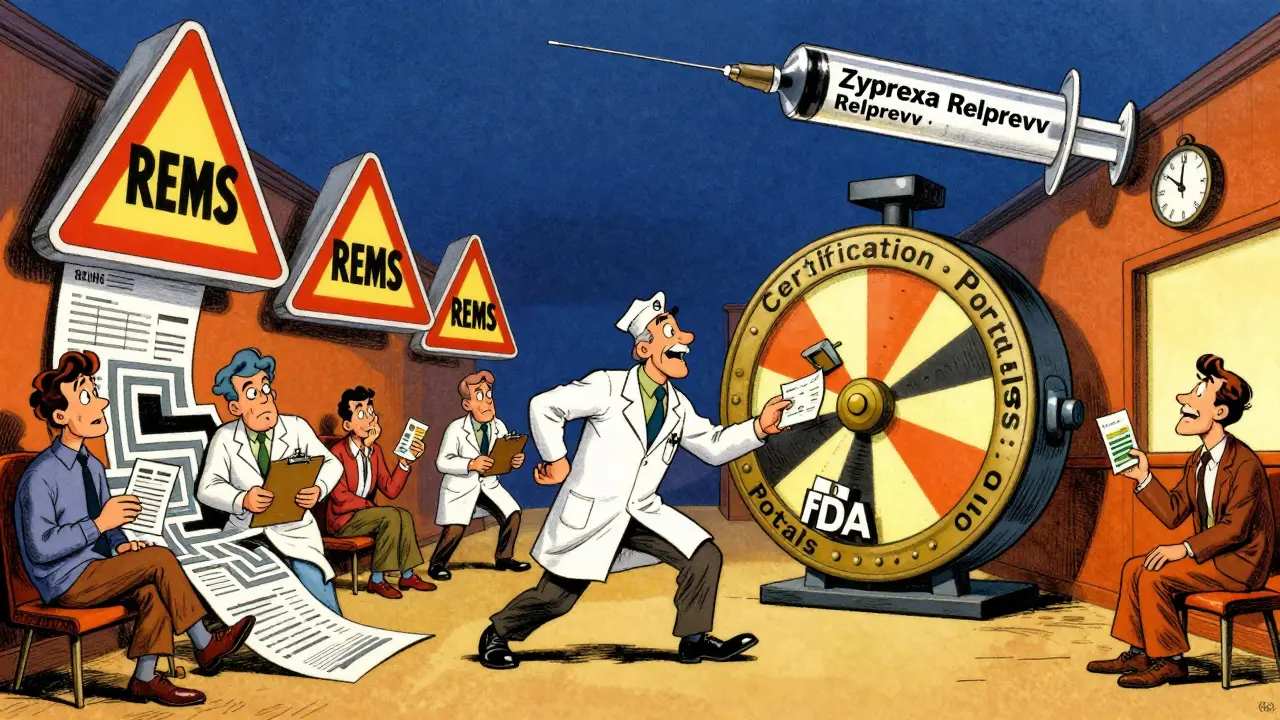
Most people think REMS means a patient gets a printed guide. That’s one part-Medication Guides-but it’s the easiest part. The real weight is in the other two: Communication Plans and Elements to Assure Safe Use (ETASU). Communication Plans mean doctors get special training, sometimes even mandatory webinars or letters signed by the drug company. ETASU? That’s where things get serious. For drugs like Zyprexa Relprevv, patients must be monitored for three full hours after injection because of a 0.8% chance of sudden confusion and sedation. Pharmacies need emergency equipment on-site. Prescribers need certification. It’s not just paperwork. It’s infrastructure.
Why REMS Exists: The Problem It Solves
Before REMS, the FDA used something called RiskMAPs. Voluntary. Unenforced. Only 35-45% of providers followed them. Drugs with dangerous side effects either got pulled from the market or never got approved at all. REMS changed that. It gave the FDA teeth. Now, if a drugmaker doesn’t meet REMS requirements, they can be fined up to $250,000 per violation.
Take Tysabri, a multiple sclerosis drug. It carries a risk of a rare brain infection called PML. Before REMS, doctors didn’t consistently test for the JC virus, which makes PML more likely. After the REMS program launched in 2008, clinics started requiring antibody testing before every infusion. One Ohio clinic reported a 30% drop in serious adverse events. That’s not theory. That’s real patients avoiding brain damage.
REMS also made it possible for drugs to reach the market that otherwise wouldn’t have. Between 2018 and 2022, 12 new drugs were approved solely because REMS programs managed their risks. Without REMS, those drugs would’ve been too dangerous to sell. That’s a win-until it becomes a barrier.
The Hidden Cost: Delays, Complexity, and Burnout
For patients, REMS can feel like a maze. A 2022 survey of 1,200 doctors found 68% said REMS caused treatment delays. For oncologists? That number jumped to 82%. One cancer patient in Texas waited six weeks to get her oral chemotherapy because her pharmacy wasn’t certified. She had to switch providers three times. The FDA’s own data shows 17% of specialty pharmacies report REMS delays in treatment.
Doctors aren’t just frustrated-they’re quitting. Nearly half of surveyed physicians said they’ve stopped prescribing a drug because the REMS process was too complicated. Imagine being a neurologist who wants to help a patient with epilepsy, but the drug requires six different registrations, three separate portals, and 12 hours of training. Many just pick a safer, less effective alternative.
Pharmacies are drowning too. A 2022 survey found that 57% of REMS-required drugs need three or more separate registrations. Each one takes an average of 4.2 hours to set up. That’s not just time. It’s money. Specialty pharmacies spend $450 million a year just managing REMS. And that cost? It gets passed down-to patients, to insurers, to the system.
Do REMS Actually Change Outcomes? The Evidence Gap
This is the big question. Does all this effort actually lead to fewer deaths, fewer hospitalizations, fewer bad outcomes? Or are we just checking boxes?
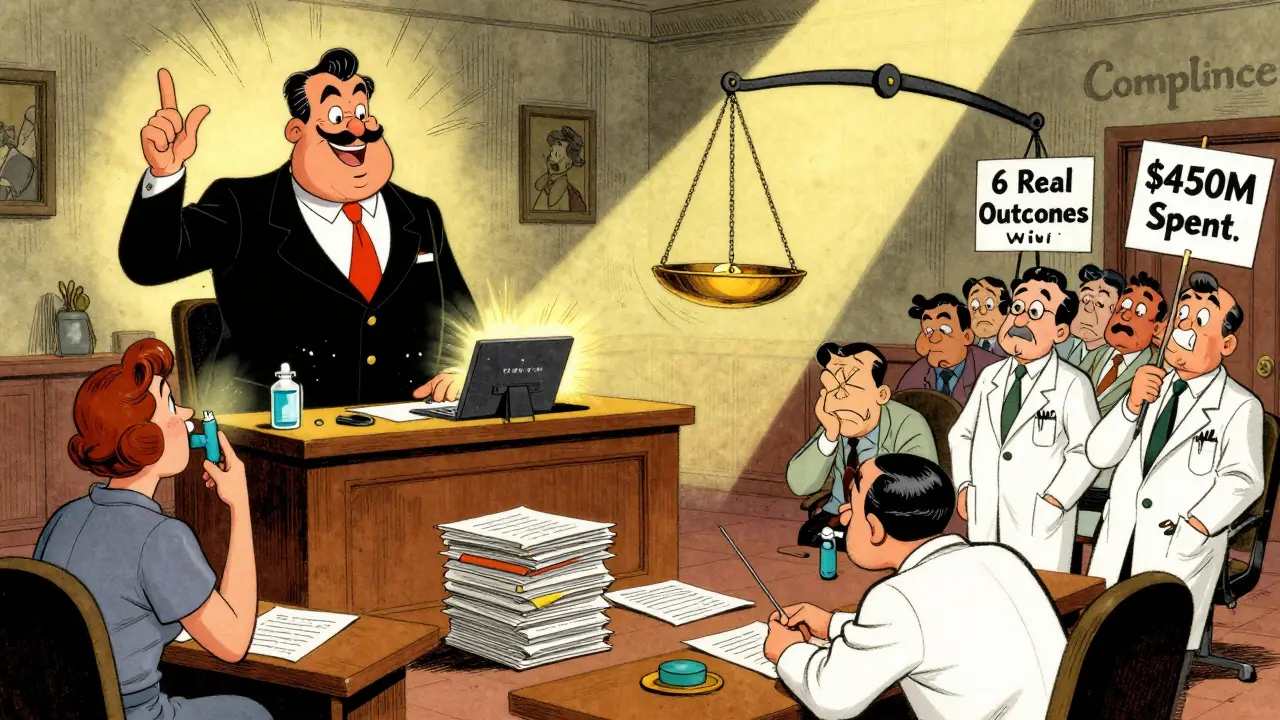
The FDA admits it: only 30% of REMS programs have enough data to measure real clinical outcomes. The rest? They track distribution of guides. They measure how many doctors completed training. They count how many pharmacies are certified. These are process metrics. They tell you if the system is working. But not if patients are safer.
Dr. Peter Lurie, a former FDA official, put it bluntly: ‘The evidence for REMS actually changing clinical outcomes remains thin.’ He’s not alone. Industry analysts point out that drugmakers spend an average of $18.7 million in the first year just to launch a REMS program. Is that money buying safety-or just compliance?
There are exceptions. The Tysabri REMS program reduced PML cases. The Opioid REMS programs helped cut off prescription overuse in rural clinics. But these are the outliers. Most REMS programs still rely on indirect measures. No one is tracking whether patients on a REMS drug are living longer, having fewer ER visits, or reporting better quality of life. That’s the missing piece.
The Future: REMS Is Changing-Fast
By 2025, everything changes. The FDA is drafting new rules that require drugmakers to prove REMS is improving actual patient outcomes-not just paperwork. That’s huge. They’re no longer satisfied with ‘80% of doctors completed training.’ They want to know: Did fewer patients get liver failure? Did hospitalizations drop? Did people stick with their treatment longer?
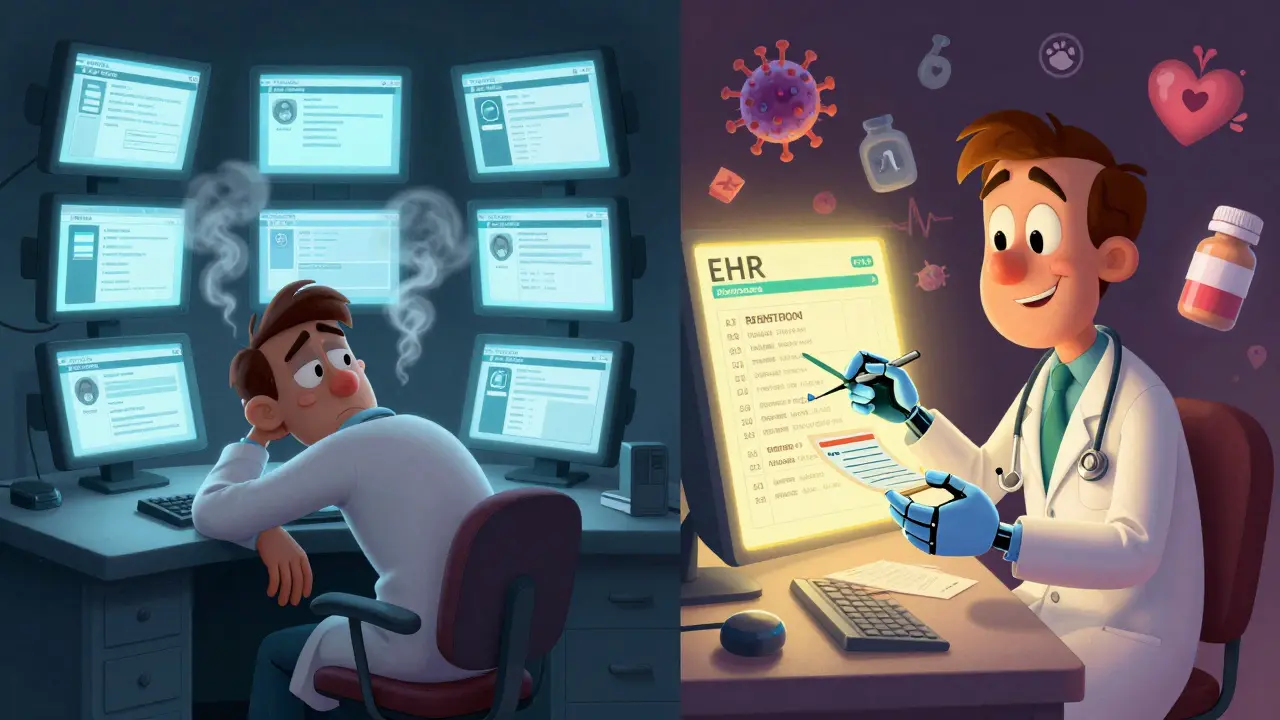
They’re also pushing for integration. Right now, prescribers jump between 4.7 different REMS portals. That’s insane. The REMS@FDA portal launched in 2020 and already covers 63% of programs. By 2026, the goal is to have 90% of REMS built directly into electronic health records. Imagine a doctor clicks ‘prescribe’ and the system auto-checks if the patient has the right test results, if the pharmacy is certified, and if the guide was handed out. No extra logins. No delays.
And there’s talk of ‘REMS Lite’-simplified versions for lower-risk drugs. Why force a cancer drug’s full compliance on a common painkiller? That could expand REMS to 50-75 more medications without overburdening the system.
Who Wins? Who Loses?
Patients with rare diseases or life-threatening conditions benefit most. REMS made drugs like Kalydeco for cystic fibrosis possible. Without it, those patients would’ve had no options. For them, REMS is a lifeline.
But for the millions on chronic meds-diabetes, depression, arthritis-REMS often feels like a roadblock. A patient in Ohio lost her job because she missed work waiting for her REMS-certified pharmacy to process her prescription. A veteran in Florida skipped his medication because the paperwork was too much. These aren’t edge cases. They’re the norm.
Providers are caught in the middle. They want to help. But they’re stretched thin. One oncologist told me: ‘I’d rather spend 20 minutes talking to my patient than 45 minutes filling out forms for a drug I barely understand.’
Drugmakers? They’re spending millions on compliance, not research. The $5.3 million annual cost per drug could fund dozens of clinical trials. Is this the best use of resources?
The Bottom Line
REMS isn’t good or bad. It’s necessary-but broken. It saved lives by allowing dangerous but life-saving drugs to exist. It also created a system that’s slow, confusing, and disconnected from real patient outcomes.
The future is clear: REMS must evolve from a compliance checklist to a true safety tool. That means measuring actual health results, not just signed forms. It means integrating with EHRs so doctors don’t have to be data entry clerks. It means simplifying for low-risk drugs so the system doesn’t collapse under its own weight.
If the FDA gets this right, REMS could become the gold standard for global drug safety. If they don’t, it’ll remain a costly, frustrating machine that helps no one-not patients, not doctors, not even the companies paying for it.
The question isn’t whether REMS should exist. It’s whether we’re using it the right way.
Are Medication Guides the same as REMS?
No. Medication Guides are just one part of REMS. They’re the printed handouts patients get with their prescription. REMS is the entire legal framework that may include those guides, plus mandatory training for doctors, special pharmacy certifications, and even patient monitoring requirements. All REMS programs include Medication Guides, but not all Medication Guides are part of a REMS program.
How many drugs in the U.S. have REMS requirements?
As of October 2023, 72 active REMS programs cover about 150 drugs and biological products. That’s less than 1% of all prescription medications, but these drugs account for roughly $120 billion in annual U.S. sales-mostly cancer, neurological, and immune therapies.
Can REMS cause delays in getting medication?
Yes. A 2021 Government Accountability Office report found that 17% of specialty pharmacies reported treatment delays due to REMS requirements. Patients often wait weeks because prescribers or pharmacies aren’t certified, or because multiple registrations are needed across different portals. Oncology and rare disease patients are most affected.
Do doctors have to get trained for REMS?
It depends. For REMS programs with ETASU (Elements to Assure Safe Use), prescribers must complete 8-16 hours of specialized training and get certified. For simpler REMS, they may only need to read a ‘Dear Doctor’ letter or complete a short online module. About 38 active REMS programs require some form of provider communication or training.
Is REMS effective at preventing deaths?
There’s strong evidence for some drugs-like Tysabri, where JC virus testing cut PML cases by 30%. But overall, the FDA admits only 30% of REMS programs have enough data to prove they reduce serious adverse events. Most still measure process metrics like guide distribution or training completion, not actual patient outcomes. The FDA is pushing for outcome-based data starting in 2025.
What’s the difference between REMS and RiskMAPs?
RiskMAPs were voluntary programs used before 2007. They had no enforcement power, and compliance was only 35-45%. REMS, created by the 2007 FDAAA law, is mandatory. Drugmakers must meet strict requirements or face fines up to $250,000 per violation. REMS has measurable goals, legal teeth, and FDA oversight-RiskMAPs didn’t.
Health systems are already adapting. Some hospitals now assign a dedicated REMS coordinator for every 10,000 patients. EHR vendors are building automated checks into their systems. The goal is no longer just to manage risk-but to make safety seamless.
Aparna karwande
January 6, 2026 AT 20:22Let me be crystal clear-this REMS circus is a national embarrassment. We spend billions on paperwork while patients die waiting for prescriptions because some bureaucrat in D.C. thinks a signed form equals safety. India doesn’t have this madness. We trust doctors. We don’t turn healthcare into a compliance scavenger hunt. This isn’t patient safety-it’s corporate liability theater dressed in FDA branding. And don’t even get me started on the $450 million wasted on pharmacy registrations. That money could’ve cured cancer twice over.
Emma Addison Thomas
January 8, 2026 AT 05:27I appreciate the depth of this analysis. In the UK, we’ve seen similar tensions between regulatory rigor and access-though our system leans more toward centralized oversight rather than fragmented certification portals. The emotional toll on clinicians is real. I’ve known consultants who left oncology because they couldn’t bear the administrative burden. Perhaps the solution isn’t more rules, but better integration-like embedding safety checks into existing workflows, not layering new ones on top.
Rachel Steward
January 8, 2026 AT 21:17You’re all missing the point. This isn’t about safety-it’s about power. The FDA doesn’t care if patients get their meds faster. They care about plausible deniability. If someone dies on a REMS drug, they can point to the checklist. If someone dies without REMS? That’s negligence. The entire system is designed to protect regulators, not patients. And don’t give me that ‘Tysabri worked’ nonsense-correlation isn’t causation. The drop in PML cases could’ve been due to better screening culture, not the REMS form. They’re measuring inputs, not outcomes. That’s not science. That’s legal insurance.
Jonathan Larson
January 9, 2026 AT 22:23While the frustrations expressed are valid and well-documented, it is imperative to acknowledge the foundational ethical imperative underpinning REMS: the duty to prevent harm. The historical precedent of thalidomide and other tragedies is not theoretical-it is etched into medical jurisprudence. The complexity you describe is not a flaw of intent, but rather a reflection of the intricate balance between innovation and protection. Streamlining through EHR integration is not merely desirable-it is morally urgent. The system must evolve, but its purpose remains non-negotiable.
Alex Danner
January 11, 2026 AT 10:22Let me tell you what no one’s saying: REMS is the reason I’m still prescribing Zyprexa Relprevv to my schizophrenic patients who can’t swallow pills. Three-hour monitoring? Yes. Pain in the ass? Absolutely. But I’ve seen guys who were about to OD on street antipsychotics stabilize because they got their meds under supervision. The delays? Real. The bureaucracy? Absurd. But when you’re staring at a guy who hasn’t slept in 17 days and he’s finally got a shot that might save him? You don’t care about the 12 portals. You care that he’s alive. This system is broken-but it’s saving lives anyway. That’s not nothing.
Katrina Morris
January 12, 2026 AT 13:47LALITA KUDIYA
January 13, 2026 AT 03:42Anthony Capunong
January 13, 2026 AT 18:31Let’s be honest-this isn’t about safety. It’s about control. The FDA doesn’t trust American doctors. They don’t trust pharmacies. They don’t trust patients. So they built a system where every single step is monitored, logged, and certified. Meanwhile, in China, they just hand out the meds and let the doctors decide. Guess what? Mortality rates are lower. We’re not protecting lives-we’re protecting the FDA’s reputation. And if you think this is unique to the U.S.? You’re delusional. This is American bureaucracy at its finest: expensive, slow, and completely detached from reality.
Sai Ganesh
January 15, 2026 AT 16:19The tension between safety and access is not unique to the U.S.-it is a universal challenge in modern pharmacology. In India, we face similar dilemmas with counterfeit drugs and unregulated distribution. REMS, despite its flaws, represents a structured attempt to harmonize innovation with responsibility. The solution lies not in dismantling the system, but in simplifying it-integrating digital verification, reducing redundant certifications, and prioritizing outcomes over paperwork. Collaboration between regulators, providers, and patients must be the compass. The goal is not to eliminate burden, but to redirect it toward meaningful impact.