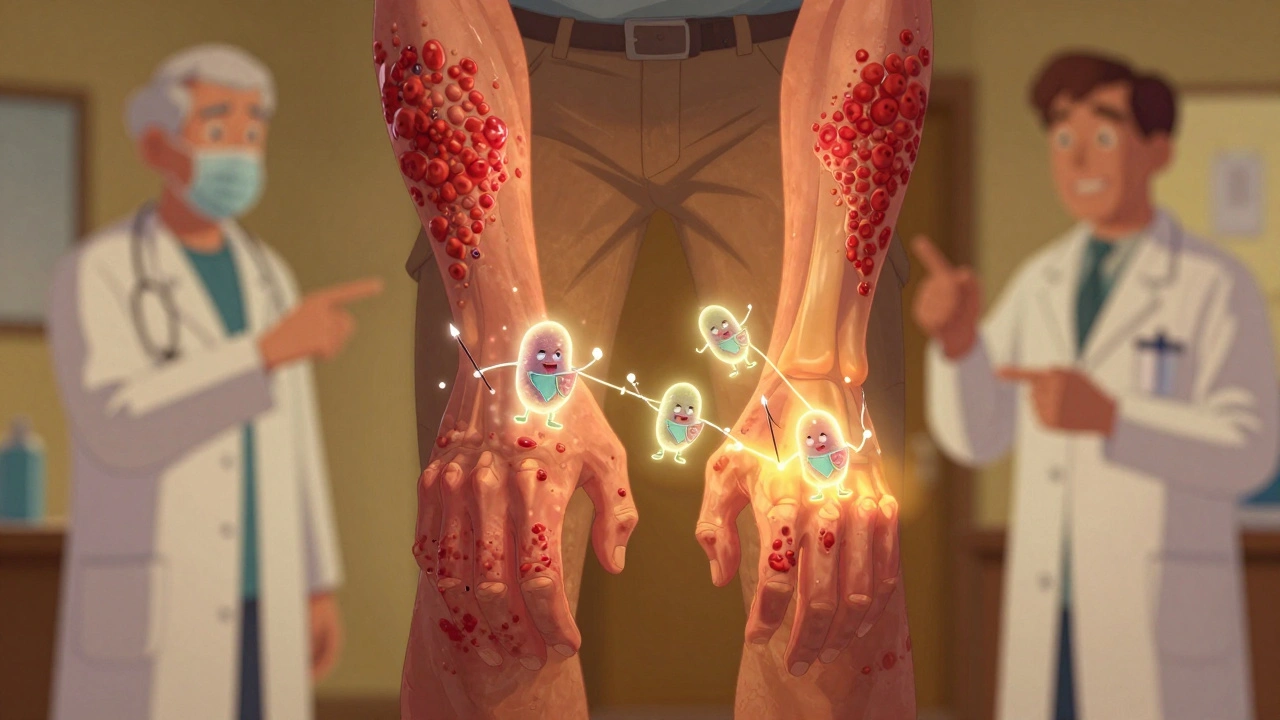
When your skin flares up with red, scaly patches and your fingers or knees suddenly swell up with pain, it’s not just coincidence. These aren’t two separate problems - they’re two signs of the same disease: psoriatic arthritis. This isn’t just arthritis with a skin rash. It’s an autoimmune condition where your immune system attacks both your joints and your skin at the same time. And if you’ve been told it’s just "old age" or "overuse," you’re not alone - many people wait years for the right diagnosis.
How Skin and Joints Are Connected
Psoriatic arthritis doesn’t appear out of nowhere. Most people already have psoriasis - usually plaque psoriasis - with thick, red patches covered in silvery scales. About 30% of people with psoriasis will eventually develop joint pain. But here’s the twist: in 15% of cases, joint symptoms come first. That’s why so many people end up seeing rheumatologists after years of misdiagnosis.
The link isn’t random. The same immune cells that cause flaky skin on your elbows also swarm into your joints, attacking the synovium (the lining) and the entheses (where tendons and ligaments meet bone). This dual attack is what makes psoriatic arthritis unique. You won’t see this pattern in rheumatoid arthritis or osteoarthritis.
And the signs? They’re specific. Nail changes like pitting, ridges, or the nail lifting off the nail bed (onycholysis) happen in 80-90% of people with psoriatic arthritis. That’s far more common than in psoriasis alone. Swollen fingers or toes - called dactylitis - look like little sausages. It’s not just swelling; it’s the whole digit inflamed from tip to base. About half of patients get this.
Where It Hurts: The Telltale Joint Patterns
Unlike rheumatoid arthritis, which usually hits the same joints on both sides (symmetric), psoriatic arthritis is often asymmetric. One knee might ache while the other feels fine. One wrist swells, the other doesn’t. This pattern shows up in about 70% of cases.
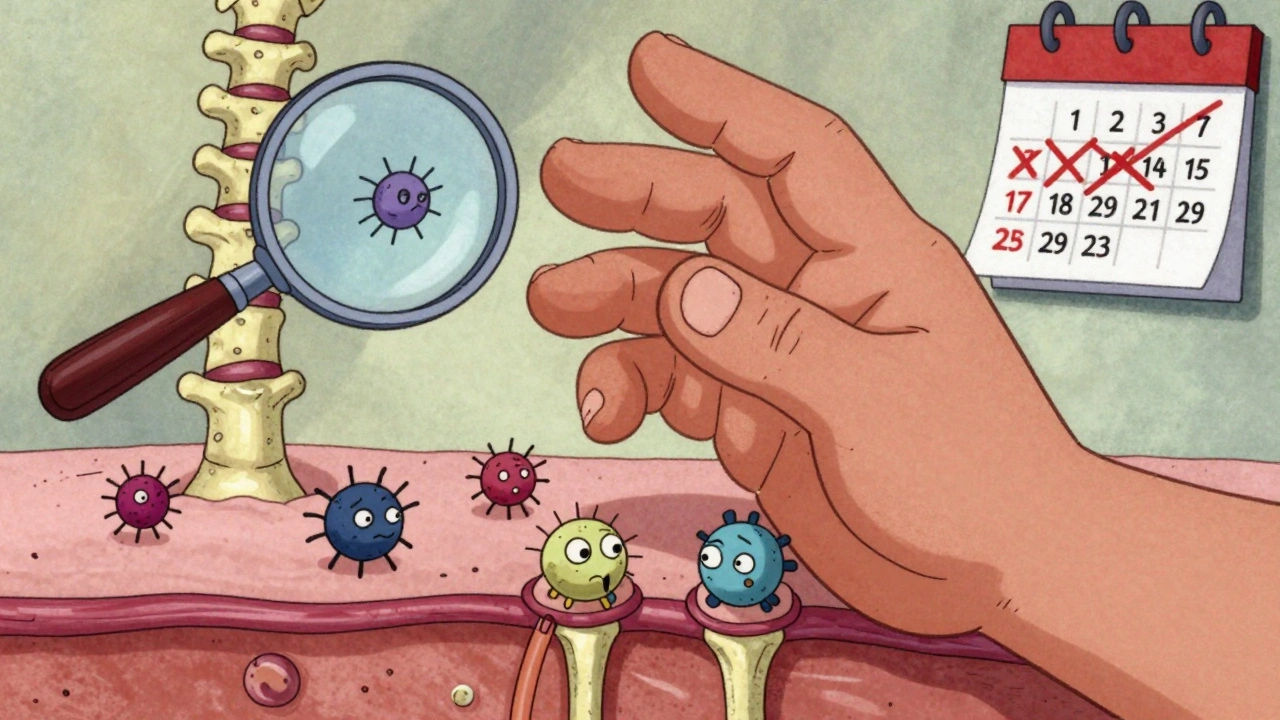
The joints most affected? The small ones closest to your nails - the distal interphalangeal joints. Eighty percent of patients have pain here. Knees are next, involved in 60% of cases. But it doesn’t stop there. Your spine can get involved too - about 15% develop spondylitis, with stiffness in the lower back or neck that feels worse in the morning.
Enthesitis is another hallmark. That’s inflammation where tendons attach to bone. Think of it as the "anchor points" of your muscles. If you have pain under your heel (plantar fasciitis) or at the back of your ankle (Achilles tendinitis), it’s not just overtraining. It’s psoriatic arthritis. Up to 40% of patients have this.
Why Diagnosis Takes So Long
There’s no single blood test for psoriatic arthritis. Rheumatoid factor? Negative in 90% of cases. ESR and CRP might be high, but they’re not specific. That’s why diagnosis is delayed - on average, 2.3 years. People see a dermatologist for skin, a GP for joint pain, maybe a physical therapist for stiffness. No one connects the dots.
Doctors rely on clinical signs: psoriasis history, dactylitis, enthesitis, nail changes, and asymmetric joint swelling. X-rays might show bone erosion or new bone growth, which looks different from rheumatoid arthritis. MRI or ultrasound can catch early inflammation before damage shows up on X-rays.
And here’s something many don’t know: 45% of psoriatic arthritis patients are first diagnosed by a dermatologist. If you have psoriasis and new joint pain, ask your skin doctor to refer you to a rheumatologist. Don’t wait.
Treatment: Beyond Painkillers
Painkillers like ibuprofen help temporarily, but they don’t stop the damage. The goal now is to hit the disease hard and early - before joints are permanently destroyed. Studies show that treating within 12 weeks of symptom onset prevents irreversible damage in 75% of cases.
Treatment starts with traditional DMARDs like methotrexate. But for moderate to severe cases, biologics are the standard. These are targeted drugs that block specific parts of the immune system. TNF inhibitors - like adalimumab (Humira) and etanercept (Enbrel) - were the first. Now there are newer options:
- IL-17 inhibitors (secukinumab, ixekizumab): Great for skin and joints
- IL-23 inhibitors (guselkumab, risankizumab): Often clear skin completely
- TYK2 inhibitor (deucravacitinib): First oral option approved in 2022
- JAK inhibitors (upadacitinib): Coming soon, oral pills with strong results
One patient switched to guselkumab and went from two hours of morning stiffness to 20 minutes in six weeks. Another found that ustekinumab reduced joint swelling by 80% - but triggered scalp psoriasis. That’s the trade-off. What helps joints can sometimes worsen skin, and vice versa.
Real Challenges Patients Face
Cost is a huge barrier. Biologics can cost over $500 a month out-of-pocket. Insurance approvals take an average of 14.7 business days. Many patients delay starting treatment because of this.
Self-injections are another hurdle. About 70% need 2-4 training sessions to feel confident giving themselves shots. Some prefer oral pills - which is why the new TYK2 inhibitor, deucravacitinib, is a game-changer. No needles. Just one pill a day.
And then there’s "brain fog." Even when joints feel better, 52% of patients still report mental fatigue, difficulty concentrating, or memory lapses. It’s not in your head - it’s inflammation affecting your brain. Sleep, stress, and diet all play a role here.

What Works Best: A Team Approach
Psoriatic arthritis isn’t just a rheumatology problem. It’s a team sport. The most effective care involves a rheumatologist, a dermatologist, and a physical therapist. Eighty-five percent of successful treatment plans involve at least two specialists working together.
Physical therapy isn’t optional. Gentle movement keeps joints flexible and reduces stiffness. Swimming, yoga, and tai chi are low-impact favorites. Strength training helps support damaged joints. And weight management? Crucial. Extra weight puts more stress on knees and hips.
Education matters too. Patients who understand the "treat-to-target" approach - aiming for minimal disease activity, not just less pain - stick with treatment longer. They’re more likely to notice early flare signs: new joint warmth, increased fatigue, or a tiny patch of skin flaking.
What’s Next: The Future of Treatment
The psoriatic arthritis market is growing fast - projected to hit $28 billion by 2030. That’s because new drugs keep coming. AI tools are now predicting who with psoriasis will develop arthritis with 87% accuracy, using nail images and joint scans. That could mean screening before symptoms even start.
Personalized medicine is on the horizon. By 2028, genetic testing may tell you which drug will work best for you - cutting out the trial-and-error phase. Right now, patients try an average of 2.3 therapies before finding one that sticks.
And long-term? With proper treatment, life expectancy is nearly normal. But there’s a catch: psoriatic arthritis raises your risk of heart disease by 1.5 times. That’s why checking blood pressure, cholesterol, and blood sugar is now part of every treatment plan.
What to Do If You Suspect It
If you have psoriasis and feel new joint pain, stiffness, or swelling - especially in fingers, toes, knees, or lower back - don’t wait. Write down:
- When the pain started
- Which joints hurt
- Whether your nails changed
- If your skin flared at the same time
- How long morning stiffness lasts
Take this list to your dermatologist or primary care doctor. Ask: "Could this be psoriatic arthritis?" If they’re unsure, ask for a referral to a rheumatologist. Early treatment changes everything.
You don’t have to live with pain that gets worse over time. The tools to stop it are here. The key is connecting the dots - between your skin and your joints - before the damage becomes permanent.
Can you have psoriatic arthritis without psoriasis?
Yes, but it’s rare. About 15% of people develop joint symptoms before any visible skin psoriasis appears. Still, most will develop skin changes within a few years. If you have joint pain, dactylitis, enthesitis, or nail changes - and no psoriasis yet - your doctor should still test for psoriatic arthritis. Family history of psoriasis is a strong clue.
Is psoriatic arthritis the same as rheumatoid arthritis?
No. Rheumatoid arthritis usually affects joints symmetrically - both hands, both knees. Psoriatic arthritis is often asymmetric. It also causes dactylitis, enthesitis, and nail changes, which don’t happen in rheumatoid arthritis. Blood tests differ too: rheumatoid factor is positive in most rheumatoid cases, but negative in 90% of psoriatic arthritis cases. Treatment overlaps, but the underlying immune triggers are different.
Do biologics cure psoriatic arthritis?
No cure exists yet. But biologics can put the disease into remission - meaning no signs of active inflammation. Many patients stay in remission for years with consistent treatment. Stopping medication often leads to flare-ups. The goal isn’t to cure, but to control so damage doesn’t happen and quality of life stays high.
Can diet or exercise help psoriatic arthritis?
Yes, but not as a replacement for medication. Losing weight reduces joint stress and improves drug effectiveness. Anti-inflammatory diets - rich in fish, vegetables, nuts, and olive oil - may help reduce overall inflammation. Regular movement prevents stiffness. Swimming, cycling, and yoga are ideal. Exercise doesn’t cure it, but it makes treatment work better and reduces fatigue.
Why does psoriatic arthritis cause fatigue?
Chronic inflammation releases cytokines that affect your brain and energy levels. Even when joints feel okay, inflammation can still be active inside your body. This leads to persistent tiredness - sometimes called "brain fog." Sleep problems, depression, and medications can add to it. Managing inflammation with the right drugs, plus good sleep and stress control, helps most people regain energy over time.
Are there side effects from psoriatic arthritis treatments?
Yes. Biologics lower your immune system, so you’re more at risk for infections like tuberculosis or hepatitis. That’s why testing is required before starting. Other side effects include injection site reactions, headaches, or digestive issues. Some drugs can trigger skin flares - like ustekinumab causing scalp psoriasis. Your doctor will monitor you closely and adjust if side effects occur.
Jean Claude de La Ronde
December 11, 2025 AT 04:06so basically our immune system is like a drunk roommate who can’t tell the difference between a pizza box and a knee joint? thanks for that analogy, science. i’ve been told my psoriasis is just ‘stress’ for 8 years. turns out my body’s just allergic to existing.
Kristi Pope
December 12, 2025 AT 04:56thank you for writing this with so much heart. i was diagnosed last year after my fingers looked like little sausages and my dermatologist actually listened. you’re not alone. the road’s long but there’s light. small wins matter - like a morning without stiffness or nails that don’t look like they’ve been through a war. you’re doing better than you think.
Aman deep
December 13, 2025 AT 12:06man this hit home. i had nail pitting for years, thought it was just bad manicures. then my knee started acting up and i was like… wait, is this the same thing? turns out yes. the doc said ‘you’ve got psoriatic arthritis’ and i just stared at the wall for 10 minutes. no one ever connected the dots. now i’m on guselkumab - skin’s clear, joints feel like mine again. it’s not perfect but it’s better than crying in the shower every morning.
Eddie Bennett
December 15, 2025 AT 10:54just wanted to say i’m so glad this got shared. i’ve been dealing with this for 6 years and no one ever told me about enthesitis. i thought my heel pain was from running too much. turns out it’s my immune system attacking my Achilles tendon. i’m on a TYK2 inhibitor now - no needles, just a pill. life-changing. also, yoga helped more than i expected. not a cure, but a lifeline.
Sylvia Frenzel
December 16, 2025 AT 12:25why do we keep giving these expensive biologics to people who won’t even exercise? if you’re too lazy to swim or lose weight, why should insurance pay for your $500/month shots? this isn’t a free pass to be unhealthy and then blame the system.
Paul Dixon
December 17, 2025 AT 03:26hey sylvia - i get where you’re coming from, but it’s not that simple. some of us can’t move without pain. some of us are on meds that make us dizzy or nauseous. exercise isn’t a choice - it’s a battle. maybe try asking how someone’s doing instead of judging their effort. we’re all fighting different wars.
Vivian Amadi
December 17, 2025 AT 16:35you’re all just too nice. the real issue? doctors are lazy. they don’t connect skin to joints because it’s easier to say ‘it’s just aging’ or ‘you’re overweight.’ this post should be mandatory reading for every GP. and stop calling it ‘brain fog’ - it’s neuroinflammation. say it like you mean it.
Jimmy Kärnfeldt
December 18, 2025 AT 06:49when i first got diagnosed, i thought i’d be stuck in pain forever. then i found out about treat-to-target. it’s not about feeling ‘okay’ - it’s about getting to zero inflammation. that’s the goal. and yeah, it takes time. but i’ve been in remission for 18 months now. not cured. not perfect. but free. you can get there too.
Ariel Nichole
December 19, 2025 AT 08:47big thank you to the author. this is the kind of post that makes me feel seen. i’ve been silent about this for years because people think it’s ‘just psoriasis.’ but it’s so much more. and yes - the cost is brutal. but knowing i’m not crazy? that’s worth more than any drug.
john damon
December 19, 2025 AT 11:35psoriatic arthritis 😭🤯 i’ve got the dactylitis, the nail pitting, the achilles pain… and now i’m on a pill instead of shots 😍👍 no more needles = my new favorite thing ever 🙌
matthew dendle
December 21, 2025 AT 00:58so you’re telling me after 10 years of being told i’m ‘just old’ i had this whole autoimmune thing going on? and now i gotta take a pill that costs more than my rent? wow. thanks for the hope, i guess. but honestly? i’m just tired.
Taylor Dressler
December 21, 2025 AT 08:47Important correction: The 15% of patients who develop joint symptoms before skin involvement are often misdiagnosed as having rheumatoid arthritis. The key differentiators are enthesitis, dactylitis, and nail changes - all absent in RA. Also, the 87% AI prediction accuracy from nail images is from a 2023 Lancet study. Dermatologists are now being trained to screen for these signs proactively. Early referral saves joints. Always ask: ‘Could this be psoriatic arthritis?’ - even without visible psoriasis.