Every year, over 1.5 million people in the U.S. are harmed by medication errors-many of which start with a simple mistake on a prescription pad or in an electronic system. These aren’t rare accidents. They’re preventable. And as a patient, you don’t have to wait for your doctor or pharmacist to catch them. You can catch them yourself-before you even walk out the door with your meds.
What Exactly Is a Prescription Writing Error?
A prescription writing error happens when a doctor, nurse practitioner, or other prescriber makes a mistake while writing or entering your medication order. It’s not about the pharmacy giving you the wrong pill. It’s about the original order being wrong from the start. That could mean the wrong drug, the wrong dose, the wrong instructions, or even a drug that dangerously interacts with something you’re already taking. These aren’t just small slips. They’re serious. The FDA found that between 2010 and 2020, decimal point errors alone-like writing ".5 mg" instead of "0.5 mg"-caused 128 deaths. That’s not a typo. That’s a tenfold overdose. And it’s happened because someone didn’t write a leading zero.The Most Common Types of Prescription Errors
Here are the nine most frequent prescription mistakes, based on analysis of over 12,500 malpractice claims:- Unclear handwriting (22% of errors): Even today, some providers still write prescriptions by hand. If you can’t read it, the pharmacist can’t read it. And if they guess wrong, you could get the wrong medicine.
- Wrong dose or quantity (19%): Too much or too little. A dose of "5.0 mg" could be read as "50 mg" if the trailing zero isn’t crossed out. A dose of ".5 mg" could be read as "5 mg" if there’s no leading zero.
- Drug interactions (15%): Your doctor might not know you’re taking another medication that reacts badly with the new one. Blood thinners and NSAIDs? Dangerous combo. Certain antibiotics and birth control? Can make the pill ineffective.
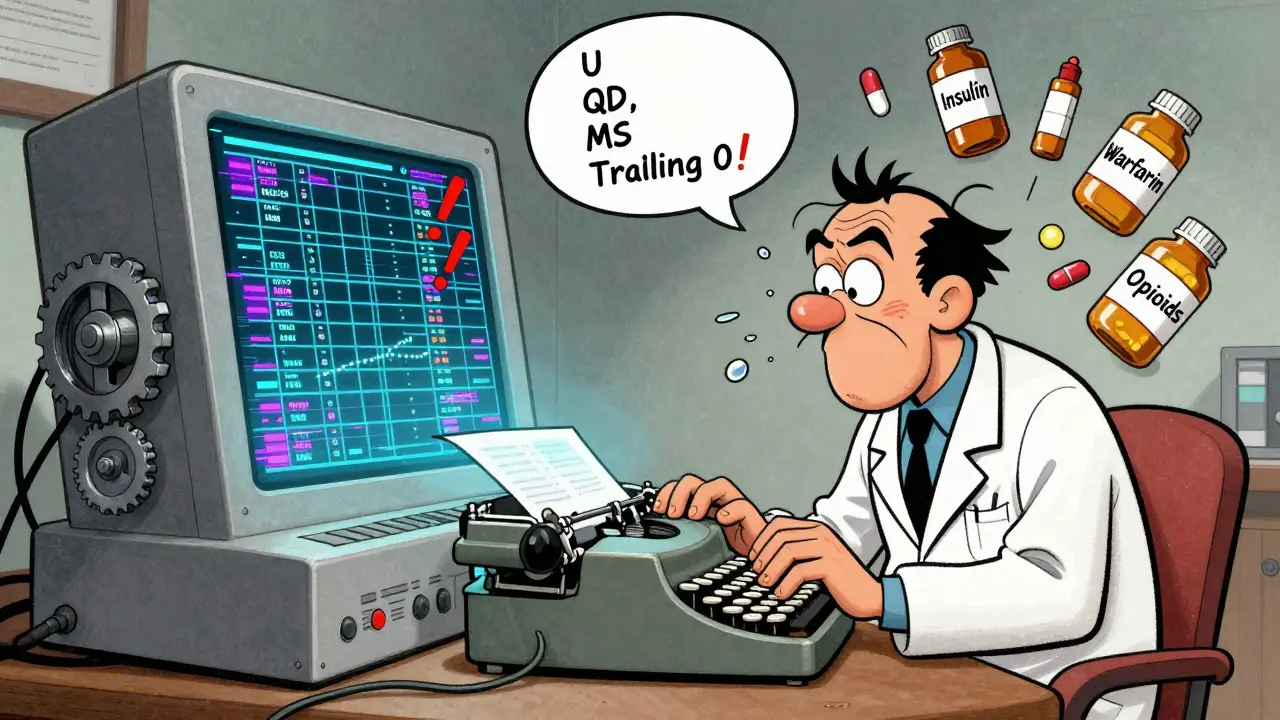
- Incorrect sig instructions (12%): "Take one by mouth daily" is clear. "QD"? That’s an abbreviation for daily-but it’s easily confused with "QID" (four times a day). And "MS" could mean morphine sulfate or magnesium sulfate. Big difference.
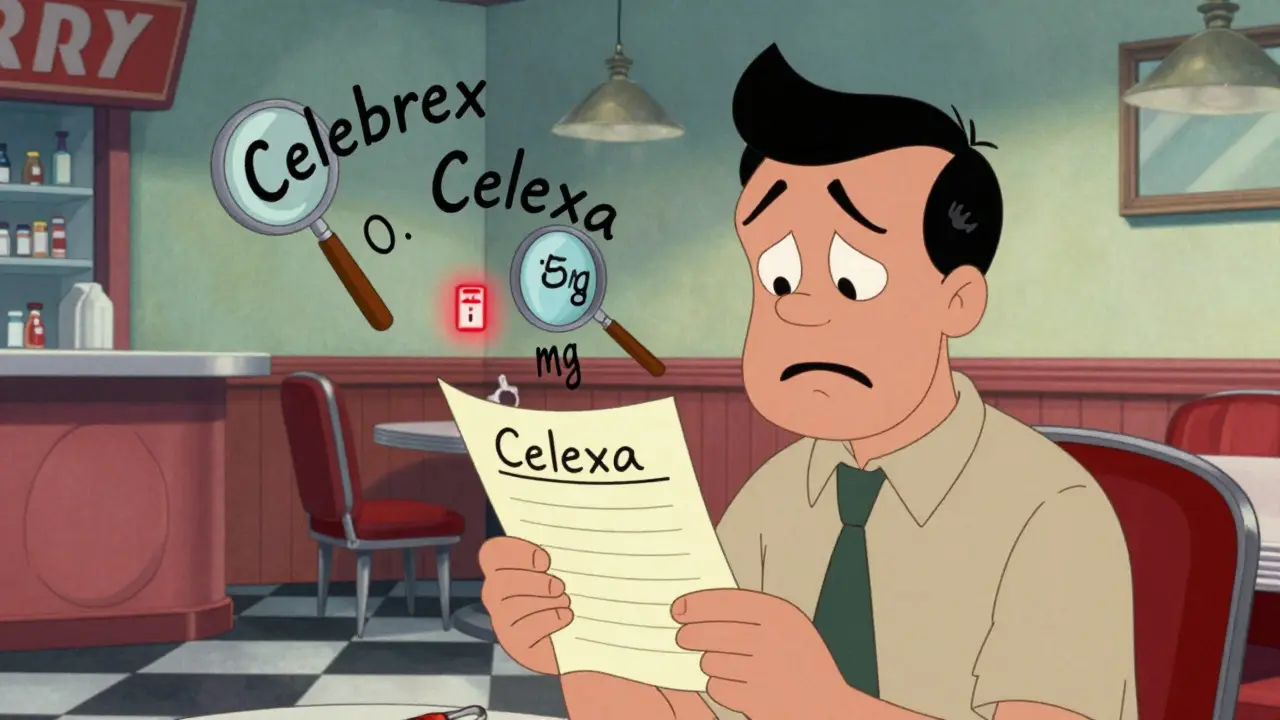
- Wrong drug name (7%): Look-alike, sound-alike drugs cause confusion. Celebrex vs. Celexa. Zyprexa vs. Zyrtec. One treats arthritis. The other treats depression. Mix them up, and you’re in trouble.
- Omission errors (3%): The doctor forgets to write a needed medication-like forgetting to restart your blood pressure pill after a hospital stay.
Why Do These Errors Keep Happening?
It’s not because doctors are careless. It’s because they’re overwhelmed. A 2021 study in JAMA found that in busy clinics, physicians spend just 17 seconds per prescription. That’s less time than it takes to brew a cup of coffee. Add in electronic health record systems that force doctors to click through endless menus, and mistakes become almost inevitable. One study showed that 34% of new prescription errors came from electronic prescribing-not despite it, but because of it. And here’s the kicker: 68% of primary care doctors admit to making at least one prescribing error every month. That’s not negligence. That’s systemic pressure. Even worse, dangerous abbreviations are still used. "U" for units? Can be mistaken for "0". "QD"? Can be confused with "QID". "Trailing zeros"? "5.0 mg" could be read as "50 mg". The Institute for Safe Medication Practices has been warning about these for decades. Yet they’re still out there.How to Catch Errors Before You Take the First Pill
You don’t need to be a doctor to spot a dangerous prescription. Here’s your simple, seven-point checklist-used successfully in a 2022 University of Michigan study that found patients using it caught 63% of errors before even reaching the pharmacy.- Full drug name, no abbreviations: Is it written as "Lisinopril" or "Lisin"? Make sure it’s the full name. Avoid anything like "HCTZ" or "MgSO4"-those are shortcuts that can kill.
- Clear dosage with proper decimals: Is it "0.5 mg" or just ".5 mg"? Always look for the leading zero. Is it "5 mg" or "5.0 mg"? Trailing zeros are dangerous. If you see one, ask if it’s meant to be 5 or 50.
- No confusing abbreviations: "QD"? Ask for "daily". "BID"? Ask for "twice daily". "TID"? Say "three times a day". "QHS"? That’s "at bedtime". Never accept abbreviations.
- Correct quantity: If you’re prescribed 30 pills for a 7-day course, that’s way too many. Ask why. If it’s a 90-day supply, make sure it matches your insurance coverage.
- Purpose stated: Is it written: "For high blood pressure"? Or just "Lisinopril 10 mg"? The purpose helps you and the pharmacist catch mismatches. If you have diabetes and get a prescription for insulin, but the note says "for weight loss", that’s a red flag.
- Prescriber contact info: If the phone number or address is missing, the pharmacy can’t call for clarification. That’s a violation of safety guidelines.
- Expiration date: Prescriptions expire. If it’s stamped with a date more than a year away, ask if it’s correct. Some states limit controlled substances to 6 months.
High-Alert Medications: The Ones That Can Kill
Some drugs are more dangerous than others. If you’re prescribed any of these, double-check everything:- Insulin
- Warfarin (Coumadin)
- Heparin
- Opioids (oxycodone, hydrocodone)
- IV potassium chloride
- Chemotherapy agents
Use the Teach-Back Method
When the doctor or nurse explains how to take your medicine, don’t just nod. Repeat it back. Say: "So, I take one pill every morning with breakfast, right? Not at night? And it’s for my blood pressure?" This is called the teach-back method. Johns Hopkins Medicine found it cuts misunderstandings by 81%. You’re not being rude. You’re protecting your life.Check Your Electronic Prescription
If your doctor sends the prescription electronically (which most do now), you still need to verify. When you get to the pharmacy, compare the label to what your doctor told you. If the pill looks different than what you’ve taken before, ask why. If the dose is higher than usual, ask if it’s correct. Apps like MedSafety let you take a photo of your prescription. The app scans it and flags potential errors-like missing zeros, wrong dosages, or dangerous combinations. In a 2023 pilot study, users caught 68% more errors using this tool.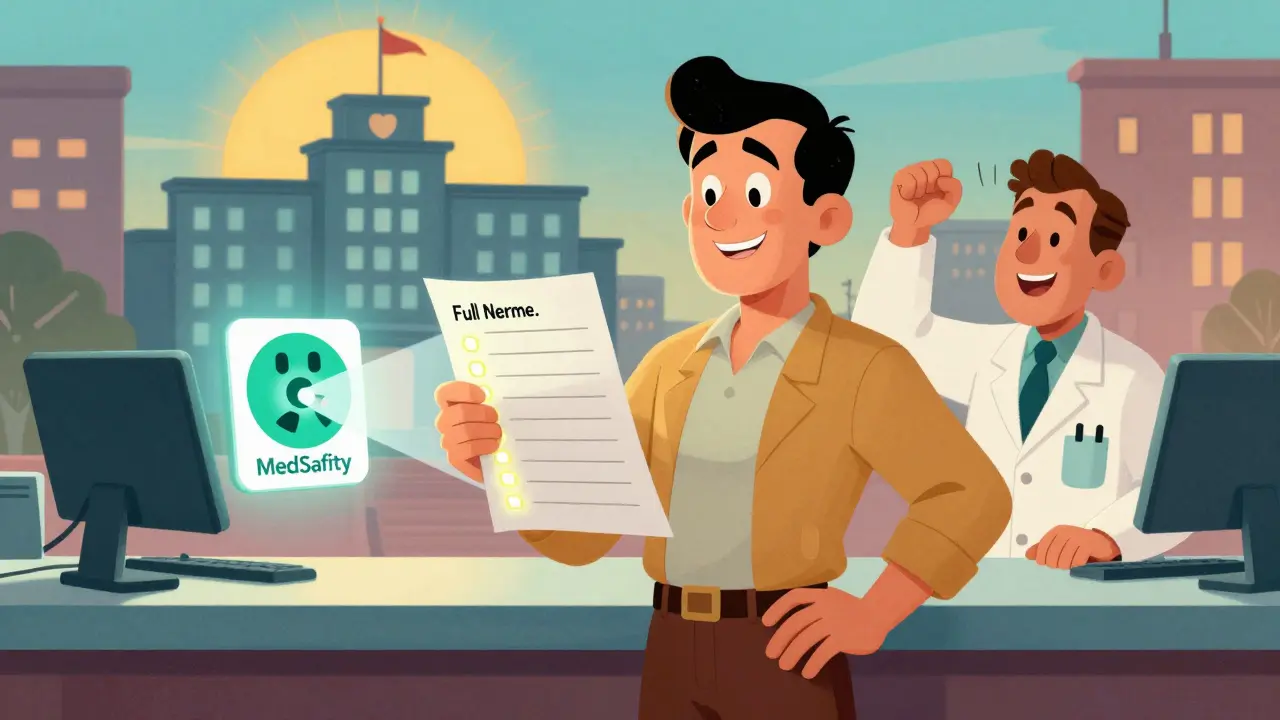
Ask the "Ask Me 3" Questions
The National Patient Safety Foundation created a simple three-question framework that works every time:- What is my main problem? (Make sure you understand the diagnosis.)
- What do I need to do? (Confirm the exact medication, dose, and schedule.)
- Why is it important for me to do this? (This helps you understand the risk of skipping or mixing meds.)
What If You Spot an Error?
Don’t panic. Don’t assume the pharmacist will catch it. Don’t assume your doctor made a typo. Call the prescriber’s office immediately. Say: "I received a prescription for [drug name], but the dose says [X mg]. I thought it was supposed to be [Y mg]. Can you confirm this is correct?" Pharmacists are trained to catch these. But they can’t fix what they don’t know is wrong. If your doctor refuses to change it, ask for a second opinion. Your life isn’t worth the risk.The Future Is in Your Hands
By 2025, all electronic health records in the U.S. will give patients real-time access to their prescriptions via secure apps. You’ll be able to see exactly what your doctor ordered before the pharmacy even gets it. That’s huge. A 2023 NEJM study showed that when patients got automated text alerts confirming their prescription details, error detection jumped from 29% to 74% within 24 hours. But technology won’t fix everything. If you have low health literacy-36% of U.S. adults do-you’re still at higher risk. That’s why community programs like "Script Check" are training volunteers to help elderly and vulnerable patients review prescriptions. If you or someone you know needs help, ask your local pharmacy or hospital if they offer this service. You are not powerless. You are not just a recipient of care. You are the last line of defense against a preventable mistake that could cost you your health-or your life.Quick Summary / Key Takeaways
- Prescription errors cause over 1.5 million injuries each year in the U.S.-many are preventable.
- Common errors include wrong dose, confusing abbreviations, look-alike drug names, and missing zeros in decimals.
- Use the 7-point checklist: full drug name, correct dosage, no abbreviations, right quantity, purpose stated, prescriber info, expiration date.
- High-alert drugs like insulin, warfarin, and opioids need extra scrutiny-always confirm dose and purpose.
- Use the teach-back method: repeat instructions back to your provider to confirm understanding.
- Ask the "Ask Me 3" questions to ensure you understand your treatment.
- Apps and SMS alerts can help you catch errors before you take your medicine.
Matt Beck
January 7, 2026 AT 10:36So basically, if your doctor writes '5.0 mg'... you're supposed to know that's a death trap? 😱 I mean, I get it, but... why is this still a thing in 2025?? We have AI that can write sonnets, but we can't fix a decimal point?? 🤦♂️
Katie Schoen
January 8, 2026 AT 12:09YES. I once got a script for 'Lisin' and thought it was a new brand. Turns out it was supposed to be Lisinopril. Pharmacist caught it-my blood pressure would’ve been a horror movie. 😅 Always ask for the full name. No shortcuts. Ever.
Cam Jane
January 8, 2026 AT 22:57Look-I’ve been a nurse for 18 years and I still get tripped up by 'QD' vs 'QID'. It’s not the patient’s fault. It’s the system. But your checklist? Gold. I print this out and hand it to every new patient. Seriously. Copy it. Tape it to your fridge. Send it to your mom. This isn’t just advice-it’s a survival guide. And the teach-back thing? That’s the secret weapon. Repeat it back. Even if you feel silly. You’re not being annoying-you’re saving your life. And if they roll their eyes? Walk out. Find a new doctor. Your life is worth more than their 17-second prescription click.
Wesley Pereira
January 10, 2026 AT 21:18Bro, the 'trailing zero' thing? That’s not a typo. That’s a felony waiting to happen. And don’t even get me started on 'U' for units. That’s like writing '1000' and meaning '10'. I’ve seen it. People die. And yeah, EHRs make it worse-click 12 menus to get to 'insulin', then accidentally pick 'insulin glargine' instead of 'lispro'. Boom. You’re a statistic. Stop blaming the docs. Blame the $200k software that makes them type like they’re playing a bad video game.
Amy Le
January 11, 2026 AT 23:54Why are we even talking about this? America’s healthcare is a dumpster fire. We let doctors write prescriptions in 1985 style while the rest of the world uses AI-assisted systems. Meanwhile, we’re still arguing about 'QD' like it’s a religious debate. 🇺🇸🇺🇸🇺🇸 Fix the system. Or stop pretending you care about safety. Just say it: we don’t value lives here. We value profit.
Pavan Vora
January 13, 2026 AT 05:45Wow, this is so important! In India, we have same problem, but worse-sometimes doctors write in Hindi script, and pharmacy staff guess... I once saw someone get 'Metformin' instead of 'Metoprolol' because 'M' looked similar. 😢 Please, everyone, check your scripts. Even if you're not in US. This is global. 🙏
Stuart Shield
January 13, 2026 AT 06:42I’ve been on warfarin for 12 years. One time, the script said '5 mg'-but I knew it was supposed to be 4.5. I called the pharmacy. They called the doctor. Turned out the system auto-filled '5' because it’s the default. I almost died because of a dropdown menu. So yeah-this isn’t paranoia. It’s practice. And if you’re reading this and you’re not checking your scripts? You’re playing Russian roulette with your liver.
Susan Arlene
January 13, 2026 AT 08:20just check the name and the number. if it looks weird, ask. thats it.
Molly McLane
January 15, 2026 AT 04:34Thank you for writing this. I’m a nurse practitioner, and I’ve seen too many of these errors-some from my own tired hands after a 14-hour shift. I’m not making excuses, but I’m also not blaming. The real issue? We’re drowning in paperwork and tech that doesn’t help. But I’ve started asking every patient: 'Can you tell me what this med is for?' And you know what? 90% of the time, they get it right. That’s the teach-back magic. You’re not a passive patient-you’re the co-pilot. And if your provider gets annoyed? That’s their problem. Your life is the priority. Print this. Share it. Save someone.
Mukesh Pareek
January 15, 2026 AT 11:27Pathetic. You're telling patients to be doctors? That's not patient empowerment-that's systemic failure. Real solution? Ban handwritten scripts. Mandate AI validation. Fire every prescriber who uses 'QD'. Stop putting the burden on the vulnerable. This isn't a checklist-it's a cry for help from a broken system. And you're just handing out band-aids.