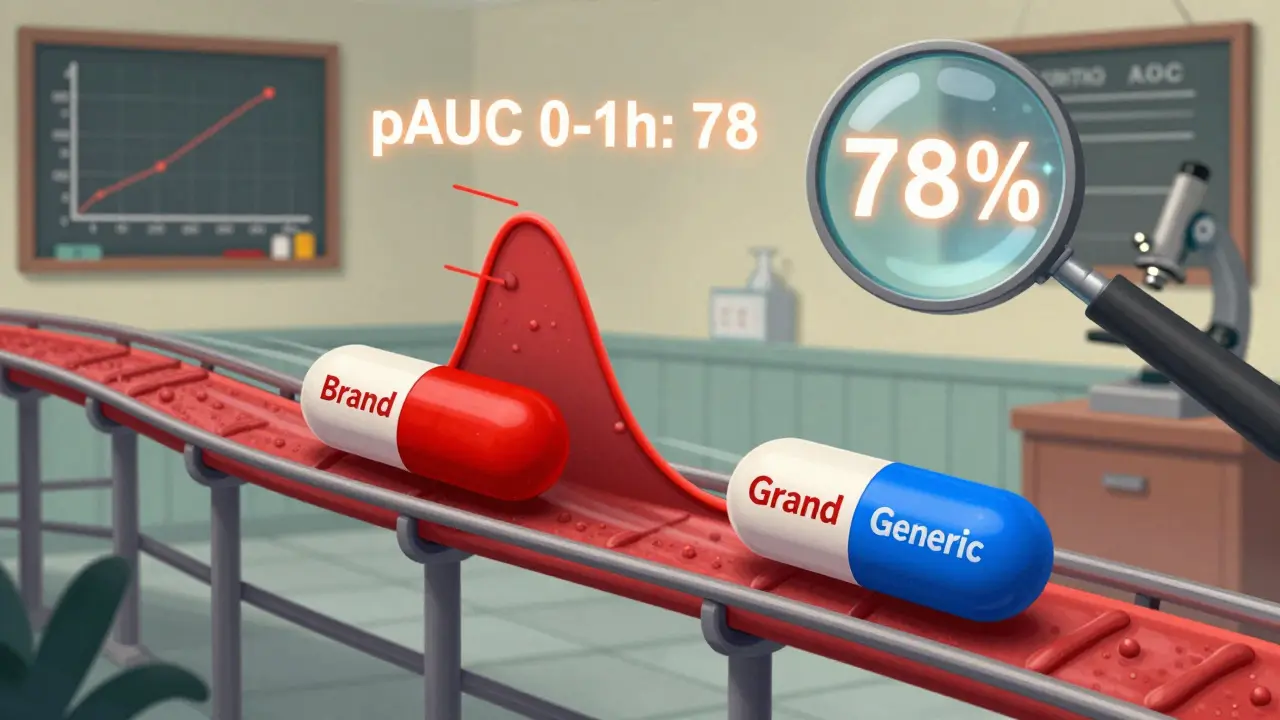
When a generic drug hits the market, you assume it works just like the brand-name version. But how do regulators know for sure? Traditional bioequivalence tests look at two numbers: partial AUC and Cmax. But for some drugs - especially slow-release painkillers, ADHD meds, or heart medications - those two numbers aren’t enough. That’s where partial AUC comes in. It doesn’t just measure total exposure. It zooms in on the exact window where the drug starts working. And if that window doesn’t match between the brand and the generic, patients could get too little or too much drug at the wrong time.
Why Traditional Metrics Fall Short
For years, regulators relied on two simple metrics to approve generics: the total area under the curve (AUC), which tells you how much drug the body absorbed overall, and Cmax, which shows the highest concentration reached. These worked fine for fast-acting pills like aspirin or antibiotics. But for extended-release formulations - think opioid pain patches, once-daily antidepressants, or long-acting insulin - the shape of the concentration curve matters just as much as the total exposure. A generic drug might hit the same Cmax and total AUC as the brand. But if it releases the drug too slowly at first, patients might not get relief for hours. If it releases too fast, they could overdose early and then crash later. That’s not bioequivalence. That’s a safety risk. The European Medicines Agency (EMA) first flagged this problem in 2013. They noticed that 20% of generics that passed traditional tests failed to match the brand’s absorption pattern in the critical first few hours. When they added fed and fasting studies together, the failure rate jumped to 40%. The same issue popped up in the U.S. FDA’s reviews. Something had to change.What Is Partial AUC?
Partial AUC, or pAUC, is a pharmacokinetic tool that measures drug concentration only during a specific time window - not the whole curve. Instead of looking at 0-24 hours, you might look at 0-2 hours, or 0-4 hours, or from the moment the drug starts rising until it peaks. This window is chosen based on clinical relevance. For example, if a painkiller needs to kick in within 30 minutes to prevent breakthrough pain, then the pAUC from 0-1 hour becomes the key metric. The FDA clarified this in a 2017 workshop: pAUC should be sensitive to differences where concentrations are high, and ignore noise where they’re low. In simpler terms: it focuses on the part of the curve that actually affects how the patient feels. There are three common ways to define the window:- Time until the reference product’s Tmax (time to peak concentration)
- A percentage of Cmax - like the area under the curve until the drug hits 50% of its peak
- A fixed concentration threshold - say, from the moment the drug exceeds 10 ng/mL
How It’s Used in Regulatory Decisions
Regulators don’t just want to see pAUC - they want to see it meet the same 80-125% bioequivalence range as total AUC and Cmax. But here’s the catch: pAUC often has higher variability. Why? Because you’re measuring a smaller, more dynamic part of the curve. Small differences in absorption timing get amplified. That means studies need bigger sample sizes. A 2014 study in the European Journal of Pharmaceutical Sciences found that pAUC-based studies required 25-40% more participants than traditional ones. For a company running a bioequivalence trial, that’s not just more blood draws - it’s hundreds of thousands of dollars more in costs. Teva Pharmaceuticals reported in 2022 that adding pAUC to their extended-release opioid generic study increased their subject count from 36 to 50, adding $350,000 to development costs. But they avoided a clinical failure. Without pAUC, their generic would have passed traditional tests - even though early exposure was 22% lower than the brand. That difference could mean patients didn’t get pain relief when they needed it most. The FDA now includes pAUC in over 127 product-specific guidances as of 2023. That’s up from just 5% of ANDA submissions in 2015 to 35% in 2022. The biggest use cases? Central nervous system drugs (68%), pain management (62%), and cardiovascular agents (45%).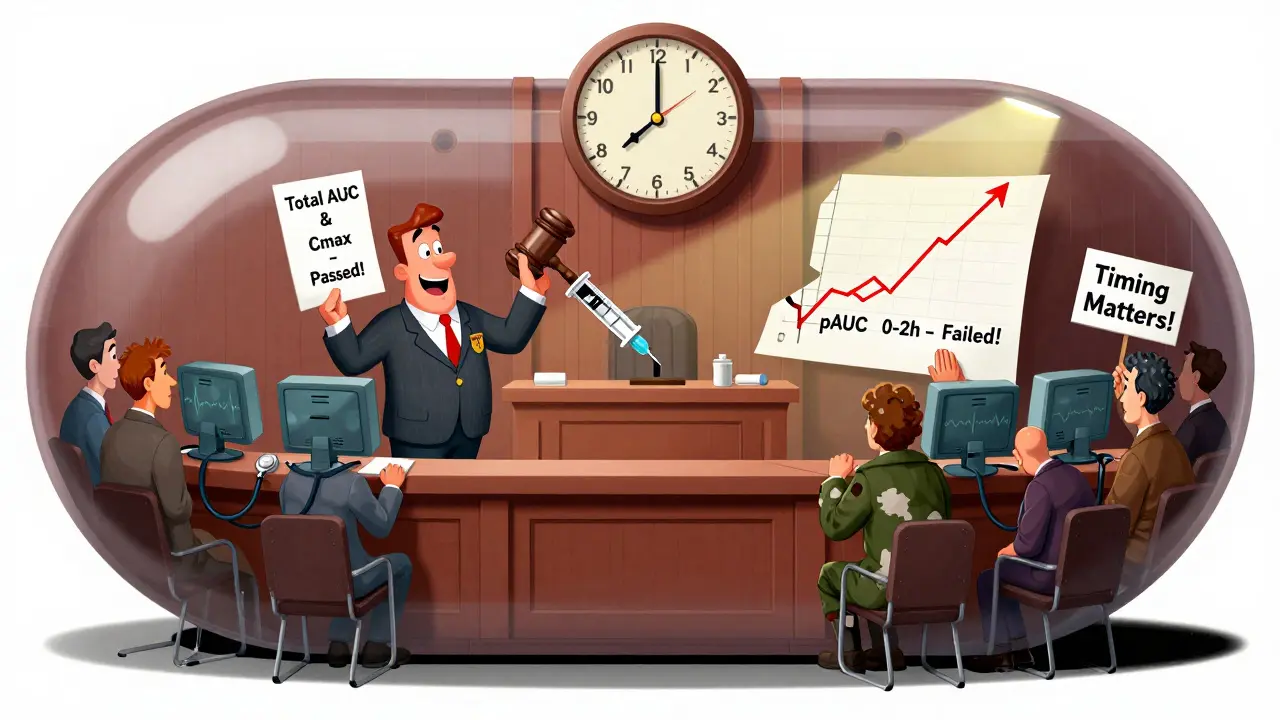
Where It’s Required - And Where It’s Not
Not every generic drug needs pAUC. The FDA only mandates it for products where timing matters. Abuse-deterrent opioids are a prime example. If a pill is designed to crush into a powder and snort, the formulation slows absorption to prevent abuse. A generic that releases the drug too quickly could be dangerous - even if total exposure matches. That’s why pAUC is now required for nearly all abuse-deterrent opioids. Same goes for extended-release stimulants like Adderall XR or Concerta. If the drug hits too fast, it can cause anxiety or palpitations. Too slow, and the patient’s focus drops midday. The FDA’s 2021 white paper explicitly says pAUC is needed here because “the time to truncate the partial area should be related to a clinically relevant pharmacodynamic measure.” But for a simple immediate-release tablet like amoxicillin? No pAUC needed. The drug’s absorbed in under an hour. Total AUC and Cmax tell the whole story.Implementation Challenges
The science is solid. The execution? Messy. One big problem: no universal standard for choosing the time window. The FDA’s guidances vary. Some say “use reference Tmax.” Others say “use 50% of Cmax.” A 2022 survey found only 42% of product-specific guidances clearly defined the method. Generic developers are left guessing. That’s led to 17 rejected applications in 2022 alone - all because the pAUC window was defined incorrectly. One company used the average Tmax across all subjects. Another used the median. One even picked a fixed 2-hour window for a drug whose Tmax varied from 1.5 to 6 hours. All were rejected. Then there’s the statistical complexity. Most biostatisticians were trained on traditional AUC and Cmax. pAUC requires advanced modeling tools like Phoenix WinNonlin or NONMEM, and a deep understanding of the Bailer-Satterthwaite-Fieller method for confidence intervals. A 2022 survey by the Generic Pharmaceutical Association found 63% of companies needed extra statistical help for pAUC - compared to just 22% for traditional metrics. And training? It takes 3-6 months for a biostatistician to become proficient. Job postings now list pAUC expertise as a requirement - 87% of bioequivalence specialist roles in 2023 did.The Future of Bioequivalence
The FDA is trying to fix the inconsistency. In January 2023, they launched a pilot program using machine learning to automatically determine the optimal pAUC window based on historical reference product data. The goal? Reduce guesswork and make approvals faster. Evaluate Pharma predicts that by 2027, 55% of all new generic approvals will require pAUC. That’s more than double the 2022 rate. The push is global. The EMA has expanded pAUC recommendations from 12 to 27 product categories since 2021. But there’s a cost. The International Consortium for Innovation and Quality in Pharmaceutical Development estimates inconsistent pAUC rules across the U.S., EU, and Canada add 12-18 months to global drug development timelines. Smaller companies can’t afford to hire specialized statisticians. Many now outsource to CROs like Algorithme Pharma, which now controls 18% of the complex generic BE study market.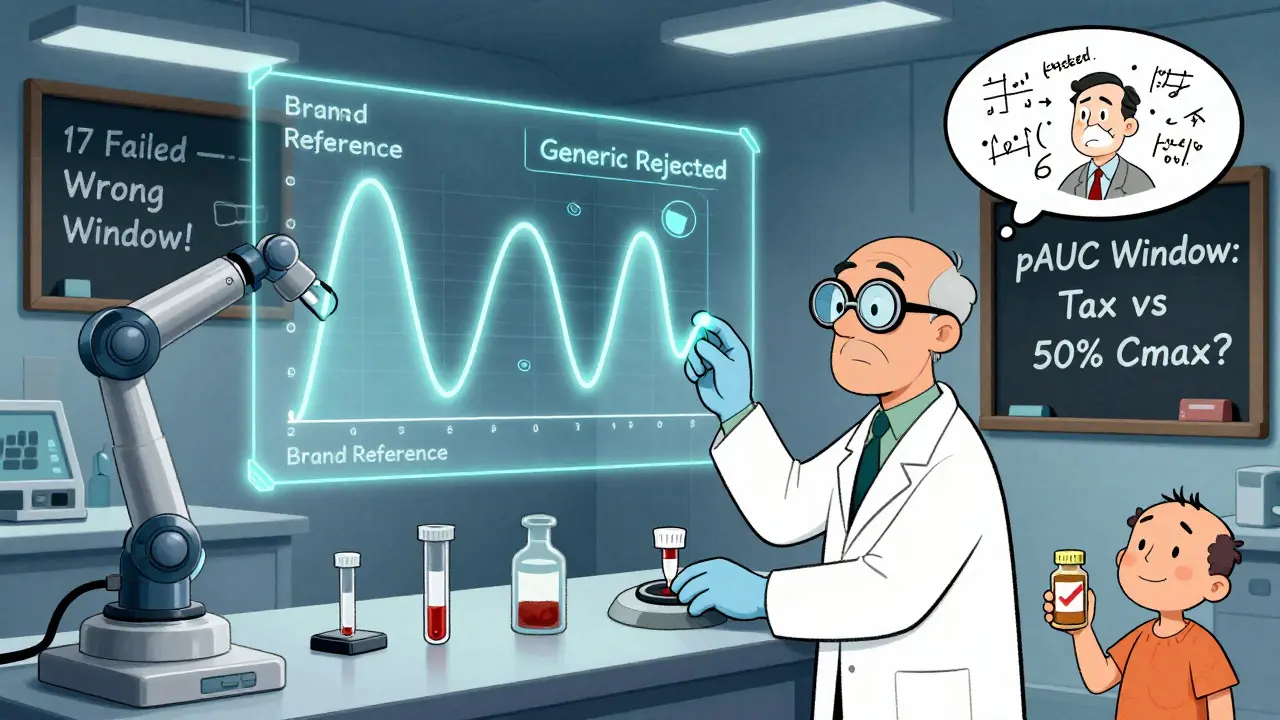
What This Means for Patients
You might never hear the term “partial AUC.” But you’ll feel its impact. When your doctor prescribes a generic painkiller, and it works just as fast as the brand - that’s pAUC at work. When your extended-release antidepressant keeps your mood stable all day - that’s pAUC making sure the drug didn’t spike too early or fade too soon. It’s not about making generics harder to approve. It’s about making sure they’re safe and effective - not just mathematically similar, but clinically identical. For complex drugs, traditional metrics were like judging a car’s performance by only looking at its top speed. pAUC looks at how fast it accelerates from 0 to 60. That’s the difference between a car that gets you there - and one that gets you there safely.Getting Started with Partial AUC
If you’re developing a generic drug with a modified-release profile, here’s what to do:- Check the FDA’s product-specific guidances. Search for your drug’s name + “bioequivalence.” If pAUC is mentioned, you’re in the required zone.
- Identify the clinically relevant time window. Talk to clinicians. What’s the onset time for therapeutic effect? What’s the duration? Use that to define your window.
- Use reference product data. Don’t guess. Use Tmax from the brand’s clinical studies. If Tmax varies widely, use the 90% confidence interval or the composite curve.
- Run pilot studies. Test your formulation in a small group to see how the curve behaves. This helps avoid costly late-stage failures.
- Partner with a biostatistician who’s done pAUC before. Don’t try to learn it on the fly.
What is partial AUC in bioequivalence?
Partial AUC (pAUC) measures the area under the drug concentration-time curve over a specific, clinically relevant time window - not the full curve. It’s used to assess whether a generic drug absorbs at the same rate as the brand in the critical early phase, especially for extended-release formulations where timing matters more than total exposure.
When is partial AUC required by regulators?
Regulators like the FDA and EMA require pAUC for complex formulations where absorption timing affects safety or effectiveness - such as abuse-deterrent opioids, extended-release stimulants, and some cardiovascular drugs. It’s not needed for simple immediate-release products.
How is the time window for partial AUC chosen?
The window is based on clinical relevance - often tied to the reference product’s Tmax, a percentage of Cmax (like 50%), or a concentration threshold that triggers therapeutic effect. The FDA recommends linking the cutoff to a pharmacodynamic measure, such as when pain relief begins or when seizure control is achieved.
Does partial AUC require larger studies?
Yes. Because pAUC measures a smaller, more variable part of the curve, studies often need 25-40% more participants than traditional bioequivalence trials. This increases costs but reduces the risk of approving a generic that fails clinically.
Why do some generic applications get rejected for pAUC?
Most rejections happen because the pAUC time window was defined incorrectly - using the wrong method, ignoring variability, or picking a fixed time that doesn’t match the drug’s actual absorption profile. In 2022, 17 ANDA submissions were rejected for this reason alone.
Is partial AUC used outside the U.S.?
Yes. The European Medicines Agency (EMA) began recommending pAUC in 2013 and has expanded its use to 27 product categories. Other regions, including Japan and Canada, are adopting similar approaches, though standards vary - creating delays in global drug approvals.
Jessica Salgado
December 15, 2025 AT 16:07This is the kind of detail that actually saves lives. I had a family member on extended-release oxycodone who switched to a generic and spent three days in agony because it didn’t kick in until 3 hours later. No one told us why. Now I get it.
Partial AUC isn’t just regulatory busywork - it’s the difference between ‘works sometimes’ and ‘works when you need it.’
Linda Caldwell
December 16, 2025 AT 06:15Finally someone gets it. Stop treating meds like they’re all the same. If your painkiller takes 4 hours to work, it’s not generic - it’s a gamble.
Anna Giakoumakatou
December 16, 2025 AT 10:00Oh wow. A whole 12-page essay on how regulators are now doing their jobs. How revolutionary. I suppose next they’ll start requiring that aspirin dissolve in your mouth before you swallow it. What a triumph of over-engineering.
CAROL MUTISO
December 17, 2025 AT 10:34Let’s be real - this isn’t about science. It’s about dignity. We’ve spent decades reducing patients to pharmacokinetic variables - AUC, Cmax, Tmax - like they’re lab rats with pulse rates. pAUC is the first time regulators said, ‘Wait. What does this feel like?’
It’s not about the curve. It’s about the human on the other side of it. The one who can’t function until the drug hits. The one who panics when it crashes. The one who can’t afford to wait for ‘close enough.’
This is the quiet revolution we didn’t know we needed. And yes, it’s expensive. But so is burying people because a generic was ‘statistically equivalent’ but clinically hollow.
Erik J
December 17, 2025 AT 21:23Interesting. I wonder how much of the variability in pAUC is due to inter-subject differences in gastric emptying vs. formulation issues. The paper from 2022 didn’t break that down.
BETH VON KAUFFMANN
December 19, 2025 AT 19:22Let me summarize this in jargon: pAUC is just a fancy way to say ‘we’re now requiring you to prove you didn’t fuck up the release profile.’ And yes, it’s a nightmare for CROs. 25-40% more subjects? That’s not science - that’s profit erosion. But hey, at least we’re no longer approving junk that works like a slow leak.
Martin Spedding
December 21, 2025 AT 17:51So… the FDA spent 10 years catching up to what pharmacists knew since 2010. And now they’re making everyone pay for it. Classic. Also typo: ‘bioequivalence’ is misspelled in the title. Who’s editing this?
Raven C
December 22, 2025 AT 11:13One must wonder - is this not merely a bureaucratic overreach masquerading as patient advocacy? The imposition of such nuanced, statistically intensive metrics - while ostensibly noble - inevitably entrenches the dominance of well-capitalized pharmaceutical conglomerates who can afford the $350,000 studies… while smaller innovators are systematically excluded. Is this equity… or elitism dressed in white coats?