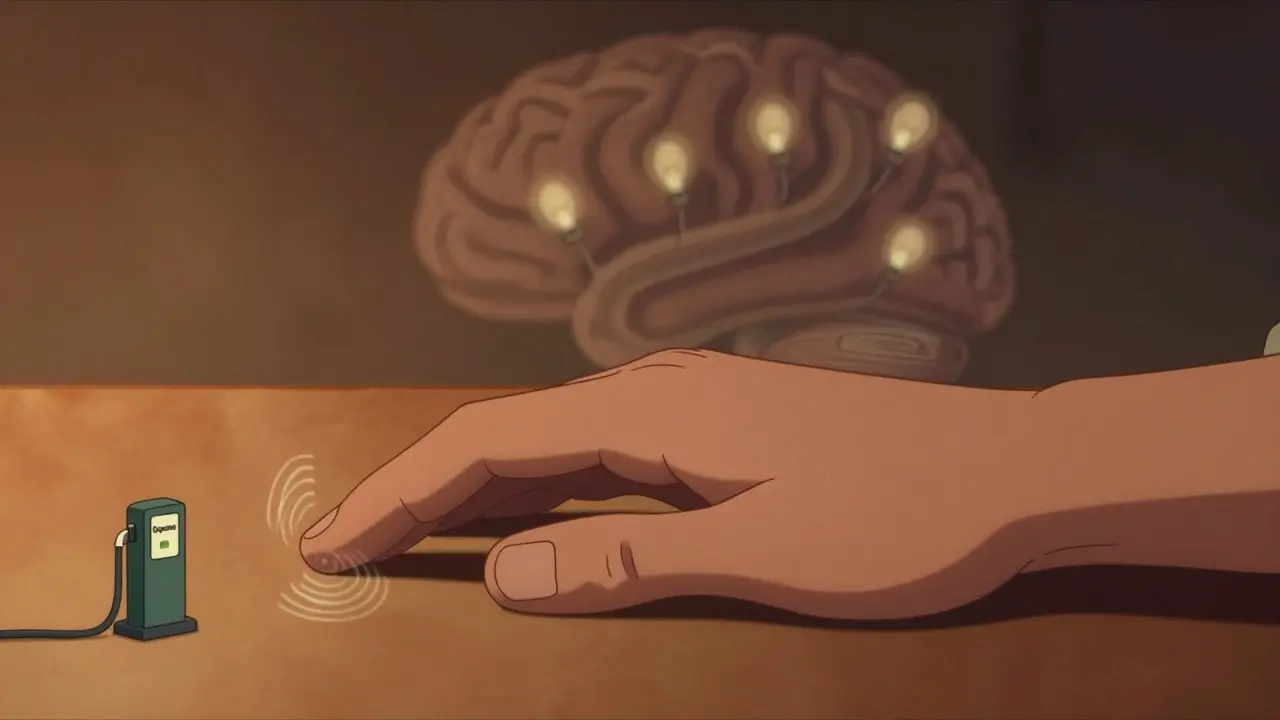
When your hand starts shaking for no reason - not from caffeine or nerves, but a quiet, rhythmic tremor that only shows up when you’re resting - it’s easy to brush it off. Maybe it’s just tiredness. Maybe it’s stress. But if that tremor sticks around, gets worse, and is joined by stiffness in your arm, slow movements, or trouble buttoning your shirt, it might not be just aging. It could be Parkinson’s disease.
More than 10 million people worldwide live with Parkinson’s. It’s not just one symptom. It’s a chain reaction in the brain, starting with the death of dopamine-producing cells. By the time most people notice something’s off, they’ve already lost 60 to 80% of those cells. That’s why symptoms like tremor and stiffness show up so suddenly - your brain has been quietly running out of fuel for years.
What’s Really Happening in the Brain?
Deep inside the brain, in an area called the substantia nigra, neurons make dopamine - a chemical messenger that helps your body move smoothly. When these neurons die, dopamine drops. Without enough dopamine, the circuits that control movement get out of sync. It’s like a car with a failing fuel pump: the engine still turns over, but it sputters, jerks, and eventually stalls.
The result? Four classic motor symptoms. The first is resting tremor. This isn’t the kind you get when you’re nervous. It’s a slow, rolling motion - often between the thumb and forefinger - like you’re pretending to roll a pill. It shows up when you’re sitting still, not when you’re reaching for a cup. About 80% of people with Parkinson’s have this. It usually starts on one side of the body and creeps over time.
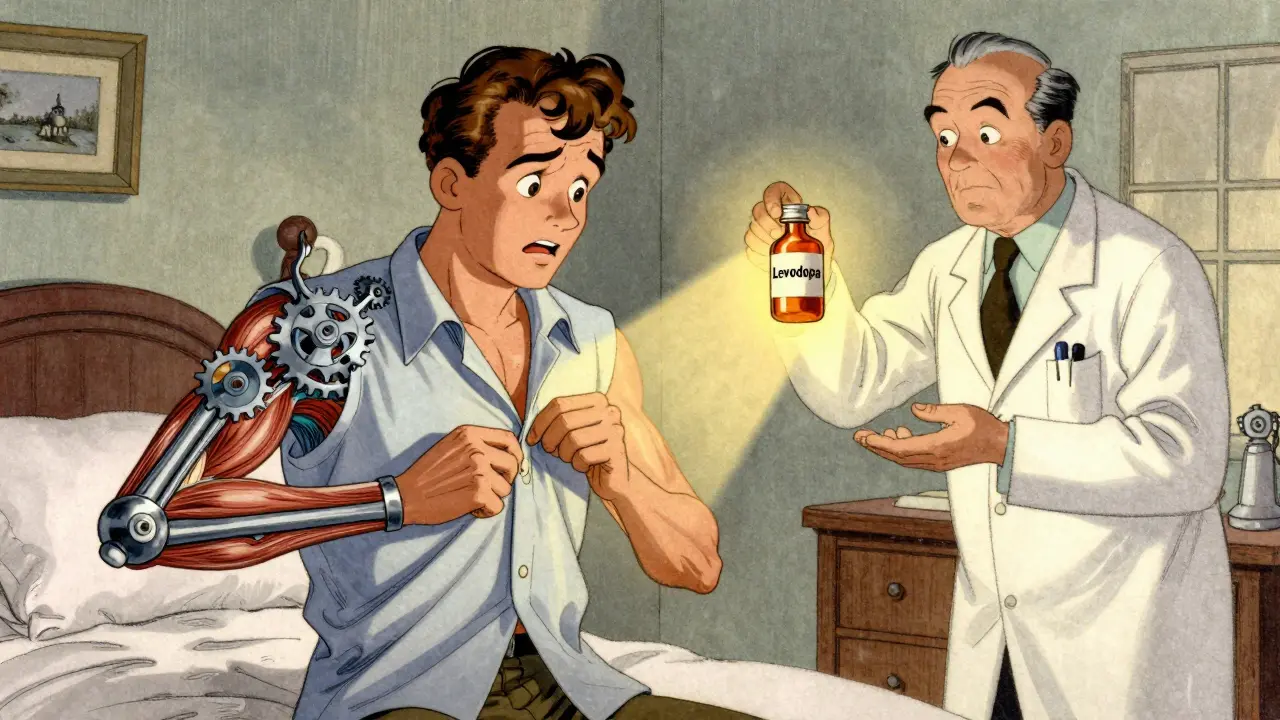
The second is rigidity, or muscle stiffness. It’s not just tight muscles. It’s a constant resistance when someone moves your arm or leg during a checkup. Doctors describe it as either "lead-pipe" - smooth, even stiffness - or "cogwheel" - a jerky, ratchety feel. This stiffness makes simple tasks hard: writing becomes cramped and shaky, buttons are impossible, shoelaces turn into puzzles. Around 73% of people report trouble with these daily activities within the first three years.
The third is bradykinesia - slowness of movement. Getting up from a chair takes longer. Walking feels heavy, like dragging your feet. Your face loses expression. You blink less. Your voice softens. This isn’t laziness. It’s your brain struggling to send the signal to move at all.
The fourth - often later - is postural instability. Balance gets shaky. You’re more likely to fall. This part is especially dangerous because falls can lead to fractures, hospital stays, and loss of independence.
Why Dopamine Replacement Is the Gold Standard
There’s no cure for Parkinson’s. But there is a treatment that works - really well, at first. It’s called dopamine replacement. And the most powerful tool for it is levodopa.
Levodopa isn’t dopamine itself. It’s a chemical your brain can turn into dopamine. Unlike dopamine, it can cross the blood-brain barrier. That’s why it works. When you take levodopa, your brain converts it into dopamine, and suddenly, movement gets easier. People often say they feel like they’ve been "switched on."
But levodopa alone causes side effects - nausea, low blood pressure - because it turns into dopamine everywhere in the body, not just the brain. That’s why it’s almost always paired with carbidopa. Carbidopa blocks dopamine production outside the brain, so more levodopa makes it where it’s needed. This combo, sold as Sinemet or in generic form, is the backbone of Parkinson’s treatment.
Studies show that about 75% of people see major improvement within 30 to 60 minutes of taking it. In the first few years - what doctors call the "honeymoon period" - motor symptoms can improve by up to 70%. For many, it means regaining the ability to walk without shuffling, write legibly, or get dressed without help.
The Downside: When the Medicine Stops Working
But here’s the catch: levodopa doesn’t stop the disease. It only masks the symptoms. And over time - usually after 5 to 10 years - it starts to lose its magic.
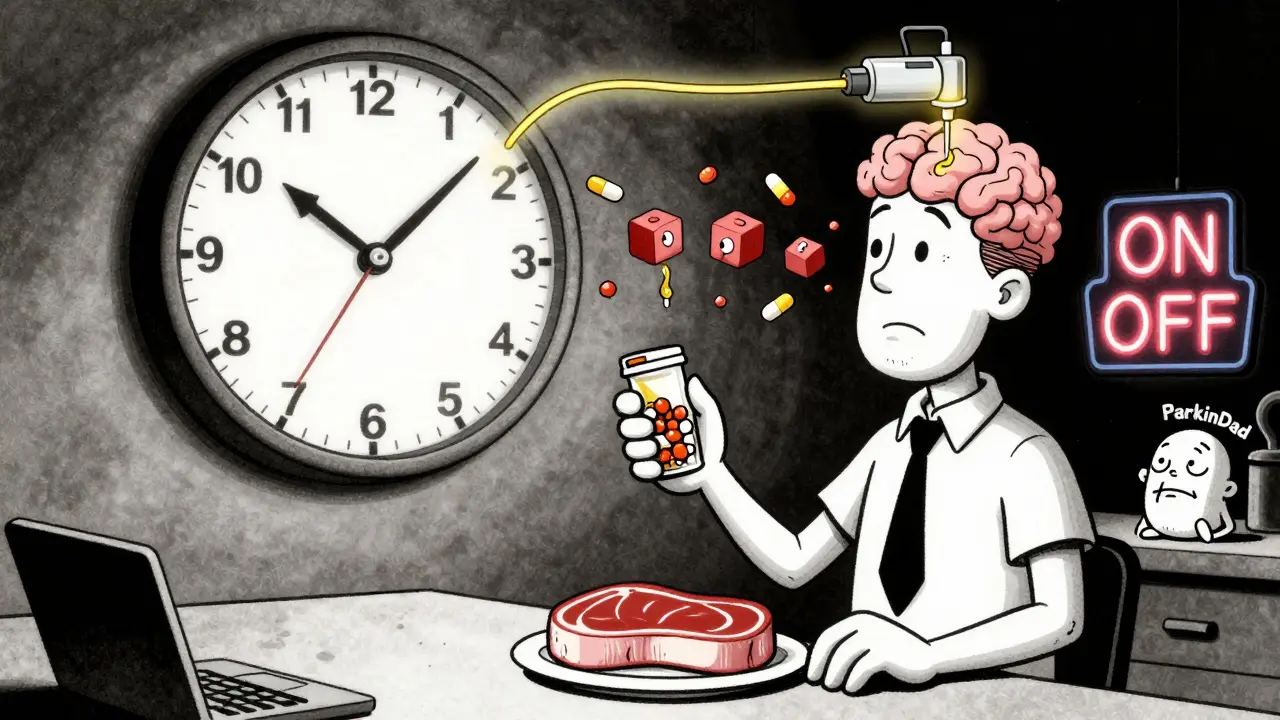
First comes "wearing-off." The medicine works for 2 or 3 hours, then fades before the next dose. You go from "on" - feeling fine - to "off" - stiff, slow, stuck - without warning. One patient described it as "a light switch flickering on and off all day."
Then come "on-off" fluctuations - sudden, unpredictable shifts between mobility and immobility. Some people get trapped in an "off" state for hours, unable to move. Others suddenly burst into uncontrollable movements - called dyskinesias - during the "on" phase. These involuntary twists and wriggles can be as disabling as the original tremor.
And then there’s the protein problem. Protein in food competes with levodopa for absorption. So if you eat a steak right before your pill, the medicine might not work. Many people learn to take levodopa 30 to 60 minutes before meals - or wait an hour after eating. It’s a constant balancing act.
One Reddit user, "ParkinDad," shared: "After 8 years on carbidopa/levodopa, my ‘on’ time dropped from 6 hours to just 2-3 hours per dose. Now I’m shaking with dyskinesias when I’m supposed to be feeling good."
Alternatives to Levodopa
Because of these long-term problems, doctors sometimes start with dopamine agonists - drugs like pramipexole or ropinirole. These mimic dopamine directly in the brain. They’re about 30-50% as effective as levodopa, but they cause fewer early dyskinesias. That’s why they’re often used in younger patients.
But they come with their own issues: dizziness, hallucinations, sudden sleep attacks, and impulse control problems - like gambling or compulsive shopping. One study found 42% of users reported dizziness, and 38% had dyskinesias over time.
Many people end up needing both. About 60% of patients eventually take levodopa and a dopamine agonist together. It’s not ideal, but it’s often necessary.
How Treatment Is Changing
Doctors are now moving away from the old "start high" approach. The Movement Disorder Society and Parkinson’s Foundation recommend a "start low, go slow" method. Begin with a small dose - maybe 25/100 mg once or twice a day - and increase slowly. This reduces side effects and delays complications.
There are also new delivery systems. Inbrija, an inhaled form of levodopa, works in under 10 minutes for sudden "off" episodes. It’s expensive - about $3,700 a month - but it’s a lifeline for those who can’t swallow pills or wait an hour for oral meds to kick in.
Another breakthrough is continuous delivery. The Foslevodopa/foscarbidopa infusion, tested in the 2022 RESTORE-1 trial, delivered dopamine nonstop under the skin. People got 2.5 more "on" hours each day compared to oral pills. It’s not yet widely available, but it points to a future where dopamine isn’t dosed by pills - but by pumps.
What Patients Really Struggle With
It’s not just the tremor or stiffness. It’s the logistics.
A survey by the Michael J. Fox Foundation found that 56% of patients say timing their meds is the hardest part of daily life. People juggle 3-5 doses a day, each timed around meals, sleep, and activities. About 78% need help from caregivers to manage this. What used to take 15 minutes a day turns into 45 minutes - or more.
And the cost? A year of generic levodopa/carbidopa runs about $600. But extended-release versions like Rytary? Around $5,800. Insurance doesn’t always cover them. Many people choose the cheaper option - even if it means more frequent dosing and more "off" time.
It’s Not Just About Medication
Dopamine replacement doesn’t fix everything. It doesn’t help with speech problems, swallowing issues, or dementia that can come later. That’s why physical therapy, speech therapy, and exercise are just as important. Walking, tai chi, boxing, dancing - they all help maintain mobility, balance, and mood.
There’s also hope on the horizon. Research funded by the Michael J. Fox Foundation is looking at genetic markers - like variations in the COMT and MAO-B genes - to predict who will respond best to which drug. The goal? Personalized treatment. Not one-size-fits-all dopamine replacement, but the right drug, at the right dose, for the right person.
For now, dopamine replacement - especially levodopa - remains the most effective tool we have. It doesn’t cure Parkinson’s. But for millions, it gives back hours of independence. It lets someone hold their grandchild’s hand. It lets them walk to the mailbox. It lets them live.
The key isn’t just taking the pill. It’s knowing when to take it. How to adjust it. When to ask for help. And understanding that while the disease keeps progressing, the way we treat it is evolving - one dose, one day, one person at a time.
Is Parkinson’s disease caused by low dopamine?
Yes. Parkinson’s disease is caused by the gradual death of neurons in the brain that produce dopamine, a chemical critical for smooth, controlled movement. By the time symptoms appear, most people have lost 60-80% of these dopamine-producing cells. This loss disrupts the brain’s ability to coordinate movement, leading to tremor, stiffness, and slowness.
What is the most effective treatment for Parkinson’s tremor?
Levodopa, usually combined with carbidopa, is the most effective treatment for Parkinson’s tremor and other motor symptoms. It’s converted into dopamine in the brain, directly replacing what’s been lost. Studies show up to 70% improvement in motor function during the first few years of use. Other treatments like dopamine agonists or inhaled levodopa (Inbrija) help, but none match levodopa’s overall effectiveness.
Why does levodopa stop working over time?
Levodopa doesn’t stop the brain’s ongoing damage - it only replaces dopamine. As Parkinson’s progresses, the brain loses more dopamine cells and becomes less able to store and use dopamine effectively. This leads to "wearing-off" (effects fading before the next dose), unpredictable "on-off" swings, and dyskinesias (involuntary movements). These are not signs the drug failed - they’re signs the disease advanced.
Can you take levodopa with food?
It’s best to take levodopa on an empty stomach or at least 30-60 minutes before eating. Protein in food competes with levodopa for absorption in the gut. High-protein meals - like meat, cheese, or beans - can make the medication less effective. Many people manage this by eating most of their protein at dinner, and keeping breakfast and lunch low in protein.
Are there alternatives to taking pills for Parkinson’s?
Yes. Inbrija is an inhaled form of levodopa used for sudden "off" episodes. There are also infusion therapies - like subcutaneous pumps delivering levodopa continuously - that are in advanced testing and not yet widely available. Deep brain stimulation (DBS) surgery is another option for people with advanced disease who have trouble controlling symptoms with medication alone.
For those newly diagnosed, the path ahead can feel overwhelming. But understanding how dopamine replacement works - its power, its limits, and its evolving options - gives you back some control. It’s not about finding a cure. It’s about finding the right rhythm - the right dose, the right timing, the right support - to live as fully as possible, one day at a time.
Scott Easterling
March 7, 2026 AT 12:36Melba Miller
March 8, 2026 AT 20:46Katy Shamitz
March 9, 2026 AT 01:09Nicholas Gama
March 10, 2026 AT 01:19Mary Beth Brook
March 11, 2026 AT 16:17Ray Foret Jr.
March 12, 2026 AT 09:07Peter Kovac
March 13, 2026 AT 13:20APRIL HARRINGTON
March 13, 2026 AT 15:30Leon Hallal
March 14, 2026 AT 15:02Judith Manzano
March 15, 2026 AT 07:46rafeq khlo
March 15, 2026 AT 12:15Morgan Dodgen
March 15, 2026 AT 17:17Philip Mattawashish
March 16, 2026 AT 03:26