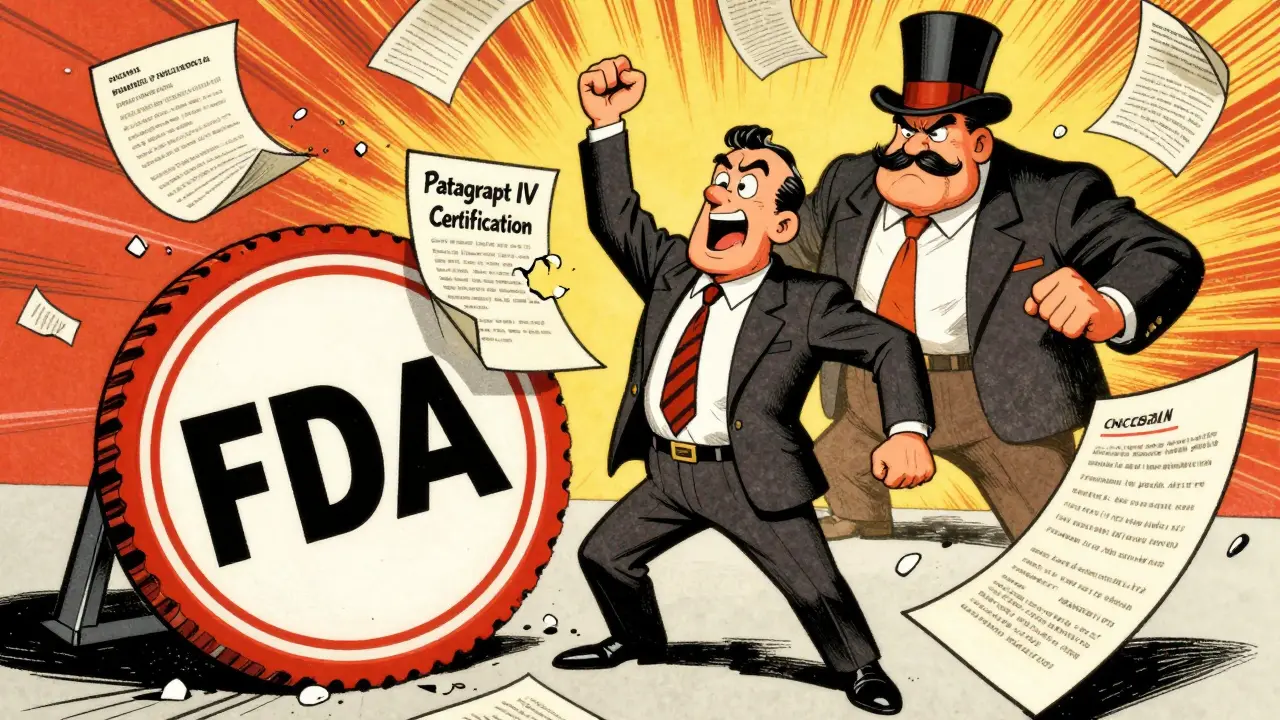
When a brand-name drug company holds a patent, it can block generic versions from entering the market for years. But there’s a legal loophole-actually, a carefully designed pathway-that lets generic drug makers challenge those patents before the drug even hits shelves. That’s the Paragraph IV certification. It’s not a secret trick. It’s written into U.S. law, and it’s how most generic drugs get to market faster-and cheaper.
What Exactly Is a Paragraph IV Certification?
A Paragraph IV certification is a formal statement included in an Abbreviated New Drug Application (ANDA) filed with the FDA. It says: "This generic version won’t infringe your patent, or your patent is invalid or unenforceable." It’s not a guess. It’s a legal declaration backed by detailed reasoning, and it triggers a chain reaction that can lead to court battles, market exclusivity, or both.
This mechanism was created by the Hatch-Waxman Act of 1984. Before that, generic companies had to wait until every patent expired-sometimes decades after the drug launched. The law was designed to balance two things: protecting innovation and speeding up access to affordable medicine. Paragraph IV is the part that lets generics push back.
How It Works: The Legal Domino Effect
Here’s the step-by-step process, no jargon:
- File the ANDA with the FDA. Along with it, submit a Paragraph IV certification for each patent you’re challenging.
- Send a notice letter to the brand-name company and patent holder within 20 days. This letter must include the legal and factual basis for your claim. If it’s too vague, the FDA rejects your application-no second chances.
- Wait for a lawsuit. The brand company has 45 days to sue you for patent infringement. If they do, the FDA can’t approve your drug for 30 months-or until a court rules otherwise. That’s called a "30-month stay."
- Go to court. The case plays out like any patent trial. The generic company must prove the patent is invalid (e.g., it’s obvious, not novel) or won’t be infringed (e.g., their drug works differently).
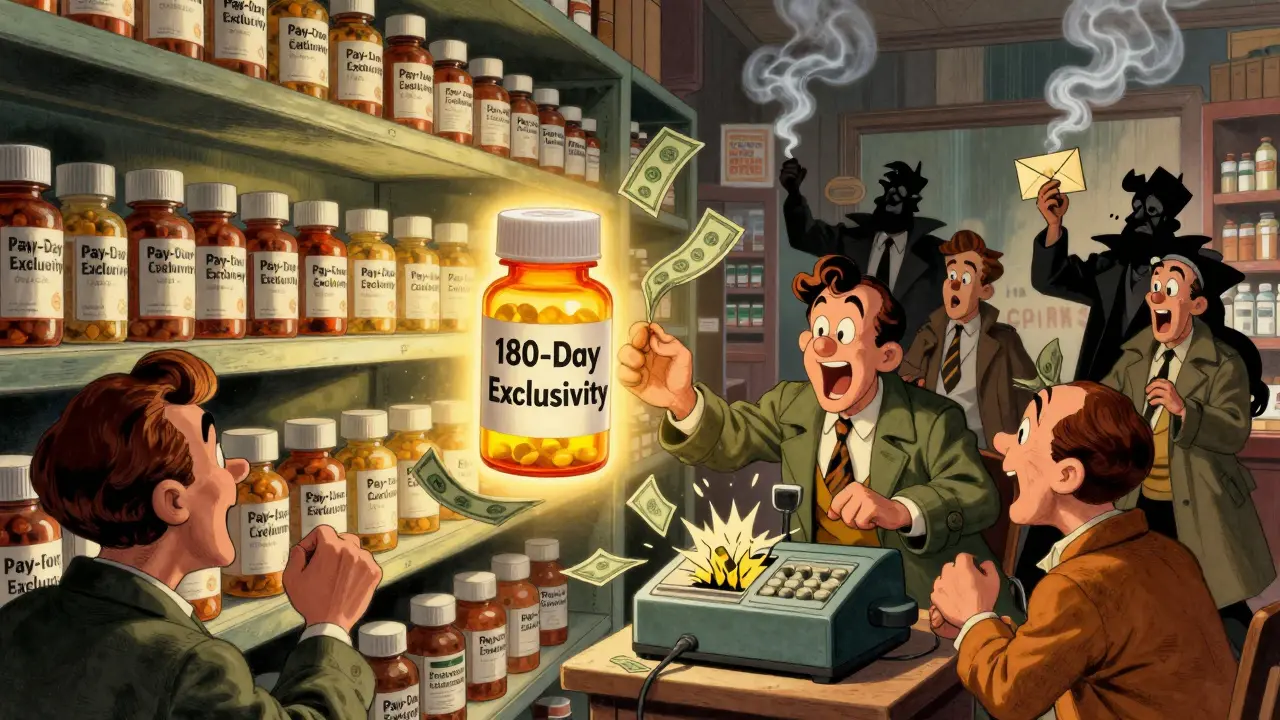
- Win? Get 180 days of exclusivity. If you’re the first to file a successful Paragraph IV challenge, you get 180 days where no other generic can enter the market. That’s a huge financial advantage.
It’s not a guarantee. Most Paragraph IV challenges don’t end in victory. But the stakes are high enough that companies still play the game.
Why Do Companies Take the Risk?
The answer is money. And exclusivity.
Let’s say a brand-name drug sells for $10,000 per year. After 180 days of exclusive generic sales, the price drops to $200. That’s a 98% drop. If you’re the only generic on the market during those 180 days, you could make $500 million or more-especially on blockbuster drugs.
Take Mylan’s challenge to Gilead’s hepatitis C drug in 2019. They won. Their generic version entered the market 27 months before the patent expired. That single win generated over $1 billion in revenue.
But here’s the catch: litigation costs an average of $12.7 million per case. Some go over $15 million. That’s why only serious players do it-companies like Teva, Sandoz, and Viatris. Small generics can’t afford the gamble.
What About the Other Certification Types?
Paragraph IV isn’t the only option. There are three others:
- Paragraph I: "This drug isn’t patented." Used for about 5% of applications. Low risk, no reward.
- Paragraph II: "The patent expires next month." Used for 15% of applications. Safe. You just wait.
- Paragraph III: "We’ll wait until the patent expires." Used for 20% of applications. No legal fight. No exclusivity.
Paragraph IV is the outlier. It’s the only one that invites a lawsuit. But it’s also the only one that offers a shot at 180 days of monopoly profits. That’s why 60-70% of ANDAs filed today include a Paragraph IV certification.
The Dark Side: Pay-for-Delay and Patent Thickets
It’s not all fair competition. Sometimes, brand companies pay generic makers to delay their entry. This is called a "pay-for-delay" settlement. The FTC calls it anticompetitive. Between 1999 and 2009, there were 197 such deals involving Paragraph IV challenges.
One famous case: Federal Trade Commission v. Actavis (2013). The Supreme Court ruled these deals can violate antitrust laws if they’re designed to keep generics off the market. Since then, courts have become more skeptical of these deals-but they still happen.
Another problem: patent thickets. Brand companies file dozens of patents covering tiny changes-like a different pill coating or a new dosage form. Each one gets listed in the FDA’s Orange Book. Generic makers have to challenge each one separately. It’s exhausting. A 2022 survey found 63% of generic companies say patent thickets have made challenges harder since 2018.
What’s Changed Recently?
The rules are evolving.
In 2023, the Supreme Court’s decision in Amgen v. Sanofi made it harder to invalidate patents. The court said a patent must enable the full scope of its claims-not just a few examples. That’s a big deal for biologics and complex drugs. It means generic companies now need even stronger evidence to prove a patent is invalid.
Also, the FDA has started cracking down on "evergreening"-the practice of filing weak secondary patents just to extend exclusivity. The 2023 Orange Book Modernization Act tightened what patents can be listed. Fewer trivial patents mean fewer legal distractions for generics.
And now, more companies are combining Paragraph IV challenges with Inter Partes Review (IPR) at the Patent Trial and Appeal Board. IPR is faster and cheaper than federal court. It’s becoming a standard part of the strategy.
Who Wins When Paragraph IV Works?
Patients win. The healthcare system wins. Taxpayers win.
Since 1984, Paragraph IV challenges have saved the U.S. healthcare system over $1.7 trillion. In 2022 alone, they helped generate $122.7 billion in generic drug sales. That’s not a guess. That’s FDA data.
Every time a generic enters the market early, prices drop. Insurance companies pay less. Patients pay less. Hospitals save money. And it’s all because one legal document forced a patent to be tested in court before the drug ever reached pharmacy shelves.
Why This Matters Beyond Big Pharma
This isn’t just about pills. It’s about how innovation and competition interact in regulated industries. The Paragraph IV system shows that the law can be used as a tool-not just to protect monopolies, but to break them.
It’s also a reminder that patents aren’t absolute. They’re temporary, conditional, and subject to legal challenge. That’s the balance the Hatch-Waxman Act tried to strike: reward innovation, but don’t let it lock out competition forever.
Today, nearly every top-selling drug with annual sales over $1 billion faces at least one Paragraph IV challenge. It’s not a fringe tactic. It’s standard practice. And it’s one of the most effective ways to bring down drug prices in the U.S.
What happens if a generic company loses a Paragraph IV lawsuit?
If the brand company wins the lawsuit, the FDA cannot approve the generic drug until the patent expires. The generic company also pays legal costs and loses any chance at the 180-day exclusivity period. In some cases, they may even face damages if the court finds the challenge was frivolous.
Can a generic company file a Paragraph IV certification on any patent?
No. The patent must be listed in the FDA’s Orange Book for the brand-name drug. Only patents covering the active ingredient, formulation, or method of use can be challenged. Method-of-use patents are common targets because they’re often easier to design around.
What’s the 180-day exclusivity period really worth?
It’s worth hundreds of millions. For a drug with $2 billion in annual sales, the first generic can earn $500 million or more in 180 days before competitors enter. That’s why companies spend millions on litigation-it’s a high-risk, high-reward bet.
Can the 180-day exclusivity be lost?
Yes. The first filer can forfeit exclusivity if they don’t get FDA approval within 30 months of filing, if they withdraw their application, or if they change their patent certification after filing. Teva lost exclusivity in 2017 for failing to get tentative approval on time.
Why do brand companies sue so often after a Paragraph IV notice?
Because they have to. If they don’t sue within 45 days, they lose the right to trigger the 30-month stay. That means the generic could get approved immediately. So even if a patent is weak, brand companies almost always sue to delay competition.
Are Paragraph IV challenges only for small molecules?
No. While most challenges target traditional pills, they’re increasingly used for complex generics like inhalers, injectables, and topical products. The FDA expects a 78% increase in Paragraph IV challenges for these products by 2028.
Final Thought: A Legal Tool That Saves Lives
Paragraph IV certification isn’t glamorous. It doesn’t make headlines like a new cancer drug. But it’s one of the most powerful tools we have to make medicine affordable. It turns patent law from a barrier into a battleground-and lets competition decide who wins.
Every time a generic enters the market early, it’s because someone took a legal risk. And that risk-backed by data, law, and strategy-keeps prices down and lives better.
Alexandra Enns
January 24, 2026 AT 23:43Oh please, like this ‘loophole’ isn’t just Big Pharma’s way of letting generics play Russian roulette with taxpayer-funded lawsuits. They don’t ‘challenge patents’-they gamble on bankrupting smaller companies so they can corner the market. And don’t even get me started on how the 180-day exclusivity is just a monopoly in a trench coat. This isn’t competition-it’s legalized extortion wrapped in legalese. 🤡
Marie-Pier D.
January 25, 2026 AT 12:25Wow, this is actually one of the most clear explanations I’ve ever read about Paragraph IV. 🙌 I used to think generics were just ‘cheap copies,’ but now I get how much strategy, courage, and legal firepower goes into this. Kudos to the folks risking millions so my insulin isn’t $1,000 a vial. Thank you for writing this.
Viola Li
January 27, 2026 AT 05:27So you’re telling me we reward companies for breaking patents? That’s not innovation-that’s theft with a law degree. If you can’t afford to develop your own drug, maybe you shouldn’t be in pharma. This system incentivizes litigation over creation. Pathetic.
Dolores Rider
January 28, 2026 AT 07:20EVERYTHING is rigged. The FDA? Controlled. The courts? Bought. That ‘180-day exclusivity’? That’s the pharma cartel letting one company win so the rest stay quiet. Pay-for-delay? That’s just the tip of the iceberg. They’re all in cahoots. You think these lawsuits are about patents? Nah. They’re about keeping prices high and patients desperate. 😈
Jenna Allison
January 30, 2026 AT 04:22Just to clarify something real quick-Paragraph IV isn’t about ‘breaking’ patents. It’s about declaring that the patent either doesn’t apply or is invalid. That’s a legal right, not a loophole. And the 30-month stay? That’s not a delay tactic-it’s a procedural pause so courts can review. Also, the FDA’s Orange Book reforms are huge. They’re finally cutting out trivial patents like ‘blue pill vs. green pill’ nonsense. This system works when it’s not gamed.
Vatsal Patel
February 1, 2026 AT 01:01Ah, the grand dance of capital: innovation is sanctified, then dismantled by the very laws meant to protect it. The patent is a covenant with time-and yet, the market, that blind god, demands its due. Is it justice when a corporation’s balance sheet becomes the arbiter of life? Or merely the theater of modern capitalism, where the stage is lit by lawsuits and the curtain falls on affordability?
Himanshu Singh
February 1, 2026 AT 22:23This is actually beautiful. Think about it-someone spent millions, bet their company’s future, just so a single mom could afford her kid’s asthma inhaler. That’s not just business. That’s activism with a briefcase. 🙏 Keep fighting the good fight, generic teams. The world sees you.
Jamie Hooper
February 3, 2026 AT 19:31so like… if you file a paragraph iv and they sue you, you get a 30 month pause? lol. so the big guys just sue everyone to slow stuff down? that’s wild. i thought patents were supposed to be about protecting innovation, not delaying it forever. also, 180 day exclusivity? sounds like a cartel handshake 😅
Husain Atther
February 3, 2026 AT 19:53It's fascinating how a single legal mechanism can balance so many competing interests: innovation, access, profit, and public health. The system isn't perfect, but it's one of the few places where the law actively forces market competition rather than suppressing it. We should be encouraging more of this kind of structured, rule-based disruption-not demonizing it.
Izzy Hadala
February 5, 2026 AT 16:56It is imperative to underscore that the Paragraph IV certification framework operates under the statutory authority granted by the Hatch-Waxman Act, which explicitly delineates the procedural obligations of both brand and generic manufacturers. The 30-month stay is not an arbitrary delay but a congressionally mandated equitable provision designed to preserve the integrity of the patent system while facilitating market entry. Empirical data confirms that this structure has generated aggregate savings exceeding $1.7 trillion since its inception, thereby substantiating its efficacy as a public policy instrument.
Marlon Mentolaroc
February 7, 2026 AT 03:27Okay but let’s be real-how many of these ‘successful’ Paragraph IV wins are just companies getting bought out by the brand name after they win? I’ve seen the financials. The ‘$1 billion revenue’? Half of it goes to lawyers, the other half gets absorbed into the parent company’s ‘R&D’ budget. It’s not a win. It’s a rebrand.
Gina Beard
February 8, 2026 AT 06:28Patents aren’t property. They’re temporary monopolies granted by the state. If they’re abused, they should be challenged. Simple.