Every year, millions of people take generic medicines because they’re affordable and just as effective as brand-name drugs. But what if the pill in your bottle isn’t real? Counterfeit generics are a growing threat - not just overseas, but right here in the U.S. and the U.K. Too often, these fake drugs look identical. The packaging is perfect. The label matches. Even the color and shape of the tablet are spot-on. Yet inside, there’s no active ingredient. Or worse - there’s something dangerous. The World Health Organization estimates that up to 10% of medicines worldwide are fake, and in some regions, it’s as high as 30%. For generic drugs, the risk is higher because manufacturers often cut corners on security features to save money. So how do you know if what you’re taking is real? The answer isn’t just trusting your pharmacist. You need to understand the packaging and labeling clues that separate real medicine from fake.
What to Look for in the Packaging
The first line of defense is your eyes. You don’t need a lab to spot some counterfeits. Real pharmaceutical packaging has tiny details that are hard to copy. Look for color-shift inks - the kind that change color when you tilt the box. Pfizer’s Viagra packaging, for example, uses a special ink that shifts from green to blue. If your generic version doesn’t do this, or if the shift looks muddy or uneven, that’s a red flag. Holograms are another common feature. Genuine ones have sharp, clear microtext that’s barely visible to the naked eye - usually around 50 to 100 micrometers in size. Fake holograms often blur or pixelate when you zoom in with your phone camera. Check the font. Not just the size - the shape. A pharmacist in Ohio once caught a counterfeit batch of Nexium® because the expiration date’s font was slightly thinner than the real one. It took her three bottles to notice. Even the spacing between letters matters. Real manufacturers use precision printing. Counterfeiters use cheap printers that smear or misalign text. Compare your bottle to an older one you’ve had before. If the label feels different - thinner paper, glossy instead of matte, or a weird smell - trust your gut.Covert Features You Can’t See Without Tools
Many real generics now include covert security features that require simple tools to check. One of the most common is UV-reactive ink. Under a standard UV light (the kind you can buy for $15 online), authentic packaging glows in a specific pattern. Johnson & Johnson uses this on Tylenol generics - the glow forms a hidden logo or code. If nothing lights up, or if the glow is too faint or inconsistent, it’s likely fake. Another method is RFID tags embedded in the blister pack. These aren’t visible, but they respond to scanners. While most consumers won’t have access to these scanners, pharmacists do. If your pharmacy doesn’t use them, ask why. A more advanced but increasingly common method is chemical taggants like Lumilink®. These are microscopic markers added to the ink or coating. They’re invisible unless you use a handheld reader that costs $200-$500. These devices flash a specific wavelength of light and detect the taggant’s unique chemical signature. They’re used by hospitals and large pharmacies, but not yet common in small community clinics. Still, knowing they exist helps you understand why some medicines are harder to fake.Track-and-Trace: The Digital Backbone
Since 2019, the European Union has required all prescription medicines - including generics - to carry a 2D data matrix code on the packaging. This code holds a unique serial number linked to a central database. In the U.S., the Drug Supply Chain Security Act (DSCSA) mandated the same system by November 2023. That means every box, bottle, or blister pack should have a scannable code that tells you where it came from and whether it’s been verified. Here’s the catch: not all generics follow this rule yet. A 2023 report from the Generic Pharmaceutical Association found that 35-45% of generic products still lack consistent serialization. That’s because small manufacturers don’t have the budget to upgrade. So if you scan the code and get an error, or if the app says “no record found,” it doesn’t always mean it’s fake. It could just be an older batch. But if the code doesn’t match the product name or expiration date, that’s a major red flag. Some apps, like MediMark, promise to verify drugs with a scan. But user reviews show they fail 40-50% of the time with generics. Why? Because the database isn’t updated, or the code was printed wrong. Don’t rely on apps alone. Use them as a second check - not your first.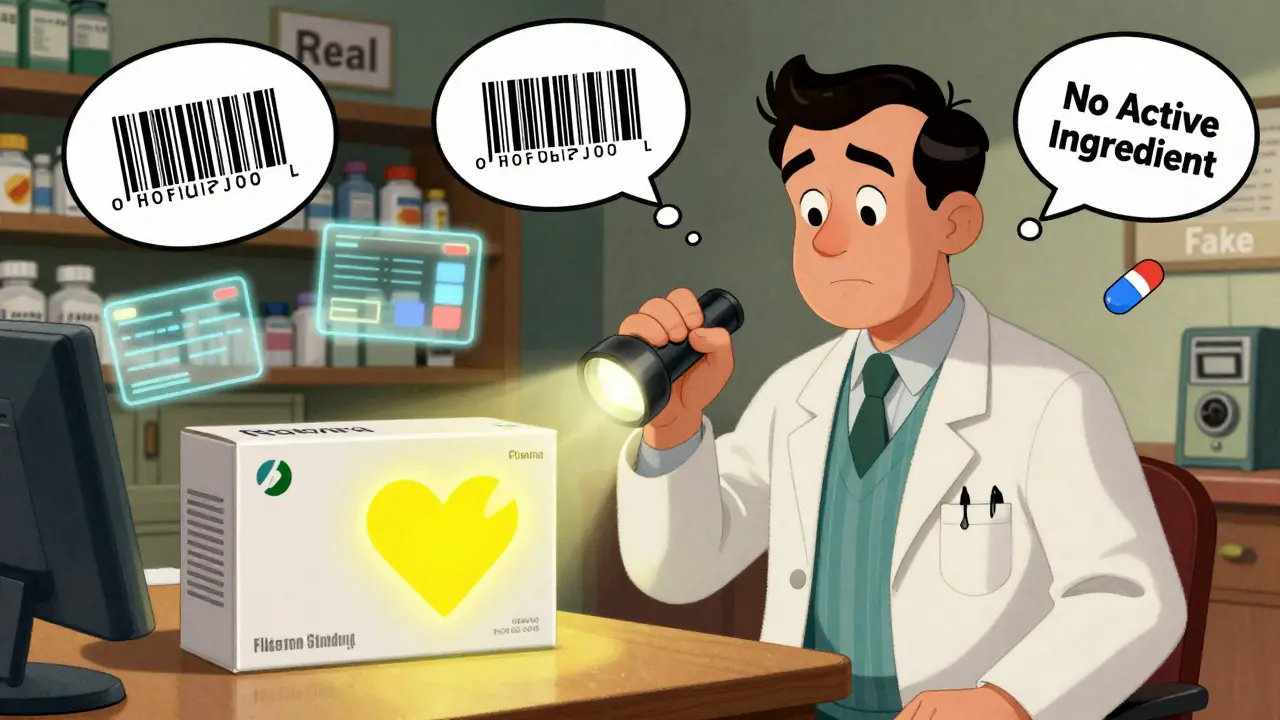
Spectroscopy: The Lab in Your Hand
The most reliable way to confirm a generic drug is real isn’t by looking at the box - it’s by testing the pill itself. Devices like the Thermo Fisher TruScan® RM and B&W Tek NanoRam® use near-infrared (NIR) or Raman spectroscopy to analyze the chemical makeup of a tablet. These handheld tools weigh less than two pounds and give results in under 30 seconds. They don’t need to crush the pill. Just point and scan. How accurate are they? Studies show NIR spectroscopy catches 92-97% of fake generics by detecting differences in coating thickness, moisture content, or inactive ingredients. Raman spectroscopy is even better at identifying specific active pharmaceutical ingredients (APIs), but struggles with dark-colored tablets. In one case, a pharmacist in Florida used a NanoRam® to test metformin that looked identical to the real thing. The device flagged it as fake - and lab tests later confirmed it contained no metformin at all. Just chalk and sugar. These devices cost $15,000-$50,000, so they’re not for home use. But if you’re a pharmacist, clinic worker, or even a hospital buyer, this is the gold standard. The FDA’s Product Quality Research Institute requires verification systems to be at least 95% accurate - and these tools meet that bar.Why Generics Are More Vulnerable
You might wonder: why are generics targeted more than brand-name drugs? The answer is money. Branded drugs make up only 10% of prescriptions in the U.S., but 78% of pharmaceutical spending. That means companies can afford to spend $500,000-$2 million per product line to install advanced security features. Generic manufacturers operate on thin margins - often less than 5% profit. So they skip the color-shift ink, skip the UV taggants, and sometimes even skip the 2D codes. A 2022 McKinsey report found that verification costs average 1.2-1.8% of revenue for generics, compared to 0.7-1.1% for branded drugs. That gap isn’t just financial - it’s a safety gap. Also, generics pass through 5-7 distribution points before reaching you. Branded drugs usually go through 3-4. More handoffs mean more chances for counterfeits to slip in. That’s why the FDA and EMA now require track-and-trace systems - but again, enforcement varies. In Southeast Asia, only 45% of manufacturers comply. In the EU, it’s 98%.
What You Can Do Right Now
You don’t need a lab to protect yourself. Here’s what works:- Compare packaging - Keep old bottles. Notice differences in color, texture, font, or seal.
- Use a UV light - Buy a $15 UV flashlight and check for hidden marks. If nothing glows, ask your pharmacist.
- Scan the code - Use your pharmacy’s app or the manufacturer’s portal. If it fails, don’t take the medicine.
- Ask questions - If your pharmacy doesn’t use verification tools, ask why. Demand transparency.
- Report suspicious products - The FDA and MHRA (UK Medicines and Healthcare products Regulatory Agency) accept anonymous reports. One report can prevent a batch from reaching others.
The Future of Verification
The good news? Things are improving. The EU will require cryptographic authentication on all generic medicine codes by January 1, 2025. The FDA is piloting blockchain tracking with 12 manufacturers, and early results show 99.2% accuracy. New spectroscopy devices like the TruScan® RM Gen3 cut analysis time to just 5-15 seconds. The Generic Pharmaceutical Association has pledged 100% serialization of U.S. generics by 2026. But the biggest challenge isn’t technology - it’s consistency. As Dr. Maria Kresal from the European Directorate for the Quality of Medicines said: “Over-reliance on packaging alone is dangerous.” Modern counterfeiters replicate labels with 95% accuracy. That’s why the future isn’t about one feature - it’s about layers. Visual checks + UV tests + barcode scans + spectroscopy. No single method is perfect. But together, they create a wall that fake drugs can’t climb.How can I tell if my generic medicine is fake just by looking at it?
Look for inconsistencies in the packaging: mismatched fonts, uneven holograms, or color-shift inks that don’t change properly. Compare your current bottle to an older one from the same drug. If the label feels thinner, the seal is loose, or the expiration date looks smudged, it could be counterfeit. Even small differences - like spacing between letters or the shape of a number - can signal a fake.
Are UV lights effective for checking generic drugs?
Yes, if the manufacturer used UV-reactive ink. Many real generics, like Johnson & Johnson’s Tylenol generics, include hidden patterns that glow under 365nm UV light. If nothing lights up, or if the glow looks blurry or incomplete, the product may be fake. But not all generics use this feature - so absence doesn’t automatically mean counterfeit. Always check with your pharmacist or the manufacturer’s website to confirm if UV verification is used for your specific drug.
Why do some generic drugs have barcodes that don’t scan?
Not all generics follow the same serialization rules. While the U.S. DSCSA requires unique barcodes for all prescription drugs by 2023, some small manufacturers still lag behind due to cost. A 2023 report found that 35-45% of generic medicines lack consistent or accurate serialization. If your barcode doesn’t scan, it might be an older batch, a misprinted label, or a fake. Don’t assume it’s safe. Contact your pharmacy or report it to the FDA.
Can spectroscopy devices detect fake generics at home?
No - handheld spectroscopy devices like the Thermo Fisher TruScan® RM or B&W Tek NanoRam® cost between $15,000 and $50,000 and require training to use. They’re used by hospitals, large pharmacies, and regulatory agencies. These tools analyze the chemical composition of the pill, not just the packaging. While they’re the most accurate method available (95%+ accuracy), they’re not practical for personal use. Your best option is to rely on your pharmacist’s verification systems.
Is it safe to buy generic medicines from online pharmacies?
Only if the pharmacy is verified. Look for the VIPPS seal (Verified Internet Pharmacy Practice Sites) in the U.S. or the GPhC logo in the U.K. Sites that sell medicines without a prescription, offer prices that seem too good to be true, or don’t list a physical address are high-risk. The FDA estimates that 96% of online pharmacies selling prescription drugs are illegal. Even if the packaging looks real, the product may be contaminated or contain no active ingredient. Always get generics from a licensed, local pharmacy.
What should I do if I suspect I’ve taken a fake generic drug?
Stop taking the medication immediately. Keep the packaging, bottle, and any remaining pills. Contact your healthcare provider to discuss symptoms. Then report it: in the U.S., use the FDA’s MedWatch portal; in the U.K., use the Yellow Card Scheme. Provide all details - batch number, pharmacy name, date of purchase. Your report helps regulators track counterfeit trends and remove dangerous products from the market. Don’t wait - even one fake pill can cause serious harm.
Randy Harkins
February 8, 2026 AT 02:47Really appreciate this breakdown. I never thought about how font spacing could be a clue - but now that you mention it, I remember my last prescription bottle looked "off" and I just couldn't put my finger on why. Turns out, the "2" in the expiration date was slightly narrower. I called my pharmacist and they confirmed it was a counterfeit batch. Glad I didn't take it.
Chima Ifeanyi
February 9, 2026 AT 08:29Let’s be real - the entire generic drug supply chain is a regulatory farce. You’re telling me we trust pills that pass through 5-7 distribution nodes with zero cryptographic integrity? The DSCSA is a compliance theater exercise. Real verification requires blockchain-anchored PKI, not some QR code printed on 70gsm paper. Also, UV lights? Please. Counterfeiters now use UV-reactive polymers that mimic OEM specs. You’re being manipulated by surface-level heuristics.
Tori Thenazi
February 9, 2026 AT 12:55Okay, but what if… the FDA is IN ON IT?? 🤔 I mean, think about it - why would they allow 35-45% of generics to lack serialization?? It’s not negligence - it’s a controlled release! They’re letting the fake drugs circulate so they can later "crack down" and justify MORE surveillance! And don’t get me started on the "UV light" - that’s just a distraction! The real signal is in the ink’s chemical composition - and they’ve been suppressing the truth about Lumilink® since 2017!!
My cousin works at a "pharma lab" (she says) and she told me they re-label expired brand drugs as generics and ship them to rural clinics. I’m not paranoid - I’m PREPARED. 🔍🧪
Angie Datuin
February 10, 2026 AT 03:35Thanks for sharing this. I’ve been taking generic metformin for years and never thought to check the packaging. I’ll start keeping old bottles for comparison. Small things like that really matter.
Jonah Mann
February 10, 2026 AT 06:51soooo… i got a new bottle of my generic lisinopril and the label felt kinda sticky? like, not in a bad way, but… different? i used my phone’s flashlight to look at the hologram and it looked kinda blurry? idk if it’s fake or if my eyes are just tired? also the cap was a little looser? should i be worried??
Brandon Osborne
February 10, 2026 AT 14:13YOU’RE ALL BEING MANIPULATED. THIS ISN’T ABOUT DRUGS - IT’S ABOUT CONTROL. THEY WANT YOU TO THINK YOU CAN "SCAN" OR "CHECK" THE PACKAGE - BUT THAT’S THE TRAP. The real counterfeiters don’t even bother with packaging anymore. They’re injecting fake drugs directly into the supply chain via compromised pharmacists. You think your pharmacy is safe? Think again. The FDA’s database? It’s hacked. The UV lights? They’re calibrated to ignore fakes. And those spectroscopy devices? They’re only used on drugs that have already been flagged - which means they’re not catching anything real. You’re being sold a false sense of security.
STOP TRUSTING SYSTEMS. START TRUSTING YOURSELF.
Marie Fontaine
February 12, 2026 AT 04:37UV light is a game-changer!! I bought one for $12 on Amazon and tested my blood pressure med - BOOM! Hidden logo glowed right away. 😍 I’ve been checking every new bottle since. It’s like a mini science experiment every time I open a pill bottle. So empowering! 💪✨
Lyle Whyatt
February 12, 2026 AT 17:25I’ve spent the last six months working in a rural pharmacy in Maine, and I can tell you - the packaging inconsistencies are real, but they’re not always malicious. Sometimes it’s just batch variation. Sometimes it’s a manufacturer switching suppliers. Sometimes it’s a distributor mislabeling. The real issue isn’t counterfeit drugs - it’s the lack of communication between manufacturers, regulators, and frontline pharmacists. We get new shipments with no documentation. We’re expected to spot fakes with no training. And when we call the wholesaler? They blame the FDA. The system is broken. Not because of bad actors - because of bureaucratic inertia. We need mandatory training for every pharmacist, not just another QR code.
Tatiana Barbosa
February 14, 2026 AT 01:53Layered verification is the future - and honestly, it’s the only way forward. Visual checks, UV, barcode, spectroscopy - each layer adds resilience. But here’s what no one’s talking about: patient education. We need public health campaigns that teach people how to spot differences, not just scan codes. I’ve trained 300+ patients at my clinic using simple comparison charts. The drop in reported adverse events? Significant. Knowledge isn’t power - it’s prevention.
Ken Cooper
February 15, 2026 AT 08:47so i tried scanning my generic xanax bottle with the medimark app and it said "no record found" - i panicked and called my doc. she said it was prob just an old batch. but then i remembered my last bottle had a different color cap? so i dug out the old one and compared… turns out the font on the new one was thinner. like, super subtle. i brought it back to the pharmacy and they replaced it. they said it was a recall. idk if it was fake or just a mistake, but i’m never trusting a bottle without checking again. thanks for the heads up!!
MANI V
February 16, 2026 AT 04:43Of course you’re being scammed. You think generics are safe? You’re naive. People die every day from fake metformin laced with NDMA. And you’re out here checking holograms like it’s a magic trick? The real problem is profit-driven healthcare. Big Pharma doesn’t care if you live or die - as long as they get paid. Stop trusting the system. Stop trusting your pharmacist. Stop trusting the FDA. The only safe drug is the one you grow in your backyard. And even then… who knows?
Susan Kwan
February 18, 2026 AT 00:09Wow. So after all that, the takeaway is… check the font? Use a $15 UV light? And if it doesn’t glow, call your pharmacist? That’s it? I guess I’ll just keep my fingers crossed and hope for the best. 😌
Random Guy
February 18, 2026 AT 13:10Bro. I just took a generic version of my anxiety med. Looked exactly like the brand. Same color. Same logo. Same everything. Took it. Felt nothing. Thought I was just tired. Then I read this. Now I’m convinced I got ripped off. I’m gonna go to the pharmacy tomorrow with a crowbar and demand answers. 🤡💊