G6PD Deficiency Risk Assessment Tool
This tool helps you understand your risk of developing hemolytic anemia if you take nitrofurantoin. Based on your ethnic background, gender, and health history.
Risk Assessment
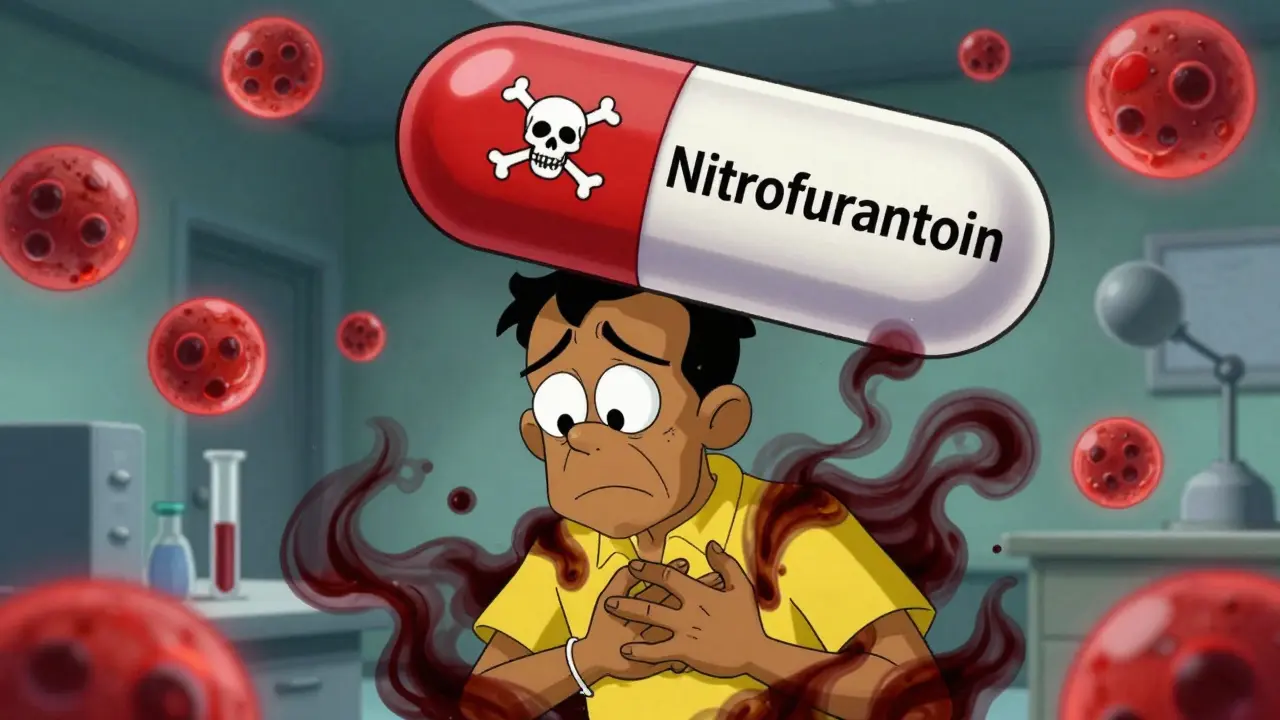
Imagine you're prescribed nitrofurantoin for a stubborn urinary tract infection. You take it as directed, but two days later, you feel dizzy, your skin turns yellow, and your urine looks dark. You didn't know you had G6PD deficiency - and now, your red blood cells are breaking down. This isn't rare. It happens more often than most doctors admit.
What Is Nitrofurantoin, and Why Is It Used?
Nitrofurantoin, sold under brand names like Macrobid and Furadantin, is an antibiotic used almost exclusively for simple urinary tract infections (UTIs). It works by attacking bacteria in the urine, not the bloodstream. That’s why it’s safe for most people - it doesn’t linger in the body long enough to cause widespread harm. It’s cheap, effective, and has low resistance rates compared to other UTI drugs like trimethoprim-sulfamethoxazole.
But here’s the catch: nitrofurantoin is also one of the most common drugs to trigger hemolytic anemia in people with G6PD deficiency. And that’s not a small risk. Around 400 million people worldwide have this genetic condition, mostly in African, Mediterranean, Middle Eastern, and Southeast Asian populations. In the U.S., about 1 in 10 Black men and 1 in 14 Black women carry the gene. Yet, most doctors don’t test for it before prescribing.
What Is G6PD Deficiency?
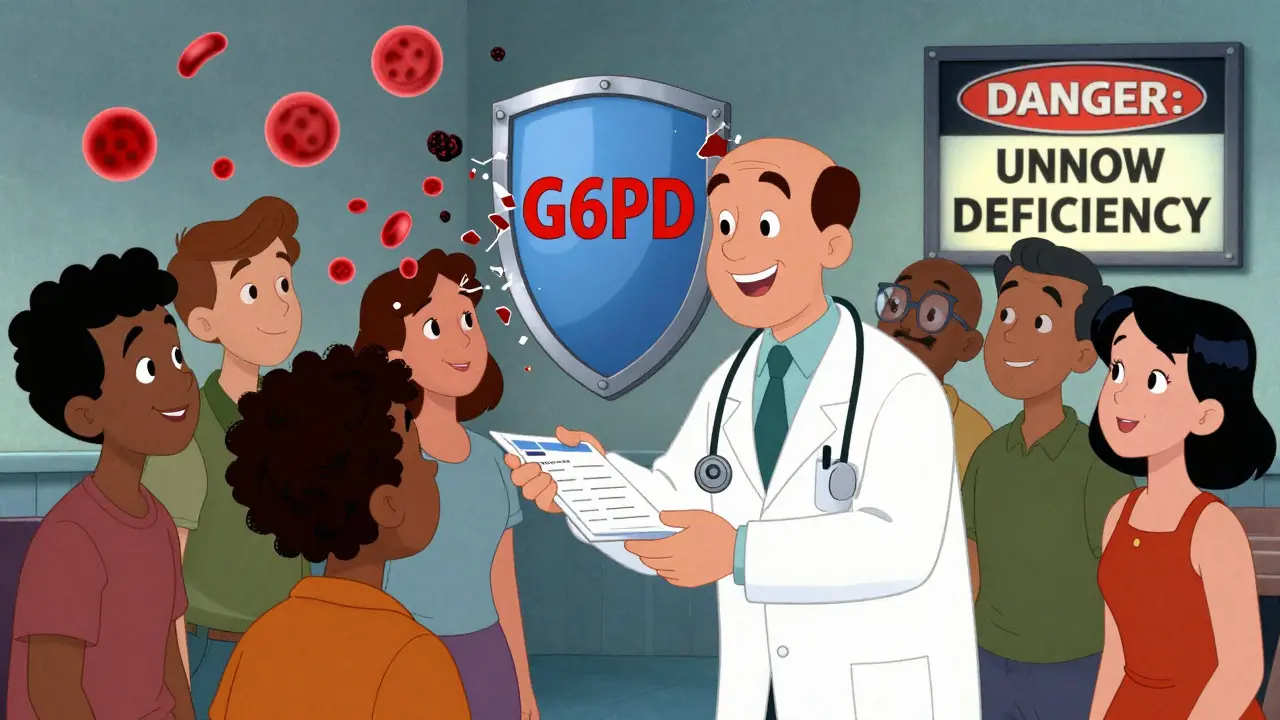
G6PD stands for glucose-6-phosphate dehydrogenase. It’s an enzyme your red blood cells need to protect themselves from oxidative stress. Think of it like a shield. When you take certain drugs - like nitrofurantoin, sulfonamides, or primaquine - they create free radicals that damage red blood cells. Normally, G6PD helps neutralize those radicals. But if you’re deficient, your shield is broken. The cells burst, and hemoglobin leaks into your blood and urine.
This isn’t theoretical. In 1956, a case report in JAMA first linked nitrofurantoin to hemolytic anemia. Since then, over 300 documented cases have been published. Of those, 42 were confirmed in G6PD-deficient patients. Ten ended in death. Many more went unreported because the connection wasn’t made.
How Does Nitrofurantoin Cause Hemolytic Anemia?
Nitrofurantoin gets activated in the acidic environment of the bladder to kill bacteria. But in your bloodstream, it can also create oxidative stress. In people with normal G6PD levels, this is no problem. Their red blood cells have enough glutathione - a natural antioxidant - to clean up the damage.
In G6PD-deficient people, glutathione levels drop fast. Red blood cells can’t repair themselves. Hemoglobin clumps together, forming Heinz bodies. The spleen sees these damaged cells and destroys them. That’s hemolysis. You lose red blood cells faster than your bone marrow can replace them. Your hemoglobin plummets. Your bilirubin spikes. Your skin yellows. You feel weak, feverish, short of breath.
Onset is fast - usually within 24 to 72 hours of starting the drug. Labs show low haptoglobin, high LDH, high reticulocytes. The worst drop in hemoglobin happens around day 3 to 5. Most patients recover within 48 hours of stopping the drug, but some need hospitalization. A few need transfusions.
Who’s at Risk?
You’re at higher risk if you’re:
- Of African, Mediterranean, Middle Eastern, or Southeast Asian descent
- Male (since G6PD deficiency is X-linked)
- Have a family history of jaundice or anemia after taking certain drugs
- Are pregnant (nitrofurantoin crosses the placenta - and newborns can be affected)
- Have a history of unexplained jaundice as a baby
Here’s the scary part: 50 to 60% of people with G6PD deficiency don’t know they have it until they have a hemolytic crisis. No one tests newborns routinely in the U.S. unless they’re in a high-risk group. Many adults never get screened.
What Do Guidelines Say?
The American Society of Hematology says: “Avoid nitrofurantoin in patients with known G6PD deficiency.”
The Clinical Pharmacogenetics Implementation Consortium (CPIC) is even more specific. They say:
- If you have G6PD deficiency without chronic hemolytic anemia - use nitrofurantoin with caution, only if no alternatives exist.
- If you have G6PD deficiency with chronic hemolytic anemia - do not use nitrofurantoin at all.
Yet, a 2022 survey of 350 U.S. primary care doctors found only 32% routinely check G6PD status before prescribing nitrofurantoin. Why? Because it’s not mandatory. The FDA label warns about the risk but doesn’t require testing. Most doctors assume the patient is fine unless they say otherwise.
What Are the Alternatives?
If you’re at risk, there are safer options:
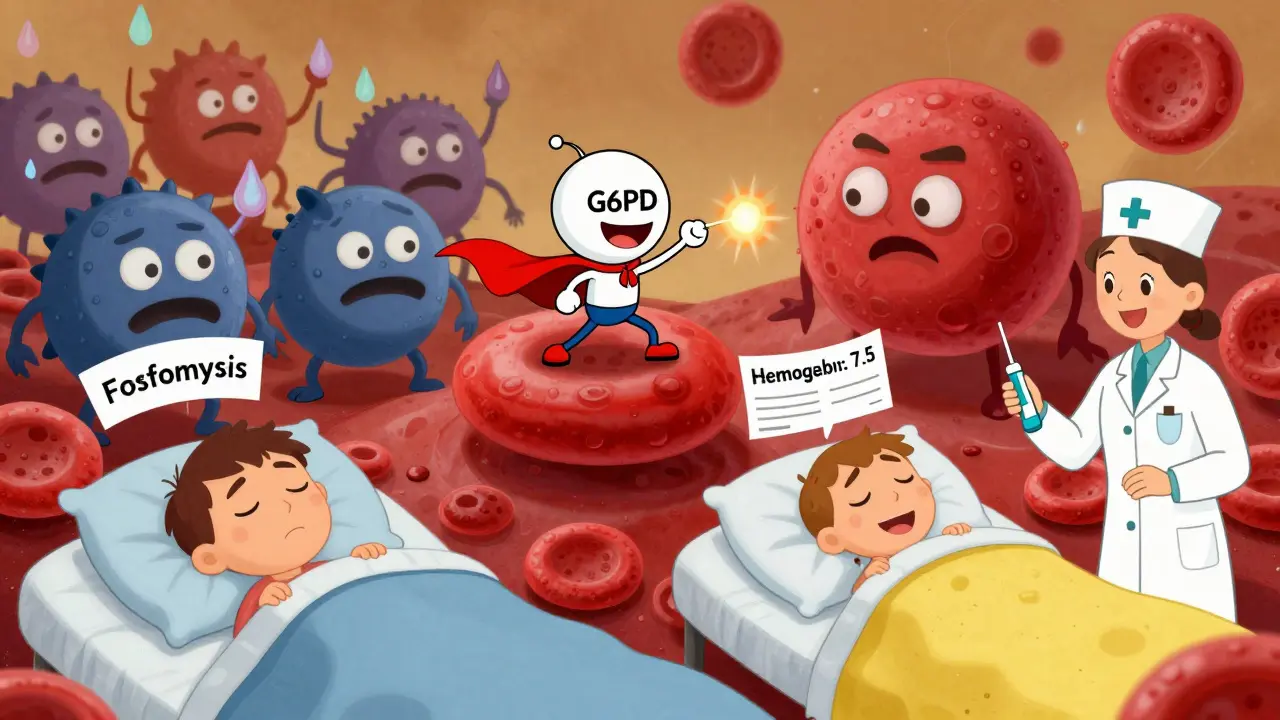
- Fosfomycin - A single-dose oral antibiotic. Safe in G6PD deficiency. Often used in pregnant women.
- Pivmecillinam - Available in Europe, not yet in the U.S., but low risk for hemolysis.
- Cephalexin - A first-generation cephalosporin. Doesn’t cause oxidative hemolysis.
- Amoxicillin-clavulanate - Good for UTIs, low risk for G6PD patients.
Trimethoprim-sulfamethoxazole (TMP-SMX) is commonly used, but it also carries a hemolytic risk - though lower than nitrofurantoin. Fluoroquinolones like ciprofloxacin are effective but come with their own side effects, including tendon damage and nerve issues. So, no perfect option - but there are safer ones.
Cost vs. Risk: Should You Get Tested?
G6PD testing costs $35 to $50. A hospital stay for hemolytic anemia? $8,500 to $12,000. That’s not even counting missed work, pain, or the trauma of nearly dying.
If you’re from a high-risk ethnic group, have a family history, or have ever had unexplained jaundice - get tested. It’s a simple finger-prick blood test. Results come back in hours. Many urgent care centers and community clinics offer it now.
Some hospitals are starting to build alerts into their electronic systems. If you’re Black, Mediterranean, or Southeast Asian and you’re prescribed nitrofurantoin, the system should pop up: “Check G6PD status.” But that’s still rare.
Real Cases, Real Consequences
A 32-year-old woman from Nigeria, living in London, took nitrofurantoin for a UTI. Two days later, she collapsed. Her hemoglobin dropped from 13 to 7.5 g/dL. Her bilirubin was over 10. She was hospitalized. She didn’t know she had G6PD deficiency. Her mother had jaundice after taking sulfa drugs in the 1970s. No one ever told her.
She recovered after stopping the drug and getting IV fluids. No transfusion needed. But she was lucky.
In another case, a 7-month-old baby developed severe anemia after his mother took nitrofurantoin while breastfeeding. The baby’s hemoglobin crashed. He needed a transfusion. His G6PD test came back positive.
These aren’t outliers. They’re preventable.
The Bigger Picture
Nitrofurantoin isn’t going away. It’s cheap, effective, and works against resistant bacteria. But its use needs to change. We’re in the age of precision medicine. We test for BRCA genes before giving certain chemo drugs. We screen for HLA-B*5701 before prescribing abacavir. Why not test for G6PD before giving nitrofurantoin?
The global market for G6PD testing is expected to hit $310 million by 2027. That’s because awareness is rising. But until testing becomes standard - especially for high-risk populations - people will keep getting hurt.
If you’re prescribed nitrofurantoin and you’re from a population with high G6PD prevalence - ask: “Have you checked my G6PD status?” If the answer is no, ask for an alternative. Or get tested before you start.
One test. One question. Could save your life.
Can nitrofurantoin cause hemolytic anemia even if I don’t know I have G6PD deficiency?
Yes. About half of people with G6PD deficiency don’t know they have it until they take a drug like nitrofurantoin and develop symptoms. Hemolytic anemia can strike suddenly - often within 2 to 3 days of starting the antibiotic. Symptoms include dark urine, yellow skin, fatigue, fever, and rapid heartbeat. If you’re from a high-risk ethnic group and you’ve never been tested, assume you might be at risk.
Is G6PD testing expensive or hard to get?
No. A G6PD test is a simple blood test, often done with a finger prick. It costs between $35 and $50 in the U.S., and many insurance plans cover it. Community health centers, urgent care clinics, and even some pharmacies offer it. If you’re at risk - African, Mediterranean, Middle Eastern, or Southeast Asian descent - ask your doctor for a test before taking any antibiotic.
What are the safest antibiotics for UTIs if I have G6PD deficiency?
Fosfomycin is the top choice - it’s a single-dose pill, safe in G6PD deficiency, and commonly used in pregnancy. Cephalexin and amoxicillin-clavulanate are also low-risk alternatives. Avoid nitrofurantoin, sulfonamides, and primaquine. Trimethoprim-sulfamethoxazole carries a lower risk than nitrofurantoin but still isn’t ideal. Always tell your doctor your G6PD status before any antibiotic is prescribed.
Can I take nitrofurantoin if I’m pregnant and have G6PD deficiency?
No. Nitrofurantoin crosses the placenta and can cause severe hemolytic anemia in the fetus or newborn. Even if you don’t know your status, if you’re from a high-risk group, ask for an alternative like fosfomycin. There are documented cases of newborns developing life-threatening anemia after maternal nitrofurantoin use. The risk is real and avoidable.
Why don’t doctors test for G6PD before prescribing nitrofurantoin?
Because it’s not required by the FDA or most medical guidelines. Many doctors assume the patient is fine unless they say otherwise. Also, UTIs are common, and nitrofurantoin is fast, cheap, and effective. But this assumption is dangerous. Studies show only about one-third of doctors routinely screen. As point-of-care testing becomes faster and cheaper, this will change - but until then, you need to advocate for yourself.
Dusty Weeks
December 31, 2025 AT 12:40bro i took nitrofurantoin last year for a UTI and i was fine 😅 but then i saw this post and now im scared to poop 😂 i think i might have g6pd deficiency my grandpa had jaundice after sulfa drugs... maybe i should get tested? 🤔
Bill Medley
January 2, 2026 AT 10:42The clinical evidence supporting routine G6PD screening prior to nitrofurantoin prescription is insufficient to justify universal implementation. However, targeted screening in high-risk populations remains a prudent, evidence-based precaution.
Richard Thomas
January 2, 2026 AT 16:27It’s strange how we treat medicine like a vending machine-pop in a symptom, get a pill, and assume the body will just absorb it without consequence. We’ve built a system that prioritizes speed over safety, convenience over curiosity. G6PD deficiency isn’t some exotic rarity-it’s a quiet biological legacy carried across continents, shaped by malaria’s shadow. And yet we don’t ask. We don’t test. We just prescribe. What does it say about us that we wait for someone to collapse before we bother to learn their story? The body doesn’t whisper-it screams. And we’ve trained ourselves not to listen.
Paul Ong
January 3, 2026 AT 20:30if you're from africa or asia or mediterranean and get a uti just ask for fosfomycin or cephalexin dont wait till you turn yellow
one test could save you
your doctor might not know but you can know
Donna Peplinskie
January 4, 2026 AT 06:12Thank you so much for sharing this-it’s so important, especially for people who might not have access to detailed medical info or feel too intimidated to ask questions. 💛 I’ve seen so many friends from South Asian backgrounds be prescribed nitrofurantoin without a second thought, and it breaks my heart. Please, if you’re reading this and you’re from a high-risk background, please ask your provider for a quick G6PD test-it’s a finger prick, it’s cheap, and it could literally save your life. You deserve to be safe. 💪❤️
Liam George
January 5, 2026 AT 14:23you think this is about medicine? nah. this is about the pharmaceutical-industrial complex silencing genetic risks to keep profits rolling. nitrofurantoin is dirt cheap, and testing costs money. the FDA knows. the AMA knows. they just don’t care unless it’s a lawsuit waiting to happen. they’re not ‘forgetting’-they’re optimizing. and you? you’re just a statistic in their quarterly report. next time they prescribe you something, ask: who benefits if I die?
sharad vyas
January 6, 2026 AT 08:23in India we call this ‘jaundice after medicine’-many elders know it. my uncle got sick after sulfa tablets in 1980s. no one knew why. now i know. G6PD is common here. why dont doctors here test? because they dont know or dont care. i tell everyone now. one test. one question. dont wait for yellow skin.
jaspreet sandhu
January 8, 2026 AT 02:36everyone is freaking out over nitrofurantoin but what about all the other drugs that cause hemolysis? chloroquine, dapsone, aspirin even. you think testing for one drug is enough? this is fearmongering. if you’re so worried about your genes then get a full genetic panel. stop acting like one antibiotic is the devil. your body is not a fragile toy. you have to be responsible for your own health not blame doctors for being lazy.
Alex Warden
January 9, 2026 AT 23:40americans be like ‘oh no i might be sick’ but in real countries we just take the medicine and deal with it. this is why we’re weak. if you’re black or asian and you can’t handle a simple antibiotic then maybe you shouldn’t be living in the west. get stronger. stop making everything a medical emergency. nitrofurantoin has saved millions. stop the panic.
Lee M
January 10, 2026 AT 04:01the real issue isn’t nitrofurantoin. it’s the illusion of medical neutrality. medicine claims to be objective but it’s built on colonial assumptions: that bodies are interchangeable, that risk is evenly distributed, that ‘average’ means white and western. G6PD deficiency isn’t a genetic anomaly-it’s a mirror. it shows us who got left out of the clinical trials, who got ignored in the textbooks, who got prescribed as if they were just a footnote. this isn’t about antibiotics. it’s about who gets to be seen as human.