Quick Summary
- Cause: Primarily the Epstein-Barr Virus (EBV), a member of the herpesvirus family.
- Key Symptoms: The "triad" of fever, sore throat (pharyngitis), and swollen lymph nodes.
- The Big Risk: Spleen enlargement (splenomegaly) requires avoiding contact sports to prevent rupture.
- Recovery: Focuses on rest and gradual activity; there is no cure for the virus itself.
- Duration: Acute symptoms last a few weeks, but fatigue can linger for months.
What Exactly is the Epstein-Barr Virus?
To understand mono, you have to understand Epstein-Barr Virus is the primary causative agent of infectious mononucleosis, belonging to the herpesvirus family (specifically human herpesvirus 4). This virus is a master of stealth. Once it enters your body-usually through saliva-it attaches to B-lymphocytes in the throat and spreads through the lymphatic system.
Here is the wild part: about 95% of adults in the U.S. carry EBV by age 35. Most people get it as young children and barely notice it. However, when the infection hits during the teenage or college years, it often triggers the full-blown syndrome we call mono. The virus doesn't just leave; it stays in your B-cells for life in a dormant state, though it rarely causes problems again for most people.
Spotting the Symptoms: More Than Just a Sore Throat
Mono is a bit of a shapeshifter, which is why it is so often misdiagnosed as strep throat. The classic signs usually appear after an incubation period of 4 to 6 weeks. You might feel fine while you're contagious, then suddenly hit a wall.
The hallmark of the infection is a specific triad of symptoms: fever, a severely sore throat, and swollen lymph nodes, especially in the neck. But the most defining characteristic is the fatigue. We aren't talking about "I need a nap" tired; we are talking about a crushing exhaustion that affects 98% of patients and can make a shower feel like a workout.
Other common signs include:
- Fever typically between 101°F and 104°F.
- Swollen tonsils that may have white patches (exudates).
- A headache and muscle aches.
- In about 50% of cases, an enlarged spleen, which you can't feel, but a doctor can detect.
One weird quirk: if a doctor mistakenly gives you amoxicillin or ampicillin for a suspected strep infection, you might develop a full-body rash. This happens in up to 90% of mono patients given those specific antibiotics, serving as a strange diagnostic clue for the physician.
How Mono Differs from Other Illnesses
It is easy to confuse mono with the flu or a common cold, but the timeline is the biggest giveaway. A cold lasts a week; the flu might take two. Mono often lingers for 2 to 6 weeks, with the fatigue stretching into months.
Unlike strep throat, mono is viral, meaning antibiotics do absolutely nothing for it. If your "strep" isn't getting better with medicine, it's time to check for EBV. There is also Cytomegalovirus is a common virus that can cause a mono-like syndrome but usually features less throat pain and more liver enlargement. While CMV causes about 5-10% of these cases, it's generally less aggressive in the throat than EBV.
| Feature | Mononucleosis (EBV) | Strep Throat | Influenza (Flu) |
|---|---|---|---|
| Cause | Virus | Bacteria | Virus |
| Fatigue Level | Severe / Prolonged | Mild to Moderate | Moderate / Short-term |
| Treatment | Rest & Supportive Care | Antibiotics | Antivirals / Rest |
| Spleen Impact | Commonly Enlarged | None | None |
| Typical Duration | Weeks to Months | Days to 1 Week | 1 to 2 Weeks |
The Danger Zone: Protecting Your Spleen
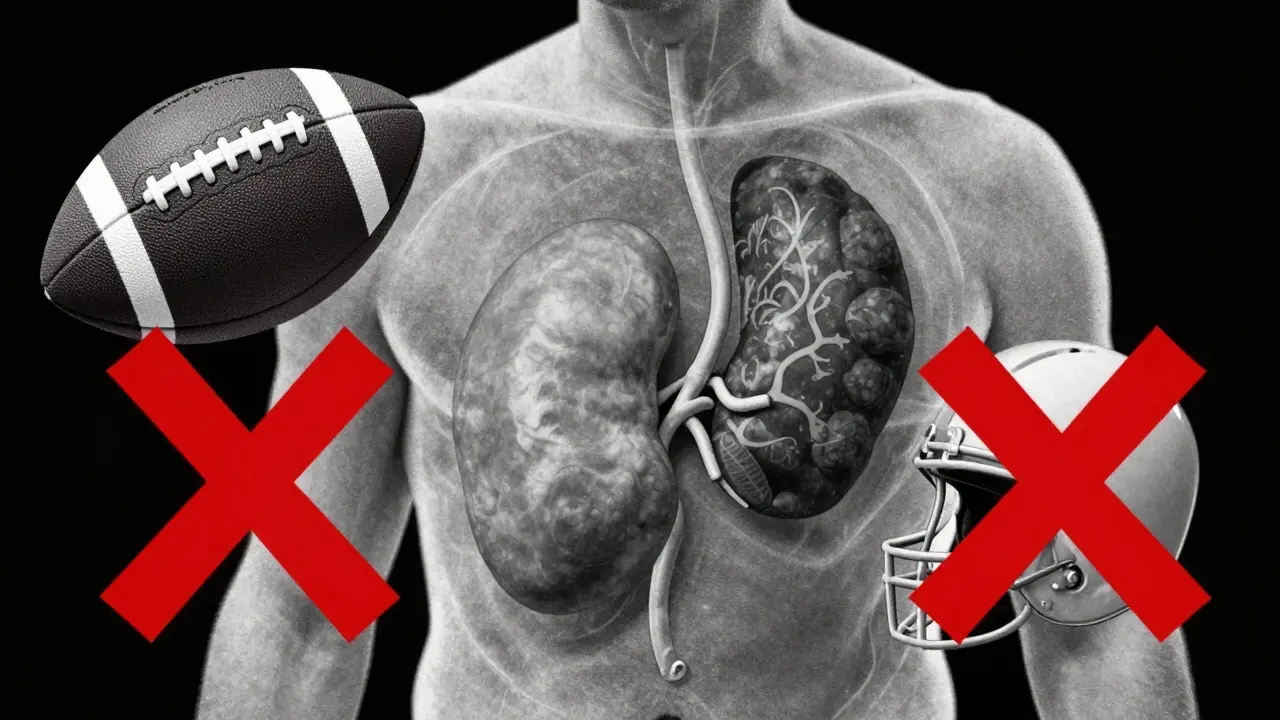
If there is one thing you must take seriously, it is the spleen. When you have mono, your spleen can swell. Because it sits just under your ribcage, it becomes vulnerable. A hard hit to the abdomen-like during a football game or even a clumsy fall-could cause the spleen to rupture. This is a medical emergency involving internal bleeding.
The general rule of thumb is to avoid all contact sports for at least four weeks after your diagnosis. Some doctors prefer to use an ultrasound to confirm the spleen has returned to its normal size before clearing you for activity. While rupture only happens in a small fraction of cases (0.1-0.5%), the risk is high enough that the American College of Sports Medicine maintains strict guidelines on return-to-play protocols.
Mastering the Recovery: Managing the Fatigue
The hardest part of mono isn't the fever; it's the recovery. Many people experience a "wave" pattern-you feel great for three days, think you're cured, try to go back to full-time work or school, and then crash for a week. This is why a structured approach to energy is vital.
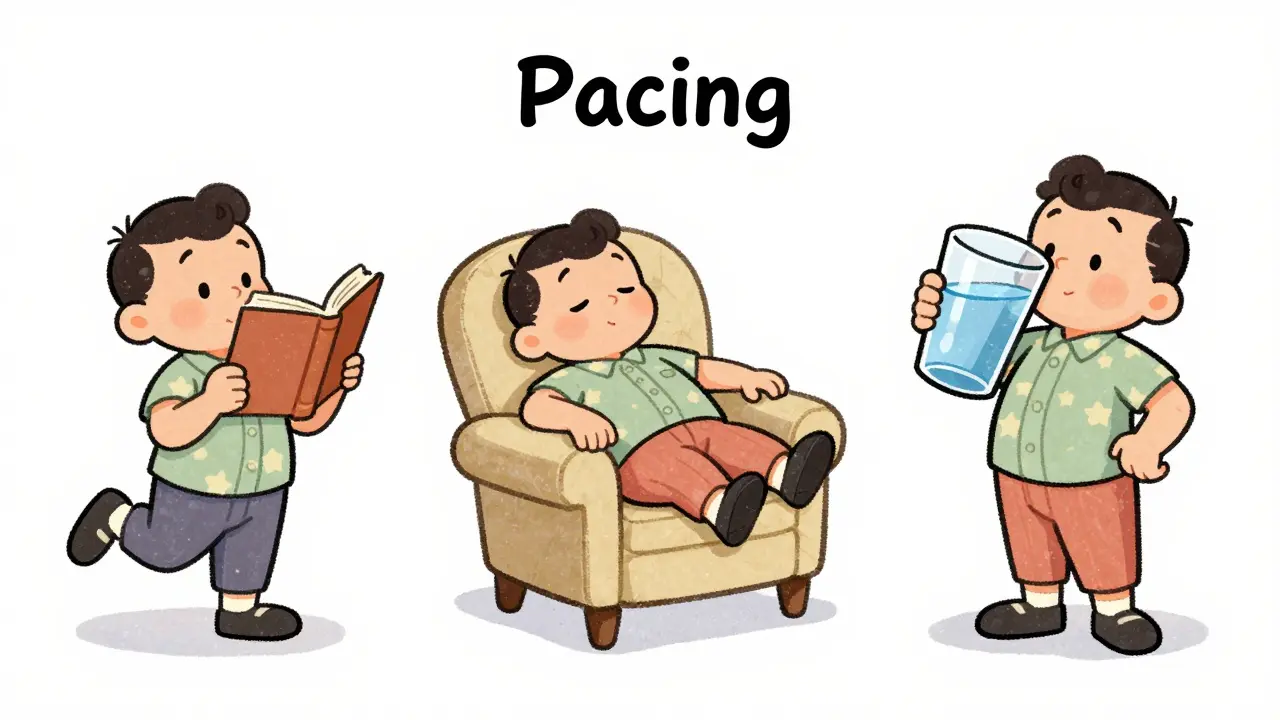
One effective method is the "Pacing, Prioritizing, Planning" strategy. Instead of trying to do everything, start at 50% of your normal capacity. If you used to study for four hours, try two. Increase your activity by about 10% each week, but only if you don't feel a flare-up of symptoms. Some patients swear by the "20-20-20 rule": 20 minutes of activity, 20 minutes of rest, and 20 ounces of water. It keeps you hydrated and prevents you from hitting that dreaded wall of exhaustion.
For the rare few who experience "long-haul" fatigue lasting beyond six months, some research suggests low-dose naltrexone can help, though this should only be done under strict medical supervision.
Treatment and Diagnosis
Since you can't "kill" a virus with antibiotics, treatment is all about making you comfortable. Use acetaminophen for the fever and pain. Be cautious with heavy NSAIDs if your doctor mentions a low platelet count, as this can increase bleeding risks. Throat lozenges and saltwater gargles are your best friends for the pharyngitis.
Getting a diagnosis usually starts with a Monospot Test is a rapid blood test that looks for heterophile antibodies produced during a mono infection. However, this test can be wrong in the first week of illness. If it's negative but you feel terrible, your doctor might order a more specific EBV antibody panel. This looks for VCA-IgM (which shows you're currently sick) and EBNA (which shows you've had it in the past).
Can you get mono more than once?
Technically, the virus stays in your body forever. While it is very rare to have a second full-blown episode of infectious mononucleosis, the virus can reactivate, especially if your immune system is severely weakened.
How long is someone contagious with mono?
You can spread EBV before symptoms even start. Generally, people are most contagious during the first few months of infection, but some can shed the virus in their saliva for six months or more.
Does mono lead to other health problems?
For most, it's a temporary nuisance. However, there is a very small risk of malignancies like Hodgkin lymphoma. More recently, studies have suggested a link between EBV and an increased risk of developing Multiple Sclerosis (MS), though the absolute risk for any one person remains extremely low.
Can antibiotics help if I have a secondary infection?
Yes. While antibiotics don't treat the mono virus, it is possible to develop a secondary bacterial infection (like a sinus infection) while your immune system is down. In those specific cases, a doctor may prescribe antibiotics.
When should I see a doctor immediately?
Seek emergency care if you experience sudden, sharp pain in the upper left side of your abdomen (a sign of spleen rupture) or if your throat swells so much that you have difficulty breathing.
Next Steps for Recovery
If you've just been diagnosed, your priority is a strict schedule of rest. Don't try to "power through" your school or work obligations; doing so often prolongs the illness. If you are an athlete, get an ultrasound of your spleen before returning to the field. For those struggling with lingering fatigue, keep an activity log to track what triggers your crashes. If your fatigue doesn't improve after two months, schedule a follow-up to rule out other complications or nutritional deficiencies that can mimic mono fatigue.