
Meningitis isn’t just a headache with a fever. It’s an inflammation of the membranes around your brain and spinal cord-and it can kill within hours if ignored. While some forms are mild, others strike fast and hard, leaving survivors with permanent damage like hearing loss or brain injury. The good news? We have powerful tools to stop it before it starts. Vaccines have slashed cases by up to 99% in places where they’re widely used. But knowing the signs and understanding which vaccines work for which type is critical.
What Causes Meningitis? Five Main Types
Meningitis isn’t one disease. It’s five different conditions with different causes, risks, and treatments. The biggest divide is between infectious and non-infectious forms.Bacterial meningitis is the most dangerous. It’s caused by germs like Neisseria meningitidis (meningococcus), Streptococcus pneumoniae (pneumococcus), and Haemophilus influenzae type b (Hib). These bugs spread through respiratory droplets-coughs, kisses, sharing drinks. Symptoms can go from mild to life-threatening in under 24 hours. Even with treatment, 5-30% of people die. Survivors often face long-term issues like seizures or learning problems.
Viral meningitis is far more common, making up about 85% of all cases. Most are caused by enteroviruses-the same viruses that give you a stomach bug. It’s uncomfortable: fever, headache, nausea-but rarely deadly. People usually recover in 7-10 days without special treatment. Still, it’s easy to mistake for the flu, which is why so many delay care.
Fungal meningitis is rare and mostly hits people with weakened immune systems-like those on chemotherapy or with HIV. The main culprit is Cryptococcus neoformans. It’s not contagious. You get it by breathing in spores from soil or bird droppings. This form kills about 81% of untreated cases, and even with treatment, outcomes are poor.
Parasitic meningitis is extremely rare outside Southeast Asia and the Pacific. It’s caused by a worm called Angiostrongylus cantonensis, usually from eating raw or undercooked snails, slugs, or contaminated produce. Symptoms can last weeks and include intense headaches and nerve pain.
Non-infectious meningitis isn’t caused by germs at all. It can come from autoimmune diseases like lupus, certain cancer treatments, or reactions to medications like NSAIDs or antibiotics. It’s less common but still needs medical attention because it can mimic infection.
What Do the Symptoms Really Look Like?
You’ve probably heard the classic trio: fever, stiff neck, and confusion. But here’s the truth-only 41% of people with bacterial meningitis show all three. In fact, nearly a third of adults and half of kids don’t have a stiff neck at all.More reliable signs include:
- High fever (over 101.3°F or 38.5°C)
- Severe, unrelenting headache
- Sensitivity to bright light
- Nausea or vomiting
- Confusion, trouble focusing, or extreme sleepiness
For bacterial meningitis, especially meningococcal, there’s one red flag that’s hard to ignore: a rash. It starts as tiny red or purple spots that don’t fade when you press a glass against them. That’s a sign of bleeding under the skin. But here’s the catch-this rash only appears in 50-75% of cases. Waiting for it means waiting too long.
Other warning signs: seizures, cold hands and feet, rapid breathing, or extreme pain in the legs or back. Babies might look different-irritable, floppy, refusing to feed, or having a bulging soft spot on their head.
Doctors check for two physical signs: Brudzinski’s sign (your knees bend when you lift your head) and Kernig’s sign (pain when you straighten your leg while lying down). But these aren’t always present. That’s why if you suspect meningitis, don’t wait for a textbook case. Get checked immediately.
How Vaccines Stop Meningitis Before It Starts
Vaccines are the single biggest reason meningitis deaths have dropped so dramatically. In the U.S., vaccines prevent about 1,000 cases every year. In Africa’s meningitis belt, the MenA vaccine cut cases by 99% between 2010 and 2021.There are four key vaccines:
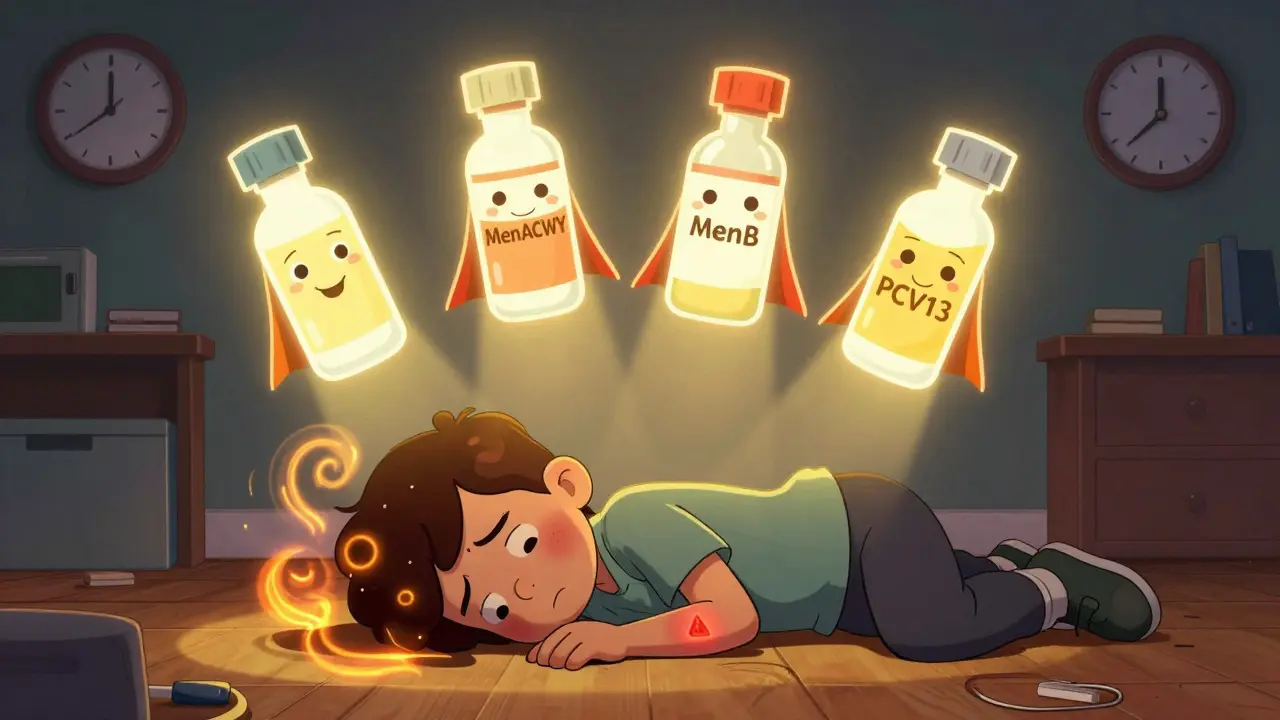
- MenACWY (Menveo, MenQuadfi): Protects against four deadly strains-A, C, W, Y. Recommended for all kids at age 11-12, with a booster at 16. If you get your first dose between 13-15, you still need a booster before 18. Effectiveness: 80-85%.
- MenB (Bexsero, Trumenba): Targets serogroup B, which causes about 30% of U.S. cases in teens and young adults. Previously only for high-risk groups, but as of early 2024, the CDC now recommends it for all adolescents 16-18. Effectiveness: 60-70%.
- PCV13 (Prevnar 13): Protects against pneumococcal meningitis in children under 5. Given at 2, 4, 6, and 12-15 months. Reduces disease by 80% in this age group.
- Hib: Almost eliminated Hib meningitis in countries with routine shots. Kids get it at 2, 4, 6, and 12-15 months. Incidence dropped by 99%.
College students living in dorms are at higher risk-3 to 5 times more likely to catch meningococcal disease. That’s why many U.S. colleges require proof of MenACWY vaccination. Some now require MenB too.
These vaccines are safe. In a study of 3.5 million children, 97% of parents reported being satisfied. Side effects? Mostly soreness at the injection site or a low fever that lasts less than two days.
What If You’ve Been Exposed?
If someone close to you-like a roommate, family member, or partner-is diagnosed with bacterial meningitis, you need antibiotics fast. This is called post-exposure prophylaxis.Drugs like ciprofloxacin or rifampin can reduce the chance you’ll get sick from 1-5% down to less than 0.1%. But timing matters. If you wait more than 24 hours after exposure, the protection drops sharply.
Health departments usually identify contacts and offer antibiotics automatically. But if you’re worried, call your doctor or local health agency right away. Don’t wait for them to reach out.
Non-Vaccine Ways to Lower Your Risk
Vaccines are the strongest shield, but hygiene helps too.- Wash your hands often, especially before eating or after coughing.
- Don’t share drinks, utensils, toothbrushes, or lip balm.
- If you’re pregnant, avoid unpasteurized dairy and undercooked meats-listeria can cause meningitis in newborns.
- Keep your immune system strong. Sleep, eat well, manage stress.
These won’t stop meningitis completely, but they cut transmission risk by 30-50%. In crowded places like dorms or military barracks, small habits make a big difference.
Why Delaying Care Is So Dangerous
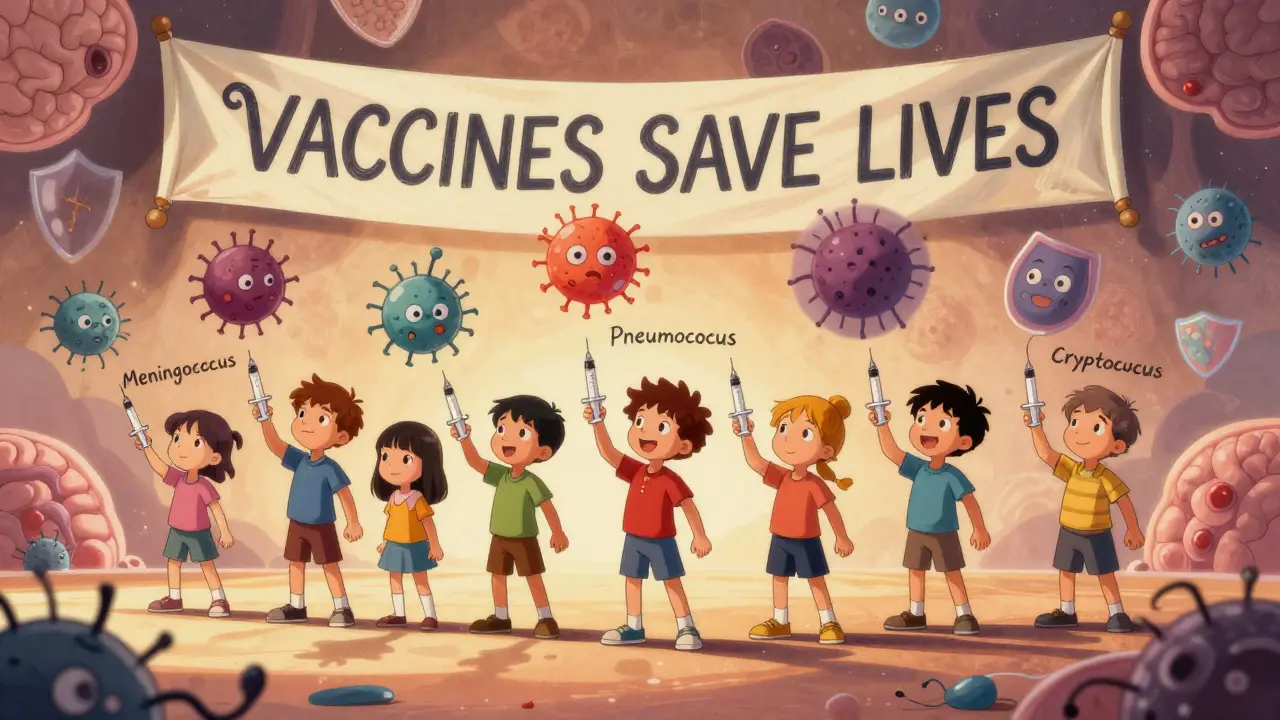
The biggest mistake people make? Waiting. A CDC study found that if treatment starts more than 4 hours after symptoms begin, death risk jumps from 5% to 21%. Survivors are more likely to have lasting damage.On Reddit and patient forums, a common theme emerges: people thought it was the flu. Or a migraine. Or just exhaustion. One parent on the National Meningitis Association’s survey said, “I didn’t realize the rash wasn’t always there.” Another said, “The ER doctor told me it was just a virus.”
That’s why awareness matters. You don’t need to be an expert-you just need to trust your gut. If you or someone you love has a sudden fever, bad headache, and feels worse than any illness before, go to the ER. Don’t wait for the rash. Don’t wait to see your doctor tomorrow. Get checked now.
What’s Next? The Future of Meningitis Prevention
The good news keeps coming. In 2024, the WHO approved a new low-cost MenACWY vaccine priced at just $0.50 per dose-set to roll out across Africa. A new universal meningococcal vaccine, tested in Phase II trials, showed 92% effectiveness against all known strains. That could one day replace all current shots.But challenges remain. Antibiotic resistance in pneumococcus is rising. In the U.S., penicillin-resistant strains jumped from 15% in 2010 to 32% in 2023. That means doctors now have to use stronger, broader-spectrum antibiotics right away.
Cost is still a barrier. In the U.S., MenB vaccines can cost $105-$150 per dose. In low-income countries, access is limited. Global efforts like the WHO’s “Defeating Meningitis by 2030” plan aim to cut cases by half and deaths by 70%-but funding and distribution must improve.
For now, the best defense is simple: know the signs. Get vaccinated. Act fast. Meningitis used to be a death sentence. Now, with the right tools, it’s preventable.
Todd Scott
December 28, 2025 AT 04:40I’ve been working in public health for over 15 years, and I still get chills reading stats like the 99% drop in meningococcal cases after the MenA vaccine rolled out in Africa. It’s not just about shots-it’s about equity. In some rural Nigerian villages, kids used to die before their parents could even get them to a clinic. Now, with door-to-door campaigns and cold-chain logistics, entire communities are protected. The WHO’s new $0.50 vaccine? That’s not just a price tag-it’s a lifeline. We need to push for global access like we did with polio. This isn’t charity. It’s justice.
And yes, I know people think vaccines are overhyped, but when you’ve seen a 3-year-old with meningococcemia on a ventilator, you don’t debate. You vaccinate.
Also, side note: the non-infectious types are way more common than people realize. I had a patient last year who got it from an NSAID reaction. No infection. Just a misfired immune system. Doctors miss it all the time because they’re looking for fever and stiff necks. Always consider meds and autoimmune history.
And don’t get me started on how colleges still don’t require MenB. My niece got it sophomore year. She lost her hearing in one ear. The vaccine was ‘optional.’ That’s not an option.
Bottom line: vaccines aren’t perfect, but they’re the closest thing we have to a force field against this nightmare.
Also, if you’re in college, get the MenB shot even if your school doesn’t require it. Seriously. It’s worth every penny.
And yes, I’m that guy who brings vaccine cards to parties. You’re welcome.
Andrew Gurung
December 29, 2025 AT 04:18Oh wow, another ‘vaccines save lives’ lecture 🙄
Let me guess-you also think fluoride is magic and sunscreen is a human right? 😒
Meanwhile, in the real world, people are getting autoimmune flares from these shots and no one’s talking about it. Oh wait-they are, but the CDC just deletes the threads. 🤫
And let’s not forget the 2012 CDC whistleblower who said they buried data on adverse events. 📉
Also, meningitis is just nature’s way of culling the weak. 🤷♂️
My cousin had it. He didn’t get vaccinated. He’s fine now. So there.
Also, why are we giving babies 4 shots before they can even hold their heads up? 🤔
Just saying… maybe we’re overdoing it. 😘
Paula Alencar
December 31, 2025 AT 00:05It is with profound respect for the sanctity of human life and the rigorous science underpinning modern immunology that I feel compelled to offer a thoughtful reflection on this essential public health discourse.
The narrative surrounding meningitis, as presented here, is not merely informative-it is a clarion call to societal responsibility. The fact that we have, as a species, engineered vaccines capable of reducing mortality by up to 99% represents one of the most luminous achievements in medical history.
Yet, the resistance to vaccination, often rooted in misinformation and fear, is not simply a personal choice-it is a collective failure of empathy. When one chooses not to vaccinate, they are not merely declining a shot; they are, in effect, becoming an unwitting vector for preventable tragedy.
I must emphasize: the rash is not a prerequisite for diagnosis. The absence of a stiff neck does not negate the presence of bacterial invasion. The delay in seeking care, often rationalized as ‘it’s just the flu,’ is a dangerous illusion that costs lives daily.
Furthermore, the global disparity in vaccine access is a moral indictment of our current systems. The $0.50 vaccine developed for Africa is not a miracle-it is a moral imperative. Why, then, do we still treat health as a commodity rather than a right?
And to those who dismiss this as alarmist rhetoric-I invite you to sit with a grieving parent whose child lost their hearing, their mobility, or their mind to a disease that could have been erased with a single needle.
Let us not be the generation that had the tools-and chose to look away.
With deep conviction,
Paula
John Barron
December 31, 2025 AT 04:27Okay, let’s be real for a second. The MenB vaccine? Yeah, it’s 60-70% effective. That’s not great. And the price? $150 a pop? Are you kidding me? My insurance won’t cover it unless I’m ‘high risk’-but what does that even mean? A college freshman living in a dorm with 300 other people? That’s not ‘high risk’? That’s a petri dish.
And don’t get me started on the fact that we still don’t have a universal meningococcal vaccine. We’re giving kids four different shots for different strains like we’re playing vaccine bingo. It’s ridiculous.
Also, the CDC’s ‘recommendation’ for MenB is just a suggestion. No mandate. No enforcement. Just ‘hey, maybe do this if you feel like it.’ That’s not public health. That’s wishful thinking.
And the antibiotic resistance spike? 32% now? That’s a ticking bomb. We’re already in the post-antibiotic era for some strains. We need new drugs, not more hand-washing pamphlets.
Meanwhile, the pharma companies are raking in billions while parents are forced to choose between rent and a shot for their kid. This isn’t medicine. It’s capitalism with a stethoscope.
Also, I had a friend who got bacterial meningitis in 2019. He survived. But his spleen? Gone. His kidneys? Damaged. He’s 24. He’ll be on meds for life. And he got it because he thought ‘it’s just a bad cold.’
So yeah. Get the shot. But also-demand better. Demand cheaper. Demand universal coverage. Because this isn’t about ‘personal responsibility.’ It’s about systemic failure.
And yes, I cried when I read the part about babies with bulging fontanelles. I’m not ashamed.
Gerald Tardif
January 1, 2026 AT 09:21Man, I wish I’d read this before my sister’s wedding last year. We were all dancing, drinking outta the same punch bowl, kissing cousins-it was a mess. Then my cousin’s 12-year-old got sick. Fever, headache, threw up. We thought it was food poisoning. Turned out it was viral meningitis. Took her two weeks to feel normal again.
She’s fine now, but holy hell-it scared the crap outta me. I didn’t even know meningitis could be viral. Thought it was all ‘deadly bacteria’ like in the movies.
Anyway, I got the MenACWY shot last week. Cost me $45 at the pharmacy. No insurance hassle. Felt like a superhero walking out.
Also, don’t share drinks. Just don’t. Even if it’s your best friend. Even if you’ve known them since kindergarten. That’s just basic hygiene now. Like not licking doorknobs. 🤷♂️
Monika Naumann
January 3, 2026 AT 02:11How can a nation that permits the consumption of pork and alcohol claim to care about health? In India, we have lived with natural immunity for centuries. Why import Western pharmaceutical propaganda? Our Ayurvedic herbs, turmeric, and giloy have protected our children for generations. This vaccine narrative is a colonial relic disguised as science.
Furthermore, your statistics are biased. You cite only American data. In India, meningitis cases are rare and mostly linked to poor sanitation-not lack of vaccines. Clean water and hygiene are the true solutions.
Why do Western nations push vaccines so aggressively? Is it to profit? To control? To erase traditional wisdom?
Our ancestors survived plagues without needles. We can too.
Do not mistake tradition for ignorance.
With respect to truth, not fear,
Monika
Elizabeth Ganak
January 4, 2026 AT 15:45omg i just read this and i’m so glad i got my menb shot last month 😭 my roommate had meningitis last year and she was in the hospital for 10 days. i was terrified. now i’m like, okay, i did my part. also, i stopped sharing water bottles with my squad. like, never again. even if they’re my besties. 🙃
Nicola George
January 6, 2026 AT 09:28So let me get this straight-we’ve got a disease that kills in hours, vaccines that work like 99% of the time, and people still think it’s ‘natural’ to catch it like a cold? 🤦♀️
Meanwhile, in South Africa, we’re still fighting for basic access to the MenACWY shot in townships. But hey, let’s all just wash our hands and pray, right? 😒
Also, the guy who said ‘nature culls the weak’? Honey, you’re not in a Darwin documentary. You’re on Reddit. And your comment is the real threat to public health.
Get the shot. Stop sharing drinks. And if you’re still on the fence? Go hug someone who lost a kid to this. Then come back.
Love you, but no.
-Nicola