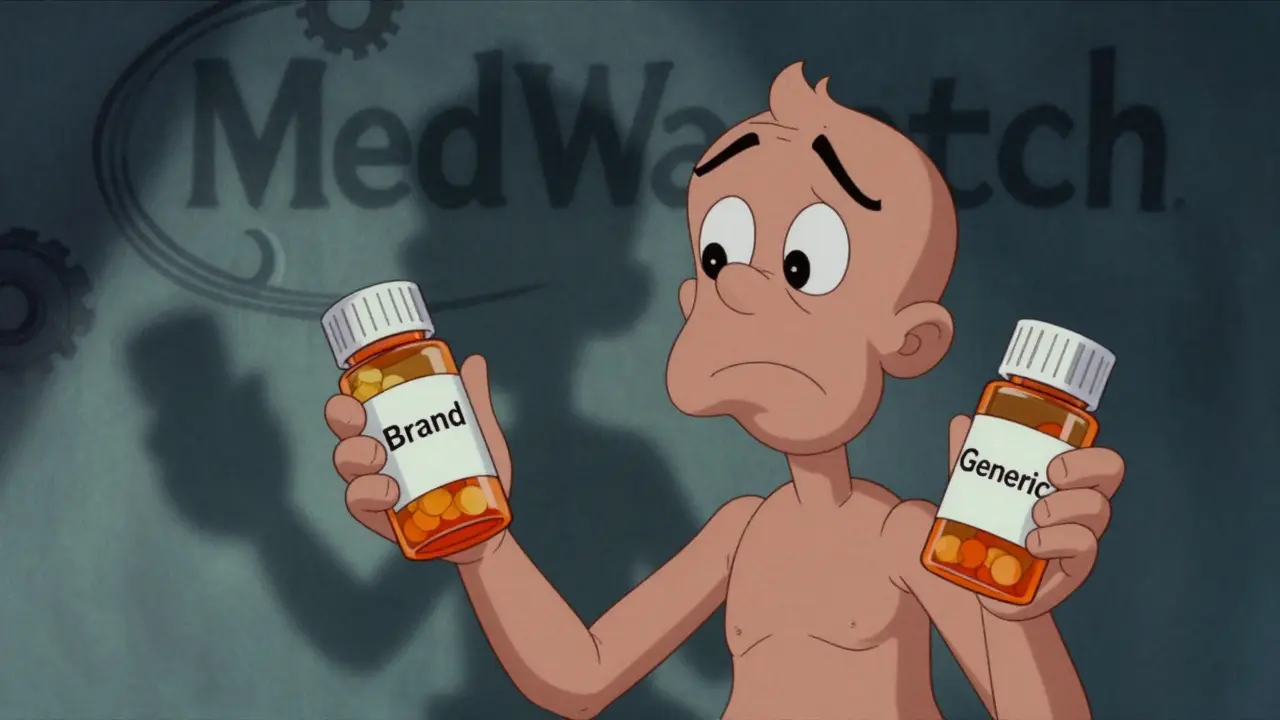
Switching from a brand-name medication to its generic counterpart is supposed to be seamless. You save money, the active ingredient is identical, and your health shouldn't change. But what happens when it does? When you feel different side effects, or the medicine just doesn't seem to work as well, who do you tell? The answer lies in a system that handles millions of reports but struggles with one specific detail: identifying exactly which generic version caused the problem.
This is where MedWatch, the FDA's safety reporting program, comes into play. It is the backbone of post-marketing surveillance in the United States, yet for generic drugs-which make up about 90% of prescriptions filled-it faces unique challenges. Understanding how this data is collected, processed, and used can help patients and healthcare providers ensure their voices are heard and safety signals are detected early.
Understanding MedWatch and Its Role in Generic Drug Safety
MedWatch is formally known as the FDA Safety Information and Adverse Event Reporting Program. Established in 1993, it serves as the primary voluntary reporting system for medical products, including prescription drugs, over-the-counter medicines, biologics, devices, and supplements. For generic drugs specifically, MedWatch acts as a critical safety net after these medications hit the market.
While generic drugs must demonstrate bioequivalence to their brand-name counterparts-meaning they deliver the same amount of active ingredient into the bloodstream within a similar timeframe-they may differ in inactive ingredients like fillers or dyes. These differences can occasionally lead to variations in how patients react. MedWatch allows anyone, from consumers to doctors, to report these discrepancies. The data feeds directly into the FDA Adverse Event Reporting System (FAERS), a massive database containing over 9 million reports on adverse events and medication errors as of 2023.
The significance of this system for generics was highlighted in recent research. A 2022 study published in PMC noted a sharp increase in patient-reported concerns regarding generic safety over the last five years. Despite generics comprising the vast majority of prescriptions, distinguishing them accurately in safety reports has historically been difficult. This gap matters because if we cannot identify which specific manufacturer’s generic product is linked to an issue, we cannot address the root cause effectively.
How Safety Data Is Collected: The Reporting Process
Reporting an adverse event related to a generic drug through MedWatch is designed to be accessible. The online portal at www.fda.gov/MedWatch is the primary mechanism, though paper forms (Form FDA 3500) are still available. The process requires minimal technical skill; you need only an internet connection and a standard web browser. However, the quality of the data depends heavily on the information provided by the reporter.
When submitting a report, especially for generics, certain details are crucial. The FDA encourages reporters to include as much detail as possible, including:
- The exact name of the drug (generic name first, followed by "generic" and the manufacturer if known).
- A clear description of the adverse event or problem.
- Patient demographics and medical history.
- Clinical outcomes and relevant lab results.
- The National Drug Code (NDC) number found on the packaging.
The NDC code is particularly important for generics. It uniquely identifies the specific manufacturer and strength of the medication. Unfortunately, analysis of 2023 data showed that only 28.3% of consumer-submitted reports included the NDC code. In contrast, 89.4% of brand-name reports correctly identified the manufacturer. This discrepancy creates a blind spot in pharmacovigilance, making it harder to track issues tied to specific generic producers.

Challenges in Distinguishing Generic Products
One of the most persistent hurdles in generic drug safety monitoring is identification. Dr. Robert Reynolds, Director of the FDA's Division of Pharmacovigilance, stated in a 2024 video that distinguishing between brand and generic products remains a major data quality challenge. Many patients do not realize that different pharmacies may dispense generics from different manufacturers, even for the same prescription.
This confusion leads to underreporting bias. Dr. Sarah Thompson, a pharmacovigilance expert at Harvard Medical School, noted in a 2023 JAMA Internal Medicine commentary that the voluntary nature of MedWatch means many generic-specific issues go unreported. Patients often assume all generics are identical and fail to specify which version they took when experiencing side effects.
Furthermore, the FAERS database structure, while robust, adheres to international guidelines (ICH E2B) that prioritize broad categorization. It consists of seven data tables covering patient demographics, drug details, adverse events, and outcomes. However, without specific fields for generic manufacturer identification in older reports, researchers had to develop algorithms to separate generic from brand data. A 2022 study described an algorithm achieving 92.4% sensitivity in distinguishing generics, which was integrated into FAERS processing in January 2024. This technological upgrade significantly improves the ability to analyze generic-specific safety signals.
Real-World Impact: From Reports to Regulatory Action
Despite these challenges, MedWatch plays a vital role in detecting safety issues. Consider the case of bupropion XL in 2022. Multiple MedWatch reports flagged therapeutic failure with a specific generic version manufactured by Mylan. These reports triggered an FDA investigation, leading to labeling changes within 11 months. This example demonstrates how aggregated patient and professional reports can drive regulatory action, even for widely used generics.
However, not every report leads to immediate change. On pharmacy forums, professionals share mixed experiences. One pharmacist reported submitting 17 MedWatch reports for generic levothyroxine issues over three years, receiving responses to only two, though one did result in a label update. Patient frustration is also common. A user on Drugs.com noted that the MedWatch form lacked a field to specify the generic manufacturer, forcing them to report simply as "generic sertraline." Such limitations highlight the need for better user guidance and system design.

Practical Tips for Effective Reporting
If you suspect a generic medication is causing issues, your report can make a difference if done correctly. Here are actionable steps to ensure your data contributes meaningfully to safety monitoring:
- Check the Packaging: Look for the manufacturer's name and the NDC code on the bottle box or label. Write these down before discarding the packaging.
- Be Specific: Do not just write "generic ibuprofen." Write "ibuprofen (generic), manufactured by [Company Name]." If you don't know the manufacturer, note that explicitly.
- Document Symptoms: Record when symptoms started, their severity, and any other medications you were taking. Include dates of drug therapy start and end.
- Use the Online Portal: The digital form is faster and reduces transcription errors compared to paper submissions. It also guides you through required fields more effectively.
- Consult Your Pharmacist: Pharmacists are trained in generic identification. They can help verify the manufacturer and submit detailed reports on your behalf if needed.
Healthcare professionals also face time constraints, with 71% of pharmacy respondents in a 2024 ASHP survey citing difficulty completing detailed reports. Yet, their involvement is crucial. Physicians and pharmacists provide clinical context that patients might miss, such as potential drug interactions or underlying conditions affecting the reaction.
Future Developments in Generic Safety Monitoring
The landscape of pharmacovigilance is evolving. The FDA launched the Generic Drug User Fee Amendments (GDUFA) III action plan in 2023, committing to enhance the identification of safety signals for generics. By 2026, MedWatch plans to integrate with electronic health record (EHR) systems. This integration aims to automatically capture NDC codes and manufacturer information, reducing reliance on manual entry and improving data accuracy.
Industry analysts project a 22% increase in generic-specific adverse event reports by 2027 as identification methods improve. Meanwhile, the European Medicines Agency’s EudraVigilance system has already implemented more robust generic identification protocols since 2022, setting a benchmark for global standards. As these systems mature, the gap between brand and generic safety monitoring should narrow, ensuring that the high volume of generic prescriptions translates into equally high levels of safety oversight.
What is MedWatch and why is it important for generic drugs?
MedWatch is the FDA's voluntary reporting system for adverse events and product problems. For generic drugs, it is crucial because it helps detect safety signals that may not have appeared during pre-market testing. Since generics make up 90% of prescriptions, effective monitoring ensures that differences in inactive ingredients or manufacturing processes do not compromise patient safety.
How do I find the manufacturer of my generic medication?
The manufacturer's name and the National Drug Code (NDC) are printed on the medication bottle label and the outer packaging. The NDC is a unique identifier that specifies the manufacturer, product strength, and package size. Keeping this information handy is essential for accurate reporting to MedWatch.
Why is it difficult to distinguish between generic brands in safety reports?
Many patients and even some healthcare providers assume all generics are identical and do not record the specific manufacturer. Additionally, older versions of reporting forms lacked dedicated fields for generic manufacturer details. This leads to data gaps where reports list only the generic drug name without specifying which company produced it, making it hard to trace specific safety issues.
Can reporting a generic drug issue lead to regulatory action?
Yes. Aggregated reports can trigger FDA investigations. For example, multiple reports of therapeutic failure with a specific generic bupropion led to an FDA review and subsequent labeling changes. While individual reports may not always result in immediate action, they contribute to the broader dataset used to identify trends and risks.
What improvements are coming to MedWatch for generic drug reporting?
The FDA is integrating MedWatch with electronic health records by 2026 to automatically capture manufacturer data and NDC codes. Additionally, enhanced algorithms introduced in 2024 improve the ability to distinguish generic from brand-name drugs in existing databases. These changes aim to reduce underreporting and increase the specificity of safety data for generics.