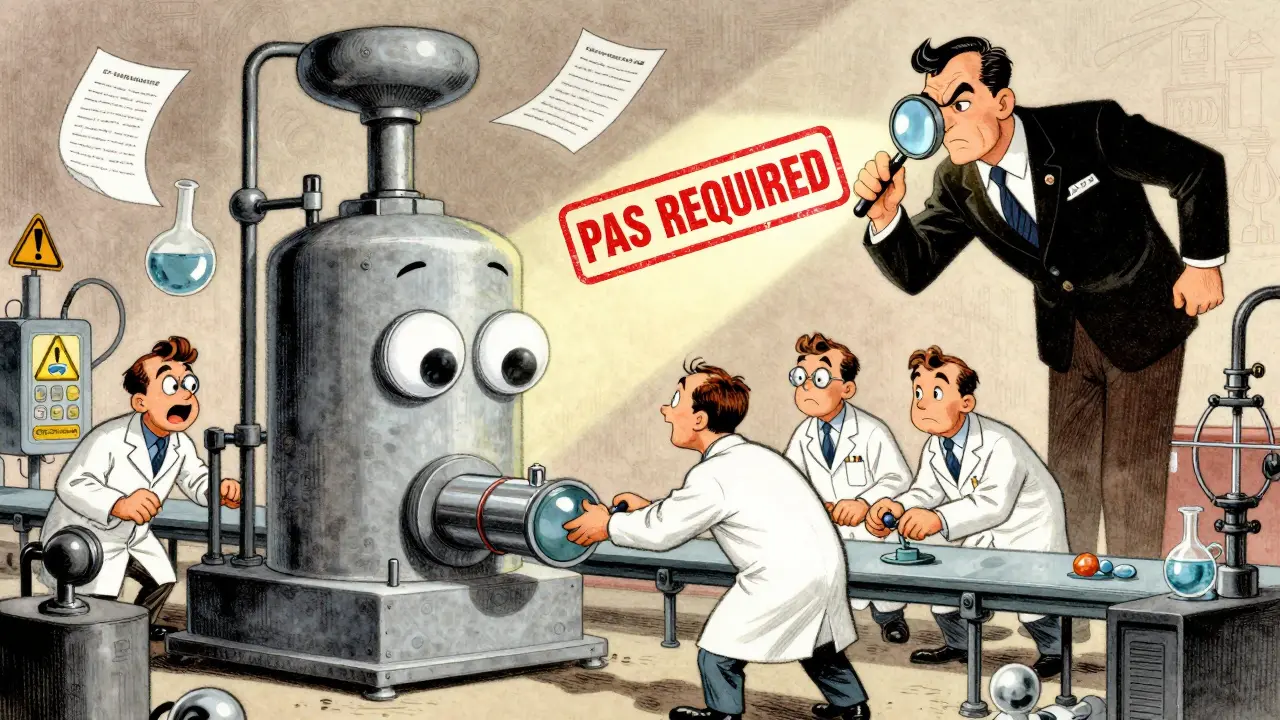
When a pharmaceutical company changes a single piece of equipment in its production line, it’s not just a maintenance update. It’s a regulatory event. Even a small tweak-like swapping out a mixer or moving a filling station-can trigger a chain of legal and scientific obligations. In the world of drug manufacturing, manufacturing changes aren’t optional adjustments. They’re controlled, documented, and often require formal approval before the product can even leave the facility.
Why Manufacturing Changes Are Heavily Regulated
Every drug approved by the FDA, EMA, or Health Canada has a specific recipe and process behind it. That recipe includes not just the active ingredient, but also the exact equipment, environment, and procedures used to make it. Change any of those elements, and you risk altering the drug’s safety, strength, or how well it works in the body.The goal of the rules isn’t to slow things down-it’s to protect patients. A change in the solvent used to clean equipment might leave traces that affect purity. Switching to a faster tablet press could crush particles differently, changing how fast the drug dissolves. Even moving production from one building to another inside the same campus can introduce new variables.
That’s why regulators require manufacturers to prove, before making a change, that the final product is still the same drug. Not “close enough.” Not “probably fine.” The same drug. This is called comparability.
The Three-Tier System: What You Must Report and When
In the U.S., the FDA uses a clear three-tier system to classify manufacturing changes under 21 CFR 314.70. This isn’t just paperwork-it’s a risk-based decision tree every manufacturer must follow.- Major Changes (Prior Approval Supplement - PAS): These are changes with a high chance of hurting product quality. Examples include switching the chemical synthesis route for the active ingredient, bringing in a new factory to make the drug, or replacing a critical piece of equipment that affects temperature, pressure, or mixing time. You cannot make this change until the FDA approves it. That process can take 6-12 months. If you move forward without approval, the FDA can seize your product, issue a warning letter, or shut down your facility.
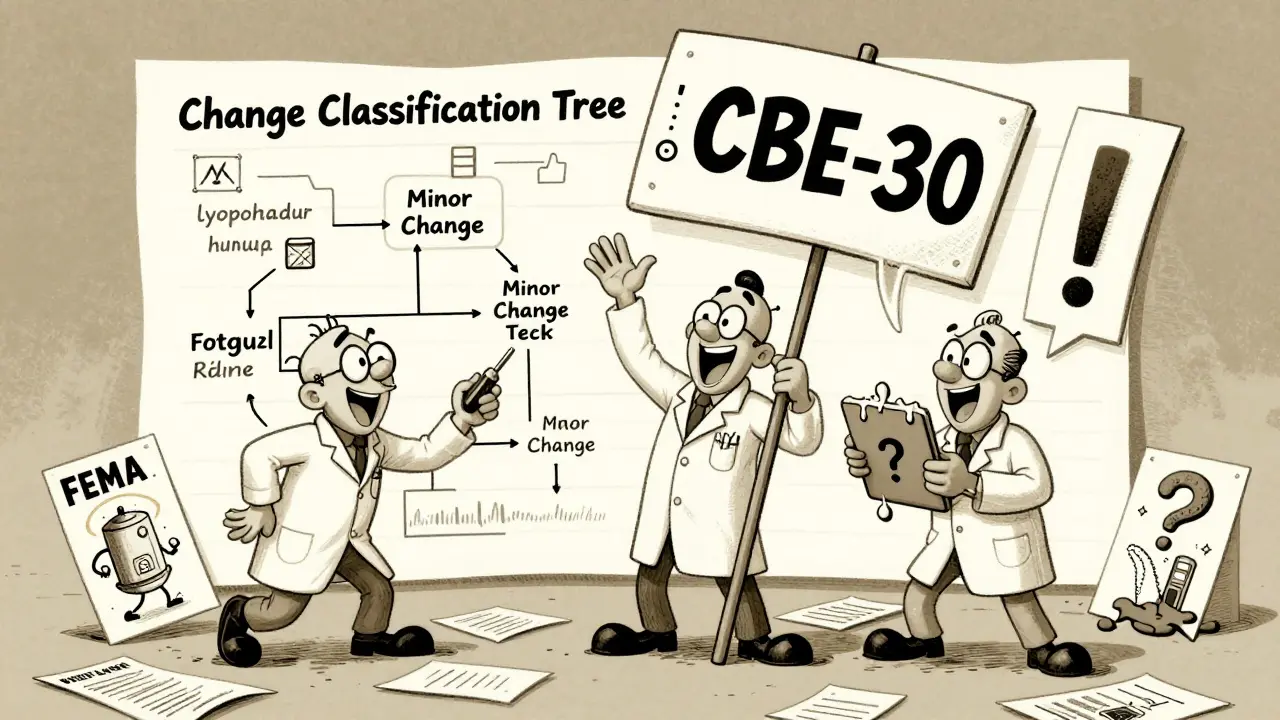
- Moderate Changes (Changes Being Effected in 30 Days - CBE-30): These are changes that could affect quality, but the risk is lower. Think replacing a tablet press with an identical model from the same manufacturer, or changing the supplier of a non-critical excipient. You can implement the change, but you must notify the FDA at least 30 days before distributing the new version. If the FDA disagrees with your classification, they can ask you to stop shipping-so you need strong data to back it up.
- Minor Changes (Annual Report): These are low-risk tweaks with no measurable impact on quality. Moving a labeling station to another corner of the same room, updating software on a non-critical machine, or changing the format of a batch record. You don’t need approval or even advance notice. Just log it in your annual report, due within 60 days of your application anniversary date.
It sounds simple-but in practice, it’s messy. One company spent 37 hours debating whether replacing a tablet press with a newer model from the same brand was a CBE-30 or a PAS. Why? Because the new machine had slightly different compression force settings. Even small differences in pressure can change tablet hardness, dissolution rate, and ultimately, how the drug behaves in the body.
How Other Regions Handle It
The U.S. isn’t the only player. Europe, Canada, and global bodies like the WHO have their own systems, and they don’t always line up.The European Medicines Agency (EMA) uses Type IA, IB, and II changes:
- Type IA: Very minor, you just notify them within 12 months.
- Type IB: Moderate changes-you must get approval before implementing.
- Type II: Major changes-full review, like a PAS.
Health Canada mirrors the U.S. with Level I (prior approval), Level II (notify and wait), and Level III (annual report).
The big difference? The EMA’s Type IA lets you make the change first and tell them later. The FDA doesn’t have that option. That’s why some companies prefer EMA rules for small changes-they’re faster. But if you sell globally, you have to satisfy every regulator. That means designing changes to meet the strictest standard, which is often the FDA’s PAS requirement.
What Counts as “Equivalent” Equipment?
One of the most common-and most misunderstood-categories is equipment replacement. When can you swap a machine without a full approval process?FDA’s 2022 guidance says “equivalent” means three things:
- Same principle of operation (e.g., both are rotary tablet presses)
- Same critical dimensions (e.g., same punch size, die depth)
- Same material of construction (e.g., stainless steel, not plastic)
That’s it. No need to prove the new machine is “better.” Just that it’s the same in ways that matter to product quality.
But here’s the trap: if the new machine runs faster, or has different vibration patterns, or uses a different lubrication system-even if it’s “equivalent”-you might still need a CBE-30. Why? Because those subtle differences can affect how the powder flows, how long it’s exposed to heat, or how uniformly the tablet is compressed.
That’s why companies do risk assessments. Tools like FMEA (Failure Modes and Effects Analysis) are used to map out every possible way a change could go wrong. A senior quality manager at a mid-sized pharma firm told me they once spent 18 months building an internal scoring system that rated each change on 15 factors: impact on CQAs, validation history, supplier reliability, even operator training level. That’s not overkill-it’s survival.
What Happens When You Get It Wrong
The cost of misclassifying a change isn’t just a delay. It’s financial, legal, and reputational.In 2023, the FDA issued four warning letters specifically for misclassified equipment changes. One went to Lupin Pharmaceuticals for replacing a lyophilizer (freeze-dryer) without a PAS. The new machine had a different vacuum system. The FDA found that the change affected moisture content in the final product-potentially reducing shelf life. The company had to halt shipments, recall batches, and pay for additional stability testing.
Another company, Apotex, got a warning letter in 2019 for classifying a major change as moderate. They changed the mixing time for a critical step, but didn’t run comparative batch data. The FDA said: “You assumed it was safe. We require proof.”
Manufacturing change violations made up 22% of all FDA warning letters in 2022. Of those, 37% were linked to equipment changes. That’s not because people are careless. It’s because the system is complex, and the stakes are high.
How Companies Are Adapting
Large companies like Pfizer and Merck have internal systems that go beyond FDA rules. They use risk scoring tools, automated workflows, and centralized databases to track every change across global sites. Their regulatory teams work hand-in-hand with manufacturing, quality, and validation-because no one department can handle this alone.Smaller companies? They struggle. Only 63% of small and mid-sized manufacturers are fully compliant, according to FDA inspection data. Many don’t have the staff, the training, or the budget to run full comparability studies.
That’s where training comes in. Regulatory affairs specialists need an average of 18 months of hands-on experience to classify changes correctly. ASQ certification data shows that even experienced professionals make mistakes-especially with new technologies like continuous manufacturing.
And that’s the next big challenge. Continuous manufacturing-where drugs are made in one long, uninterrupted flow-is becoming more common. But in these systems, changing one machine affects the whole line. That means almost every equipment change now requires a PAS. The FDA has acknowledged this in its 2022 guidance and is working with industry to develop new standards.
What’s Coming Next
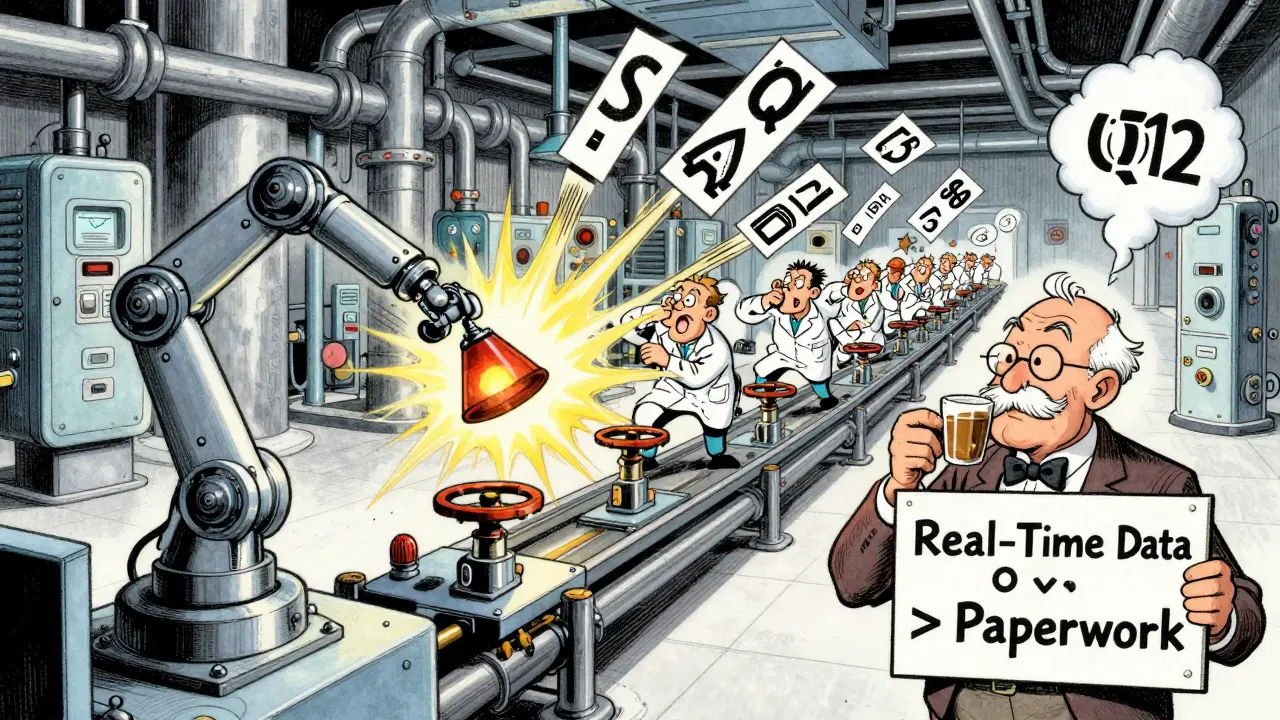
The future of manufacturing changes is about smarter regulation. The FDA’s 2023 draft guidance on quality risk management pushes companies to use data-not just rules-to justify changes. If you can show, through real-time monitoring, that a new machine produces identical product quality, you might not need a full PAS.Six major companies are already testing this in pilot programs. They’re using sensors to track temperature, pressure, and particle size during production-and feeding that data directly into their regulatory filings. By 2025, analysts predict 40% of new change submissions will include this kind of real-time evidence.
Global harmonization is also moving forward. The ICH Q12 guideline, adopted in 2020, aims to make change control consistent across the U.S., Europe, Japan, and Canada. But legal differences mean full alignment won’t happen overnight.
The real win? Fewer surprises. More clarity. Less guesswork. And above all-better, safer medicines.
What happens if I make a manufacturing change without notifying the FDA?
If you make a major or moderate change without the required approval or notification, the FDA can take enforcement actions. This includes issuing a warning letter, seizing your product, ordering a recall, or even halting distribution of your drug. In severe cases, your facility can be shut down. Misclassification is one of the top reasons for regulatory action in the pharmaceutical industry.
Can I use a new machine if it’s faster than the old one?
Speed alone doesn’t determine if a change is major or minor. What matters is whether the change affects critical quality attributes-like tablet hardness, dissolution rate, or particle size. If the faster machine alters any of those, even slightly, you likely need a CBE-30 or PAS. You must test the product from the new machine against the old one and prove comparability.
Do I need to revalidate the entire process after a minor change?
No, you don’t need full revalidation for minor changes. But you still need to document the change and show that it didn’t impact product quality. This usually means collecting data from three consecutive batches made with the new setup and comparing them to historical data. If all critical quality parameters are within acceptable limits, you’re covered.
How long does a Prior Approval Supplement (PAS) take to get approved?
A PAS typically takes 6 to 12 months for the FDA to review. The clock starts when the application is accepted as complete. Complex changes-like new manufacturing sites or changes to biologics-can take longer. You cannot ship the product until the FDA approves the supplement.
Is there a way to avoid the long approval process for equipment changes?
Yes-but only if you stick to minor changes or use the CBE-30 pathway with strong data. You can also request a pre-submission meeting with the FDA to get their opinion on how to classify your change. Many companies do this to avoid costly mistakes. There’s no shortcut, but early communication reduces risk.
What’s the biggest mistake companies make with manufacturing changes?
The biggest mistake is assuming a change is minor because it’s small. A change to a single valve, a new cleaning protocol, or even a different label supplier can affect quality if not properly assessed. The error isn’t in the size of the change-it’s in skipping the risk assessment. Always ask: Could this affect the drug’s safety or effectiveness? If you’re unsure, consult your regulatory team or the FDA.
Lisa McCluskey
January 30, 2026 AT 11:18Claire Wiltshire
January 31, 2026 AT 05:28Mike Rose
January 31, 2026 AT 23:45Niamh Trihy
February 1, 2026 AT 12:43Sazzy De
February 1, 2026 AT 13:10Natasha Plebani
February 2, 2026 AT 11:35Rob Webber
February 2, 2026 AT 16:45calanha nevin
February 4, 2026 AT 07:13owori patrick
February 4, 2026 AT 13:45Darren Gormley
February 6, 2026 AT 06:45Russ Kelemen
February 7, 2026 AT 08:13Diksha Srivastava
February 8, 2026 AT 19:34