
When you take a medication like Humira or Enbrel, you expect it to work the same way every time. But what if the bottle you get today isn’t exactly the same as the one you got last month? That’s not a mistake - it’s normal. For biologics and their copycat versions, called biosimilars, small differences between batches - known as lot-to-lot variability - are built into the science. Unlike generic pills you pick up at the pharmacy, these drugs aren’t simple chemical copies. They’re made from living cells, and that changes everything.
Why Biologics Are Never Identical
Small-molecule drugs, like aspirin or metformin, are made in a lab using chemical reactions. Every tablet is identical because the process is predictable. If you mix the same ingredients in the same way, you get the same result. But biologics? They’re grown inside living cells - yeast, bacteria, or mammalian cells - that act like tiny factories. Even under perfect conditions, those cells don’t produce perfect copies. They make millions of slightly different versions of the same protein.
These differences aren’t random errors. They’re natural outcomes of biology. Think of it like baking bread with sourdough. Two loaves from the same starter can taste slightly different because of tiny shifts in temperature, fermentation time, or even the air in the room. Biologics work the same way. The protein might be the same overall shape, but sugar molecules might stick to it differently. Amino acids might be tweaked. These are called post-translational modifications - and they happen in every batch.
The U.S. Food and Drug Administration (FDA) calls this inherent variation. It’s not a flaw. It’s a fact of life - literally. In one single lot of a biologic, you could have over a million slightly different versions of the same antibody. And that’s okay, as long as those differences don’t change how the drug works in your body.
Biosimilars vs. Generics: The Big Difference
If you’ve heard that biosimilars are like generics for biologics, that’s misleading. Generics are exact copies of small-molecule drugs. The FDA requires them to have the same active ingredient, strength, dosage form, and bioavailability. If a generic pill works, it’s because it’s chemically identical.
Biosimilars? They’re highly similar - but not identical. That’s why they don’t follow the same approval path. Generics use the Abbreviated New Drug Application (ANDA) process. Biosimilars use the 351(k) pathway, created by Congress in 2010. To get approved, a biosimilar maker must prove their product is similar enough to the original - the reference product - in structure, function, safety, and effectiveness. They don’t need to run endless clinical trials, but they must do deep analytical testing to show the variations between their lot and the reference lot are within an acceptable range.
That’s why you won’t see a biosimilar labeled as a “generic.” The FDA is clear: Biosimilars are not generics. They’re a different category entirely. And that distinction matters when it comes to switching between products.
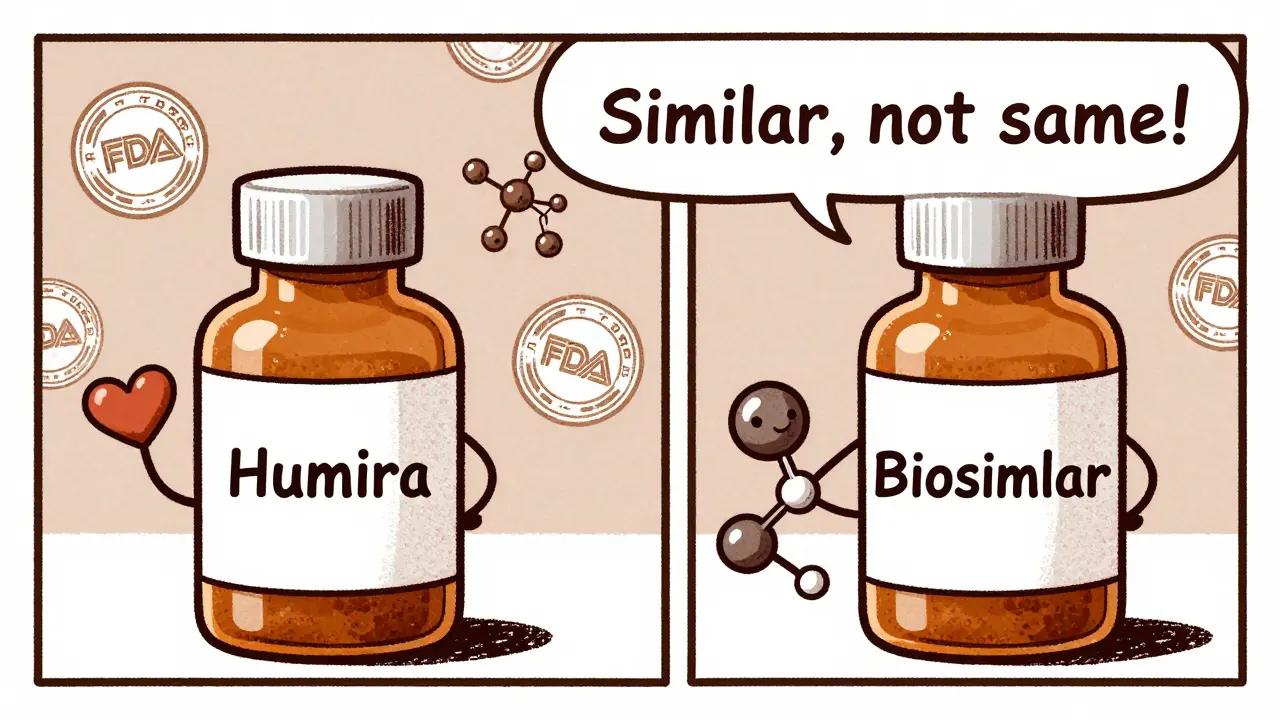
What Makes a Biosimilar Interchangeable?
Some biosimilars have an extra stamp: “interchangeable.” That means a pharmacist can swap it for the brand-name drug without asking the doctor. It’s a big deal. Only 12 out of the 53 approved biosimilars in the U.S. as of May 2024 have this designation.
To earn it, the manufacturer must prove that switching back and forth between the reference product and the biosimilar doesn’t increase risk or reduce effectiveness. That’s not easy. It requires a clinical switching study - where patients alternate between the two drugs multiple times over months - to show no negative impact. The FDA looks at everything: immune response, side effects, lab results. Even small changes in sugar attachments on the protein could trigger an immune reaction in sensitive patients. So the bar is high.
And here’s the catch: even the original biologic has lot-to-lot variability. The reference product isn’t perfect either. The FDA expects that. The question isn’t whether there’s variation - it’s whether the variation between the biosimilar and the reference product is comparable. If the biosimilar’s variation looks just like the original’s, it’s a good sign.
How Manufacturers Control the Chaos
Creating a biologic isn’t like pouring syrup into a bottle. It’s a 6-8 month process involving cell culture, purification, testing, and packaging. At every step, tiny things can shift: temperature, pH, nutrient levels, even the type of bioreactor used. That’s why manufacturers don’t just hope for consistency - they design systems to control it.
They use advanced analytics - mass spectrometry, chromatography, and AI-powered modeling - to map out exactly how each lot differs from the last. They track glycosylation patterns, charge variants, and aggregation levels. These aren’t just lab curiosities. They’re critical quality attributes. If a new lot shows a 10% spike in a certain variant, the manufacturer has to ask: Is this within the range seen in the reference product? If yes, it’s approved. If no, the batch gets rejected.
It’s not cheap. A single analytical study for a biosimilar can cost millions. But without it, you can’t prove safety. The FDA reviews these control strategies in detail before approving any product. And they keep watching. Post-market, manufacturers must report any significant changes in manufacturing - even small ones - because they could affect the product’s behavior in patients.
What This Means for Labs and Patients
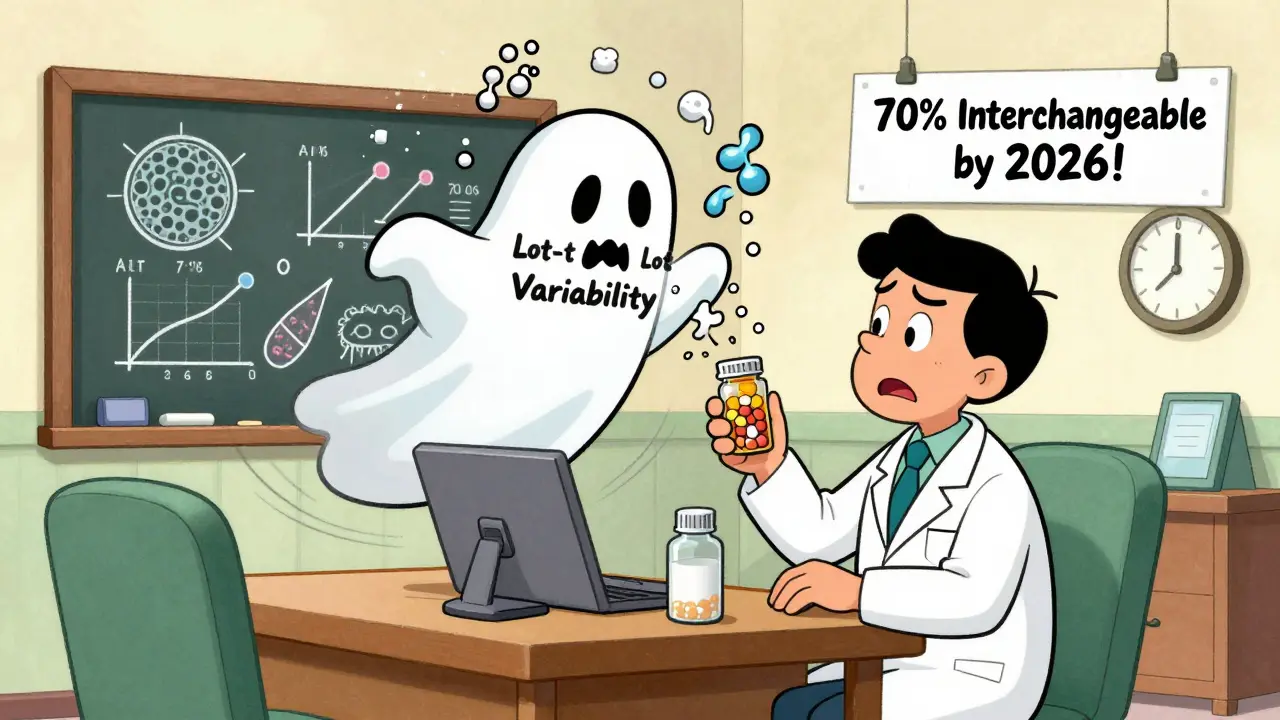
It’s not just drug makers who deal with lot-to-lot variability. Labs do too. Many diagnostic tests rely on reagents made from biological materials - antibodies, enzymes, proteins. When a lab switches to a new lot of a test kit, they have to verify it doesn’t throw off patient results.
A 2022 survey found that 78% of lab directors see this as a major challenge. Why? Because quality control samples don’t always behave like real patient samples. A reagent lot might pass QC but still give different results on actual blood samples. One case showed a 0.5% increase in HbA1c readings with a new lot - enough to push a diabetic patient from “well-controlled” to “poorly controlled” on paper. That’s not just a number. It’s a treatment decision.
Labs use statistical methods to catch these shifts. They test 20 or more patient samples with duplicate measurements. They look at moving averages - tracking the average result for a test over time - to spot trends. If the average suddenly jumps, they investigate. It’s time-consuming. Smaller labs say this verification eats up 15-20% of their tech time each quarter.
For patients, the takeaway is simple: if your doctor switches your biologic to a biosimilar, it’s safe - if it’s been approved. But if you notice a change in how you feel after switching - more fatigue, more flare-ups, unusual side effects - tell your doctor. It’s rare, but variability can sometimes manifest in subtle ways.
The Future: More Complex, More Varied
The biologics market is growing fast. In 2023, it was worth $10.6 billion. By 2028, it’s expected to hit $35.8 billion. More biosimilars are coming. And they’re getting more complex. Antibody-drug conjugates, cell therapies, gene therapies - these aren’t just proteins anymore. They’re living systems. And with complexity comes more variation.
But science is catching up. New tools let us see variations we couldn’t detect 10 years ago. The FDA’s “totality of the evidence” approach is evolving. Instead of one big clinical trial, regulators now look at the full picture: analytical data, functional assays, pharmacokinetics, and real-world outcomes.
By 2026, experts predict 70% of new biosimilar applications will include interchangeability data - up from 45% in 2023. That means more patients will get access to lower-cost options without needing a new prescription every time.
Lot-to-lot variability isn’t going away. It’s part of the price we pay for therapies that can target cancer, autoimmune diseases, and rare disorders with precision. The goal isn’t to eliminate variation - it’s to understand it, measure it, and make sure it never affects your health.
Is lot-to-lot variability a sign of poor quality in biologics?
No. Lot-to-lot variability is a natural part of manufacturing biologics using living cells. It’s not a defect - it’s expected. The FDA and manufacturers don’t aim for identical batches; they aim for consistent clinical performance. As long as variations fall within the range seen in the original reference product and don’t impact safety or effectiveness, the product is considered acceptable.
Can I tell if my biosimilar is from a different lot than before?
You likely won’t be able to tell by looking at the packaging or how the drug feels. Biosimilars are designed to work the same way regardless of lot. But if you notice a change in how you feel - like increased side effects, reduced effectiveness, or new symptoms - talk to your doctor. While rare, biological variability can sometimes lead to subtle clinical differences that require attention.
Why are biosimilars cheaper if they’re so complex to make?
They’re cheaper because manufacturers don’t have to repeat the full clinical trials done by the original drug maker. They use the reference product’s safety and efficacy data as a foundation. They still invest millions in analytical and functional testing, but they avoid the multi-billion-dollar cost of developing the original biologic from scratch. That’s how biosimilars bring down prices - without cutting corners on quality.
Are interchangeable biosimilars safer than non-interchangeable ones?
They’re not necessarily safer - they’re just better studied for switching. An interchangeable biosimilar has gone through additional clinical testing to prove that switching back and forth between it and the reference product doesn’t increase risk. Non-interchangeable biosimilars are equally safe when used as directed. The difference is about pharmacy substitution, not overall safety.
How often do lot changes affect patient outcomes?
Very rarely. The systems in place - from manufacturing controls to lab verification - are designed to catch any meaningful changes before a product reaches patients. When issues have occurred, they’ve typically been linked to diagnostic reagents, not therapeutic biologics. For drugs used to treat conditions like rheumatoid arthritis or cancer, the risk of a clinically significant outcome from lot variation is extremely low.
Annie Choi
January 14, 2026 AT 15:19Biologics are basically living soup and we're injecting it into people and calling it medicine lol
My rheumatoid arthritis flares up every time they switch my Humira lot and no one wants to hear it
But hey at least the price dropped so I guess we're all winners
Iona Jane
January 14, 2026 AT 23:22They're lying to you. Every single batch has a different molecular fingerprint. The FDA knows this. The pharma execs know this. Your doctor? Probably doesn't. They're using you as guinea pigs for profit. They don't care if your immune system starts attacking itself because a sugar molecule shifted 0.3% on the protein. This isn't science. It's corporate roulette.
Jaspreet Kaur Chana
January 16, 2026 AT 13:18Bro in India we've been dealing with this since the first biosimilar came in 2015. You think your body reacts weird because of a lot change? Wait till you get a batch from a factory in Hyderabad that uses tap water instead of purified H2O during purification. I've seen patients go from zero symptoms to full-blown anaphylaxis because someone skipped a filtration step. We don't have FDA oversight here so we just pray and hope. But hey at least it's cheaper than flying to the US for the original.
Also side note: my cousin's kid got a biosimilar for juvenile arthritis and now he's a pro soccer player. So yeah sometimes it works better than the brand. Biology is wild.
Haley Graves
January 17, 2026 AT 03:48If you're worried about lot-to-lot variability, you're not paying attention to the real issue: access. Biosimilars saved my mother's life. She couldn't afford Humira. Now she's on a biosimilar and her CRP levels are lower than they've been in 10 years. The science is solid. The regulatory framework is robust. If you're having a bad reaction, it's not because of a sugar group-it's because you're not being monitored properly. Talk to your rheumatologist. Don't blame the medicine.
ellen adamina
January 18, 2026 AT 14:10Wait so if the original biologic has lot variability too then how do we know the biosimilar is really similar? Is the FDA comparing the biosimilar’s variation to the reference product’s variation or just to some theoretical ideal? Because if the reference product’s own batches vary wildly then saying the biosimilar matches it doesn’t mean much. This feels like saying two snowflakes are identical because they’re both white.
Tom Doan
January 18, 2026 AT 19:27How fascinating. We have created a class of drugs that are so complex, we can’t replicate them exactly-even with billion-dollar equipment-and yet we still expect patients to believe they’re functionally identical. And we call this ‘science.’ Meanwhile, your generic aspirin? One molecule. One batch. One outcome. But no, we need to spend $200M to prove that a protein with 1.2 million variants is ‘close enough.’ What a triumph of overengineering.
Nishant Garg
January 19, 2026 AT 05:47Back home in Punjab, we call this 'jugaad medicine'-making it work with what you got. Biosimilars? They're the Indian version of hustle. You don't get perfection, you get 'good enough to keep you alive.' And honestly? Most people don't even know they're on a biosimilar. The pharmacy just hands it to them. No drama. No paperwork. Just relief. The real villain here isn't the lot variation-it's the system that makes people choose between rent and medicine. If a biosimilar saves a family from bankruptcy? That's not a compromise. That's justice.
Nilesh Khedekar
January 19, 2026 AT 17:45Let me get this straight-you’re telling me that a company can change a single amino acid, tweak the glycosylation pattern by 7%, and still get FDA approval because ‘it’s within the range of the original’? And the original itself is a mess? So we’re not comparing to a standard-we’re comparing to chaos? And you wonder why patients get confused? I’ve seen people switch and end up in the ER because their antibodies spiked. This isn’t medicine. It’s a Russian roulette game with a 1 in 10,000 chance of death-and the insurance company is holding the gun.
Jami Reynolds
January 20, 2026 AT 20:54There is no such thing as ‘inherent variation’ in pharmaceutical manufacturing. That is a euphemism for poor quality control. The FDA has been systematically lowering standards to accelerate biosimilar approvals and appease corporate lobbying. The fact that only 12 out of 53 are interchangeable proves the system is broken. If a product cannot be proven to be consistent across batches, it should not be approved. Period. This is not innovation. It is regulatory capture disguised as progress.