When antidepressants stop working, what’s left? For nearly one in three people with major depression, standard meds don’t help. Their symptoms stick around-hopelessness, fatigue, numbness-even after trying two or more drugs. This isn’t laziness or failure. It’s treatment-resistant depression (TRD). And for these patients, time isn’t just a factor-it’s life or death. That’s where ketamine and esketamine come in. Not just alternatives. Not just experimental. They’re the fastest-acting tools we have right now to pull someone out of the dark.
How Ketamine and Esketamine Work Differently
Ketamine isn’t new. It was approved in 1970 as an anesthetic, used in operating rooms to knock people out safely. But doctors noticed something strange: patients waking up from surgery didn’t just feel better physically-they felt lighter emotionally. Some even said they hadn’t felt this clear in years. That sparked decades of research. Scientists eventually realized ketamine’s power wasn’t in blocking pain, but in rewiring brain circuits tied to mood.
Then came esketamine. It’s not a new drug-it’s half of ketamine. Ketamine is a mix of two mirror-image molecules: (R) and (S). Esketamine is just the (S) version. Think of it like choosing one flavor from a two-flavor ice cream. The (R) side seems to drive the antidepressant effect. The (S) side? It’s milder. That’s why esketamine causes fewer hallucinations and out-of-body feelings. But it also might not work as fast or as hard.
How They’re Given-And Why It Matters
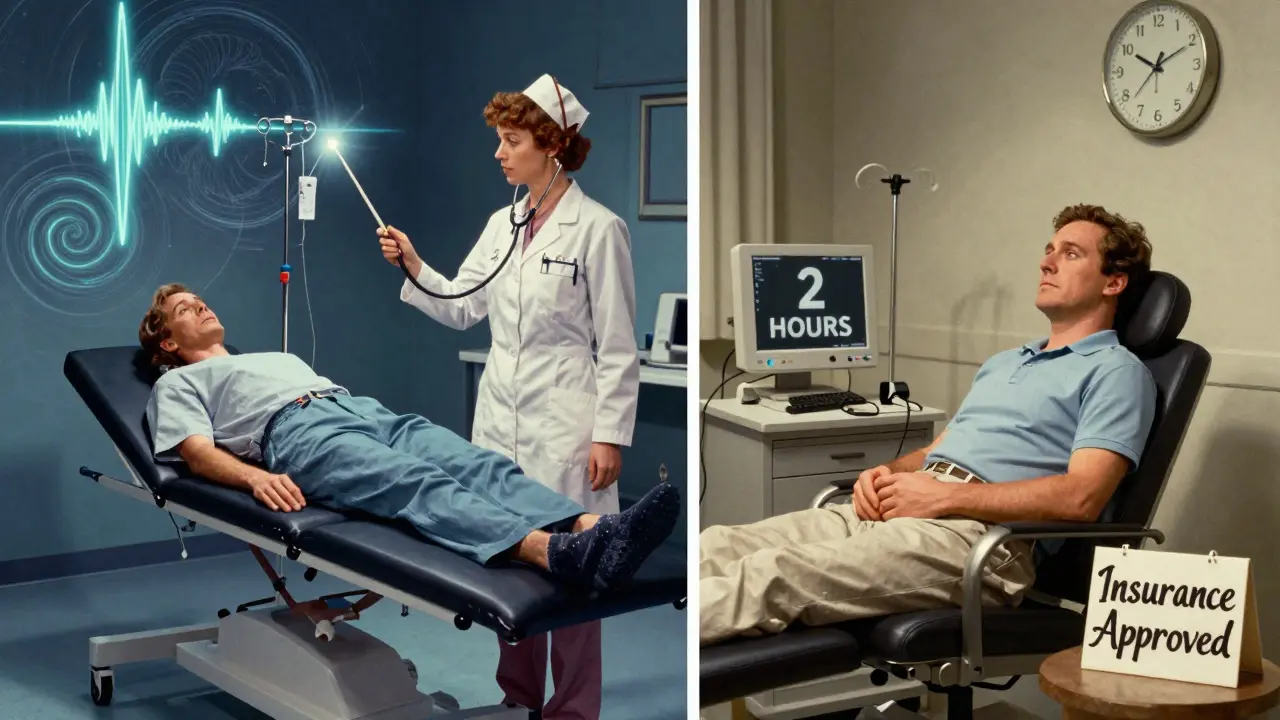
IV ketamine means a needle in your arm. You lie back. A nurse slowly pumps in a dose over 40 minutes. You might feel dizzy. Your vision might blur. You might feel like you’re floating. It’s intense. But within hours, some patients say they can breathe again. Others cry for the first time in months. The effect? Often immediate.
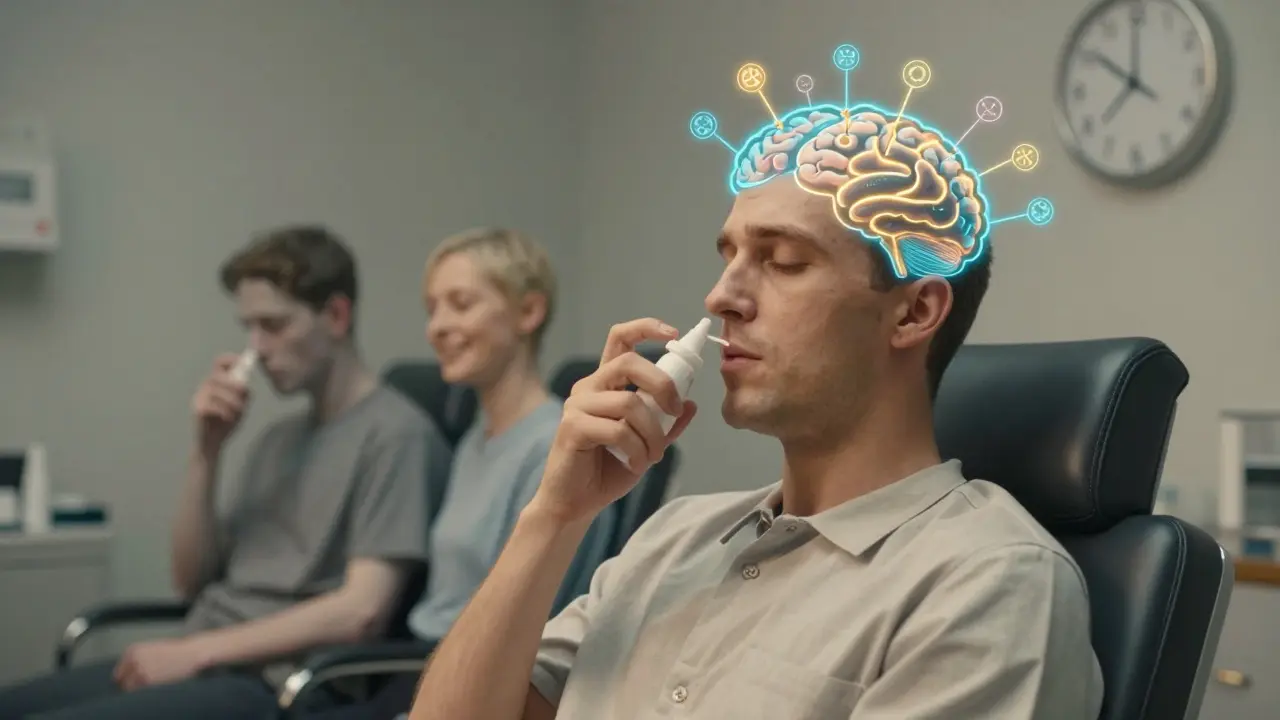
Esketamine? A nasal spray. You sit in a clinic. You spray it into each nostril. You wait. No IV. No needle. Just a puff. You’re monitored for two hours afterward. It’s calmer. Quieter. Less scary. But you don’t feel the shift right away. Most people need at least two doses before they notice anything. The FDA says you need two sprays a week for the first month. Then you might drop to once a week. It’s a grind.
Which One Works Better? The Data
A major 2025 study from Mass General Brigham tracked 153 people with severe, treatment-resistant depression. 111 got IV ketamine. 42 got nasal esketamine. The results? Clear.
- Ketamine: 49.22% drop in depression scores after the full course.
- Esketamine: 39.55% drop.
Ketamine didn’t just win-it won faster. People felt better after their very first IV session. Esketamine users had to wait. Two treatments before anything changed. A 2020 meta-analysis of 14 studies confirmed this: IV ketamine outperformed nasal esketamine across every time point-from 24 hours to eight weeks.
And the numbers don’t lie. On PatientsLikeMe, 63.2% of IV ketamine users said they felt relief within 24 hours. For esketamine? Just 51.7%. That’s a big gap when you’re in crisis.
Side Effects: Pain vs. Peace
Neither is gentle. Both can make you feel disconnected from your body. But ketamine? It’s stronger. In the 2025 study, 42.3% of IV ketamine patients had dissociation-feeling detached, strange, even scared. For esketamine? Only 28.7%. The FDA says esketamine has 37.2% fewer severe dissociative episodes.
But here’s the twist. Even though ketamine causes more side effects, many patients say they prefer it. Why? Because the intensity means it’s working. One patient wrote: "I felt like I was dying during the session. But when I woke up? I felt alive for the first time in five years."
Esketamine’s side effects are milder, but they’re still real. Nausea. Dizziness. High blood pressure. And you still have to sit in a clinic for two hours after each dose. No driving. No leaving alone. It’s not casual.
Cost: What You Pay, What Insurance Covers
Let’s be blunt: this isn’t cheap.
- Eight IV ketamine sessions: $4,200-$5,600.
- A comparable course of Spravato (esketamine): $5,800-$6,900.
But insurance? That’s where it gets messy. Only 38.2% of private plans cover IV ketamine. It’s still off-label. No FDA approval for depression. So clinics often charge out-of-pocket.
Esketamine? FDA-approved. So 67.4% of insurers cover it. That’s a huge advantage. But even then, you might need prior authorization. You might need to try five other drugs first. And some plans still cap how many doses they’ll pay for.
Here’s the kicker: a 2025 JAMA Psychiatry analysis found IV ketamine saves more money per quality-adjusted life year. $14,327 for ketamine. $18,764 for esketamine. In plain terms? Ketamine gives you more health for less money.
Who Gets Which? Expert Opinions
Dr. John Krystal at Yale says IV ketamine should be first for people on the edge. "If someone is actively suicidal and hasn’t responded to anything, you need the strongest, fastest tool. That’s IV ketamine."
Dr. Christine Denny at Columbia disagrees. "Esketamine is better for long-term use. You can do it in a psychiatrist’s office. You don’t need an anesthesiologist. It’s safer for people who can’t handle intense side effects."
It’s not about which is "better." It’s about which fits you.
- Choose IV ketamine if: You’re in crisis. You need fast relief. You can handle intense side effects. You’re willing to pay out-of-pocket or fight insurance.
- Choose esketamine if: You want something less intense. You need a maintenance option. You have insurance that covers it. You can commit to weekly clinic visits.
Access Is Still a Nightmare
Here’s the ugly truth: even if you know which one you need, you might not be able to get it.
In 2025, only 12.4% of U.S. counties had a certified Spravato center. And far fewer offered IV ketamine. Most are in big cities. If you live in rural Ohio, or small-town Texas, you’re out of luck. No clinics nearby. No transport. No help.
And it’s not just geography. You need a referral. You need a psychiatrist who knows how to order it. You need a clinic with trained staff. For IV ketamine? You need someone certified to handle airway emergencies. That’s not just a nurse. That’s a specialist.
There are 1,087 ketamine clinics in the U.S. now. Up from 142 in 2020. Progress? Yes. But it’s still not enough.
What’s Next?
Science is moving fast. The FDA just accepted Janssen’s application for a higher-dose esketamine spray-112 mg. That might mean fewer sessions. Faster results.
And researchers are testing intramuscular ketamine-shots in the butt. It’s faster than nasal, less invasive than IV. Could be a middle ground.
Even more exciting? Brain scans. A 2025 study in Nature Mental Health found that patients who responded to ketamine showed a spike in gamma brain waves after treatment. That’s not just a feeling. It’s a measurable change. In the future, we might test your brain before treatment-and know if ketamine will work for you.
Final Thoughts
Ketamine and esketamine aren’t magic. They’re tools. Powerful, fast, and not without risk. But for someone drowning in depression, they’re lifelines.
If you’ve tried everything else and still feel broken-this might be your next step. Not your last. But your next.
Don’t wait for a miracle. Ask your doctor: "Is ketamine or esketamine an option for me?" Then ask: "What’s my best shot?"
Is ketamine FDA-approved for depression?
Ketamine itself is not FDA-approved specifically for depression. It was approved in 1970 as an anesthetic. Its use for depression is "off-label," meaning doctors can legally prescribe it for this purpose, even though it’s not officially labeled for it. Esketamine, on the other hand, is FDA-approved under the brand name Spravato® for treatment-resistant depression and for depression with suicidal thoughts.
Can I take ketamine or esketamine at home?
No. Both require medical supervision. IV ketamine must be given in a clinic with trained staff, because of the risk of dissociation and airway issues. Esketamine is given as a nasal spray, but you still must stay at the clinic for two hours after each dose for monitoring. Home use is not allowed under current regulations.
How long do the effects last?
The antidepressant effect from one dose usually lasts 3-7 days. That’s why maintenance doses are needed. For IV ketamine, most patients get treatments every 1-3 weeks. For esketamine, the maintenance phase is usually once a week. Long-term studies show about half of responders still feel better at six months with regular dosing.
Are ketamine and esketamine addictive?
Both are classified as Schedule III controlled substances, meaning they have a moderate risk of abuse. But when used in a clinical setting under supervision, the risk is low. Most patients don’t seek out more doses. The dissociative effects are often unpleasant, which naturally limits misuse. However, people with a history of substance abuse are carefully screened before treatment.
Do I still need my regular antidepressant?
Yes. Esketamine (Spravato®) is only approved when used with an oral antidepressant. For IV ketamine, doctors usually keep patients on their current antidepressants, too. These treatments don’t replace antidepressants-they work alongside them. The combination often leads to better, longer-lasting results.
What if I can’t afford either option?
Cost is a major barrier. Some clinics offer payment plans. Others accept sliding-scale fees based on income. Clinical trials sometimes provide free treatment. You can also ask your doctor about nonprofit programs or local mental health organizations that help cover costs. Insurance coverage for IV ketamine is rare, but not impossible-some plans will cover it if you prove you’ve tried everything else.
Dinesh Dawn
February 25, 2026 AT 18:15Man, I wish this was available back when I was in that dark place last year. I didn’t know ketamine even existed as an option. My doc just kept pushing SSRIs like they were soda pop. I’m glad someone finally laid it out like this-clear, no fluff. Just facts and real talk.
Vanessa Drummond
February 25, 2026 AT 22:39IV ketamine is the only thing that saved me. I went from crying in the shower every morning to laughing at a dog video 12 hours later. It felt like someone flipped a switch in my brain. Esketamine? Nah. Too slow. Too weak. I’d rather pay out of pocket and get real results than waste time with a nasal spray that feels like a placebo with side effects.
Nick Hamby
February 27, 2026 AT 13:25It’s fascinating how the science here reveals not just a pharmacological difference, but a philosophical one: do we prioritize speed over safety, or vice versa? Ketamine delivers rapid neuroplastic change-almost like a reset button-but at the cost of profound disorientation. Esketamine, by contrast, is a gentler nudge toward healing, designed for sustainability rather than crisis intervention. Neither is superior; they are tools calibrated for different human conditions. The real question isn’t which drug works better-it’s which version of suffering we’re trying to alleviate.
And yet, access remains the true moral failing. If a life-saving treatment is confined to urban centers and those who can afford to fight insurance, then we’ve created a medical caste system disguised as innovation.
kirti juneja
February 27, 2026 AT 14:44OMG this post is FIRE!!! 🔥 I’m from Mumbai and we don’t even have ONE clinic that does IV ketamine. My cousin tried esketamine but the clinic was 3 hours away and the waitlist was 8 months. She cried after the first session-said it felt like her soul finally stopped screaming. But now she’s stuck paying $500 per spray because insurance said ‘nope’. I’m so mad. We need this stuff to be a right, not a luxury. Someone needs to start a GoFundMe for rural mental health access. I’m in!! 💪❤️
Haley Gumm
February 28, 2026 AT 09:45Let’s be real-this whole ketamine trend is just Big Pharma’s new opioid. They’re selling euphoria as medicine. People aren’t getting better-they’re getting addicted to dissociation. And don’t even get me started on the ‘I felt alive’ testimonials. That’s not recovery. That’s a high. You’re trading one dependency for another. Wake up.
Gabrielle Conroy
March 2, 2026 AT 02:56Thank you SO MUCH for this!! 🙌 I’ve been researching this for months and this is the clearest breakdown I’ve seen. I’m on esketamine and honestly? The first two sessions felt like nothing… then BAM-on session three, I cried during my coffee. Like, real tears. Not sad tears-just… free tears. 😭 And yes, I had to sit there for two hours, but I read a book and listened to jazz and it was kinda peaceful? Also, my insurance covered it after I sent 17 emails. You CAN do it!! 💕
Spenser Bickett
March 2, 2026 AT 23:41So… you’re telling me we’re paying thousands for a party drug that’s been around since the 70s? And we’re calling it ‘medical innovation’? LMAO. I got my buddy who works at a clinic to hook me up with a vial. I did it at home. No one’s gonna tell me I’m not ‘qualified’ to feel better. The system’s rigged. Go ahead and call me reckless-I call it self-care.
Christopher Wiedenhaupt
March 4, 2026 AT 11:14While the data presented is compelling, one must consider the methodological limitations of the 2025 Mass General Brigham study. The sample size for esketamine (n=42) is notably smaller than that for IV ketamine (n=111), which may introduce statistical bias. Additionally, the lack of blinding in participant reporting introduces potential placebo effects. Further double-blind, randomized controlled trials are warranted before definitive clinical guidelines can be established.
Maranda Najar
March 4, 2026 AT 14:16My heart shattered reading this. I’ve watched my sister go through this. She took esketamine for six months. She said the worst part wasn’t the dizziness-it was the silence afterward. The clinic staff would nod, hand her a water, and say, ‘See you next week.’ No one asked if she was okay. No one asked if she wanted to talk. We treat these drugs like vending machines-insert coin, receive relief. But healing isn’t transactional. It’s human.
Valerie Letourneau
March 5, 2026 AT 22:09As a Canadian, I find it alarming that our healthcare system hasn’t yet integrated these therapies into public coverage. In Ontario, only two clinics offer IV ketamine, and neither accepts provincial insurance. Meanwhile, esketamine is covered-but only if you’ve exhausted 10 other medications. This isn’t innovation; it’s a bureaucratic obstacle course for the desperate. We must ask: if a treatment saves lives, why do we make it so hard to reach?
Khaya Street
March 6, 2026 AT 22:17Look, I’m not saying this stuff doesn’t work. But I’m also not driving three hours to sit in a clinic for two hours just to get sprayed in the nose. I’ve got a job. A kid. A dog. I don’t have time for this. If it’s that good, why can’t I just take a pill? Why does everything have to be so complicated?