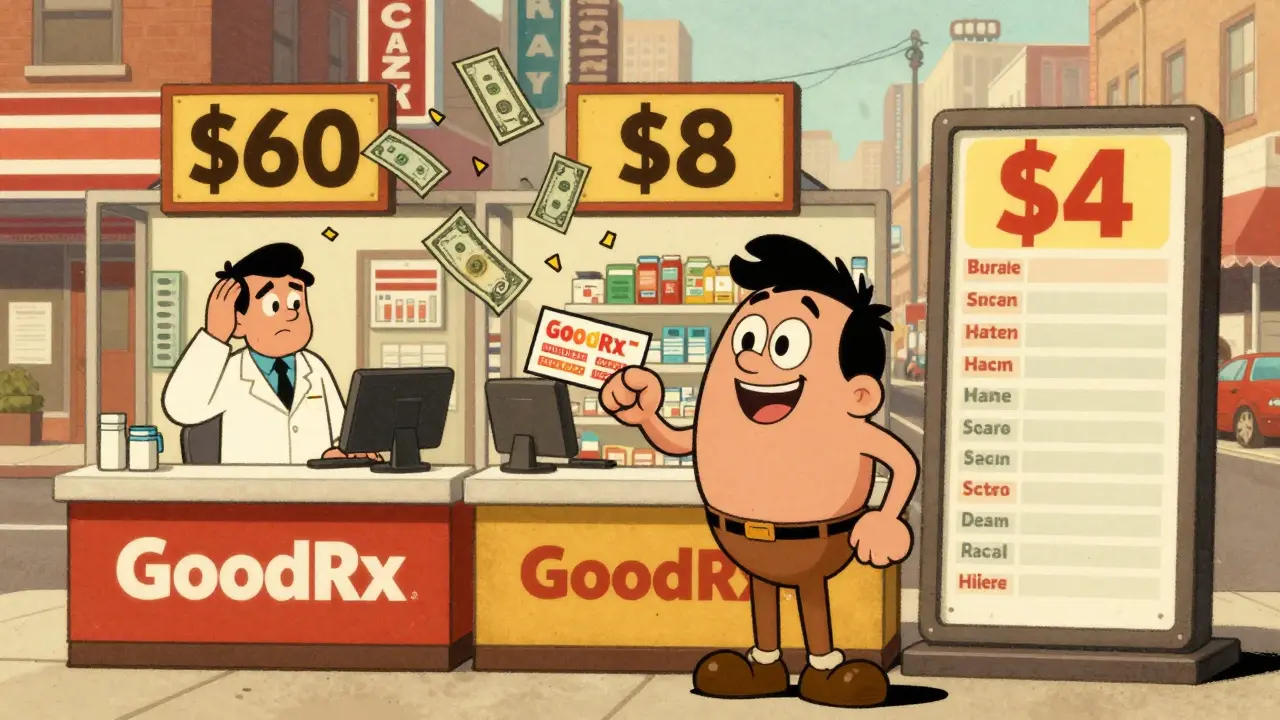
Ever paid $100 for a generic pill only to find out the same medicine costs $5 down the street? You’re not alone. In 2025, it’s still common to see the same prescription-like metformin or atorvastatin-cost anywhere from $3 to $140 at different pharmacies, even within the same city. The reason? Pharmacy pricing isn’t set by law. It’s set by negotiation, profit margins, and whether you know where to look.
Why Cash Prices Vary So Much
Pharmacies don’t have fixed prices. A national chain like CVS or Walgreens might charge $60 for a 30-day supply of generic lisinopril, while a local independent pharmacy down the road sells it for $8. Supermarkets like Kroger or Walmart often run $4 generic programs. Why? Because pharmaceutical manufacturers sell the same drug to different buyers at different prices. Big pharmacy chains pay more. Small independents pay less. And discount services like GoodRx negotiate bulk deals behind the scenes, then pass those savings to you. A 2021 NIH study found that for common generic cardiovascular drugs, prices at national chains were more than double what they were at supermarkets. And that’s before using a coupon. The gap gets even wider for brand-name drugs-unless you’re lucky enough to find a rare discount. But here’s the thing: you don’t need insurance to get the lowest price. Sometimes, paying cash with a discount coupon is cheaper than using your plan.How to Find the Lowest Cash Price
You don’t need a degree in pharmacy to save hundreds a year. Just follow these steps.- Ask for the cash price first. Always. Before you mention your insurance, ask the pharmacist: “What’s the cash price for this?” Many people assume insurance always wins-but it doesn’t. A 2023 LifeCare Advocates guide found that nearly 40% of Medicare patients paid less out-of-pocket using GoodRx than their plan’s copay.
- Compare prices using three apps. Don’t rely on just one. Use GoodRx, RxSaver, and WellRX. Each pulls data from different pharmacy networks. GoodRx covers over 70,000 U.S. pharmacies. RxSaver sometimes has deeper discounts at regional chains. WellRX often shows better deals at independent pharmacies. Cross-checking reduces the chance of a bad price.
- Check local independents. Big chains aren’t always the cheapest. A 2018 study found that small, independent pharmacies often offered the lowest cash prices-even without coupons. Walk in, ask for the price, and don’t be shy. Pharmacists at these shops know their customers and sometimes offer unadvertised discounts if you’re a regular.
- Look for store programs. Kroger, Albertsons, and Target have $4/$9 generic lists. These aren’t coupons-they’re fixed prices. Metformin, levothyroxine, and atorvastatin are usually on them. Check their websites or ask at the counter.
- Use mail-order for long-term meds. If you take the same pill every month, consider RXOutreach.com. It’s a nonprofit that sells generic medications at deep discounts to people with incomes under $45,000 a year (individual). You don’t need insurance. Just proof of income. Some users save over 80% compared to retail prices.
What Doesn’t Work
Not all savings tools are equal. Here’s what to avoid.- Brand-name drugs. GoodRx and other apps rarely save much on brand-name meds like Humira or Enbrel. The discounts are small because manufacturers don’t offer rebates for cash buyers. If you’re on a brand-name drug, ask your doctor if a generic exists. It might be just as effective-and 90% cheaper.
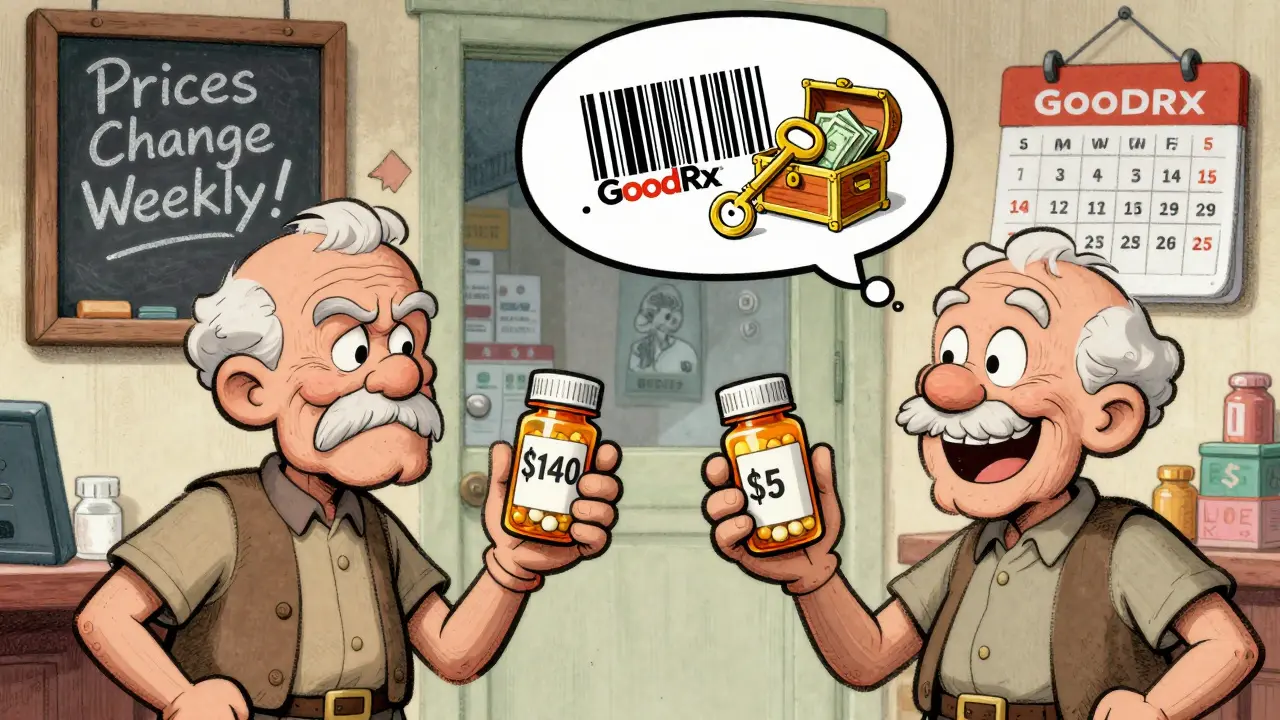
- One-time searches. Prices change weekly. A drug that was $12 last week could be $22 this week. Set a reminder to check every 30 days, especially for chronic conditions.
- Assuming your insurance is the best deal. Many high-deductible plans have high copays for generics. You might pay $40 with insurance but only $5 with GoodRx. Always compare.
Real Savings, Real Stories
People are saving big. On Reddit, one user paid $1.89 for metformin at a local pharmacy using GoodRx. The same prescription at CVS was $15.99. That’s $14 saved every month. Over a year? $168. Another user in Chicago found insulin prices ranging from $98 to $345 for the same vial-just two miles apart. They bought it for $98. That’s $247 saved in one trip. Trustpilot reviews for GoodRx show thousands of users saving $50-$150 per prescription. One person saved $112 on Synthroid at Walmart. Another saved $75 on a generic alternative after their brand-name drug didn’t get discounted at all.Special Cases: Medicare and Low-Income Patients
If you’re on Medicare, you still need to shop. Even with Part D, your plan might not cover the cheapest pharmacy. Use Medicare’s online tool to compare preferred pharmacies in your area. You can save 15-25% just by switching. For those with lower incomes, RXOutreach.com is a game-changer. It’s not a scam. It’s a nonprofit that’s been helping patients since 2005. You can get 90-day supplies of common generics for $10-$30. You’ll need to provide income documentation, but it’s straightforward.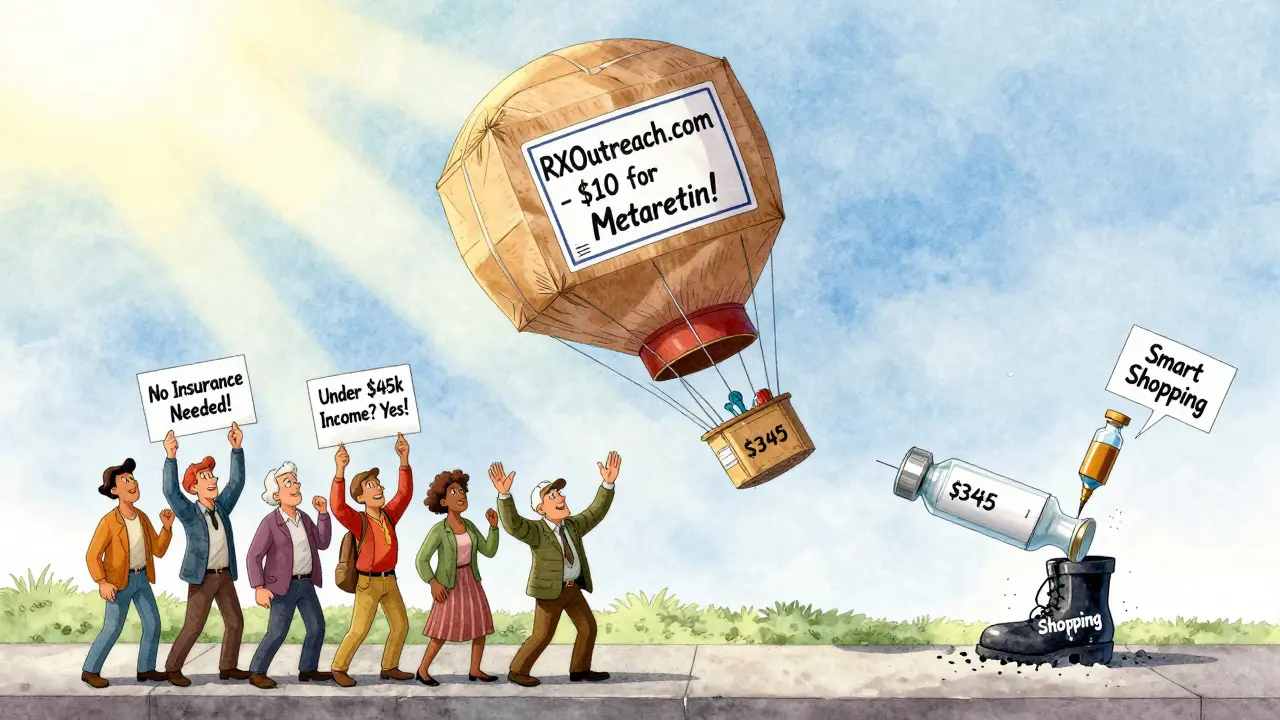
What’s Changing in 2025
The Inflation Reduction Act capped out-of-pocket drug costs at $2,000 a year for Medicare Part D users starting in 2025. That sounds great-but it doesn’t mean you shouldn’t shop. If you’re paying $500 a year for a drug that costs $100 elsewhere, you’re still overpaying. The cap helps with total spending, but smart shopping cuts your monthly bill. The FDA is also pushing more generics to market. More competition means lower prices. In 2023, over 1,000 new generic drugs were approved-the highest number in a decade. That trend will keep pushing prices down.Final Tips
- Always ask the pharmacist: “Is there a cheaper way to get this?” They know about discounts you might not. - Keep a list of your meds and their cash prices. Update it every month. - Don’t wait until you’re out of pills to check prices. Plan ahead. - If a pharmacy says a coupon won’t work, ask them to call the pharmacy network. Sometimes, it’s just a system error. - For long-term prescriptions, consider a 90-day supply. Many discount apps offer better pricing for larger quantities.Pharmacy shopping doesn’t take long. Five minutes to check an app. Ten minutes to call a few stores. That’s it. And the savings? They add up. One person saved $1,200 in a year just by switching where they filled their prescriptions. You don’t need to be an expert. You just need to know it’s possible-and that the price you see isn’t the only one.
Is it legal to use GoodRx instead of insurance?
Yes. GoodRx is a discount program, not insurance. You can choose to pay cash with a GoodRx coupon instead of using your insurance. Your insurer won’t be billed, and you won’t violate any rules. In fact, many people use GoodRx because it’s cheaper than their insurance copay.
Can I use GoodRx with Medicare?
You can, but not at the same time. If you use GoodRx, Medicare won’t pay for the prescription, and the cost won’t count toward your deductible or out-of-pocket maximum. But if GoodRx is cheaper than your Medicare copay, it’s smart to use it. Just don’t expect it to help you reach your coverage threshold.
Why is my generic drug so expensive at my usual pharmacy?
Pharmacies buy drugs from different distributors, and prices change based on contracts, inventory, and location. A national chain might pay more per pill than a small independent pharmacy. Also, some pharmacies don’t update prices in real time, so the app might show a lower price than what’s on the shelf. Always ask for the current cash price before paying.
Do all pharmacies accept GoodRx?
Most major chains and many independents do-over 70,000 pharmacies in the U.S. But not all. If a pharmacy says they don’t accept it, ask them to call the number on the coupon. Sometimes, it’s a staff error. If they still refuse, try another pharmacy or use a different discount app like RxSaver.
Are there any hidden fees with discount apps?
No. GoodRx, RxSaver, and WellRX are free to use. The price you see on the app is the price you pay at the pharmacy. There are no subscription fees, no sign-ups, and no credit card required. You just show the coupon or barcode at pickup.
What if I can’t afford my medication even after shopping around?
Contact the drug manufacturer. Most have patient assistance programs for low-income people. You can also check NeedyMeds.org or the Partnership for Prescription Assistance. Some nonprofits, like RXOutreach.com, offer generic medications for $10-$30 per 90-day supply if your income is under $45,000. Don’t skip your meds-there are options.
If you take one thing from this, let it be this: the price on the shelf isn’t final. You have power. You just need to use it.
Jody Patrick
December 17, 2025 AT 19:58Why are we even talking about this? In America, you pay what you’re told to pay. If you’re poor, that’s your problem. Get a job or stop taking medicine.
Philippa Skiadopoulou
December 18, 2025 AT 18:41While the general advice is sound, it is worth noting that price variation stems largely from wholesale acquisition cost disparities and pharmacy benefit manager rebates, not merely local negotiation. Many independents source through different PBM networks, which explains their lower prices. Always verify with the pharmacy’s actual invoice data if possible.
Nishant Desae
December 19, 2025 AT 21:30i just want to say thank you for writing this i live in india and we dont have goodrx here but my cousin in texas sent me this and i cried man i had no idea you could save so much just by asking the pharmacist like seriously i used to pay 2000 rupees for my blood pressure med and now i know to check three apps and walk into a small shop its just mind blowing i wish more people knew this its not just about money its about dignity you know like not having to choose between food and medicine
Jonathan Morris
December 21, 2025 AT 10:29This entire article is a distraction. The real issue is that the FDA and Big Pharma collude to delay generics. The 1,000 new generics in 2023? Half were me-too drugs with minor chemical tweaks. The rest were approved under pressure from lobbyists. GoodRx? A marketing shell for PBMs to funnel cash away from patients. You think you’re saving money? You’re just being played.
Anna Giakoumakatou
December 22, 2025 AT 21:38How delightful. We’ve reduced human health to a spreadsheet optimization problem. Bravo. You’ve turned the sacred act of healing into a coupon-hunting hobby. Next, we’ll be comparing insulin prices like we’re haggling over used cars at a flea market. How quaint.
Martin Spedding
December 24, 2025 AT 16:29Walmart $4 generics? LMAO. My mom got there last week and they gave her the wrong med. Then blamed her for not reading the label. Pharmacies are chaos. Don't trust apps. They're all hacked.
Donna Packard
December 26, 2025 AT 01:44I’ve been using GoodRx for my thyroid med for two years now. It’s been a game changer. I used to stress every month. Now I just check the app on Sunday night. Peace of mind, really.
Patrick A. Ck. Trip
December 26, 2025 AT 22:35While I appreciate the practical guidance offered in this post, I would respectfully suggest that the underlying systemic inequities in pharmaceutical pricing remain unaddressed. The ability to shop for prices presupposes time, digital access, and health literacy-resources not universally available. A structural solution is needed, not merely individual optimization.
Sam Clark
December 28, 2025 AT 21:30This is excellent advice. I’ve shared this with my elderly patients at the clinic. Many don’t realize they can pay cash instead of using insurance. I’ve seen them save hundreds. Thank you for making this accessible.
Chris Van Horn
December 29, 2025 AT 01:05Let me be clear: GoodRx is a Trojan horse. The data you give them? Sold to insurers. The coupons? Designed to steer you toward pharmacies that pay kickbacks. The FDA? Complicit. The Inflation Reduction Act? A publicity stunt. You think you’re winning? You’re being groomed for the next phase of corporate healthcare control.
Virginia Seitz
December 29, 2025 AT 01:17OMG YES 😭 I saved $80 on my diabetes meds this week!! 🙌 Walmart + GoodRx = LIFE CHANGER 💪
Steven Lavoie
December 29, 2025 AT 15:52My father was diagnosed with heart disease last year. We spent weeks comparing prices across 12 pharmacies. Found his meds for $7.50 at a small pharmacy in Ohio. The pharmacist, an older man named Carl, said, 'We don't make much, but we keep folks alive.' That’s the kind of care we need more of. This isn't just about money-it's about humanity.