Drug Safety Checker
Check Your Medication Safety
Enter your medical conditions and medications to see if they might have contraindications or warnings with common prescription drugs.
Enter your information and click 'Check Safety' to see if this drug is safe for you.
Every time you pick up a prescription or reach for an over-the-counter pill, there’s a hidden safety guide printed right on the label. But most people never read it. Or if they do, they skim past the big words and skip to the dosage. That’s risky. Contraindications and warnings on drug labels aren’t just fine print-they’re your first line of defense against serious harm. The FDA requires this information for a reason: drug labels save lives.
What’s the Difference Between Contraindications and Warnings?
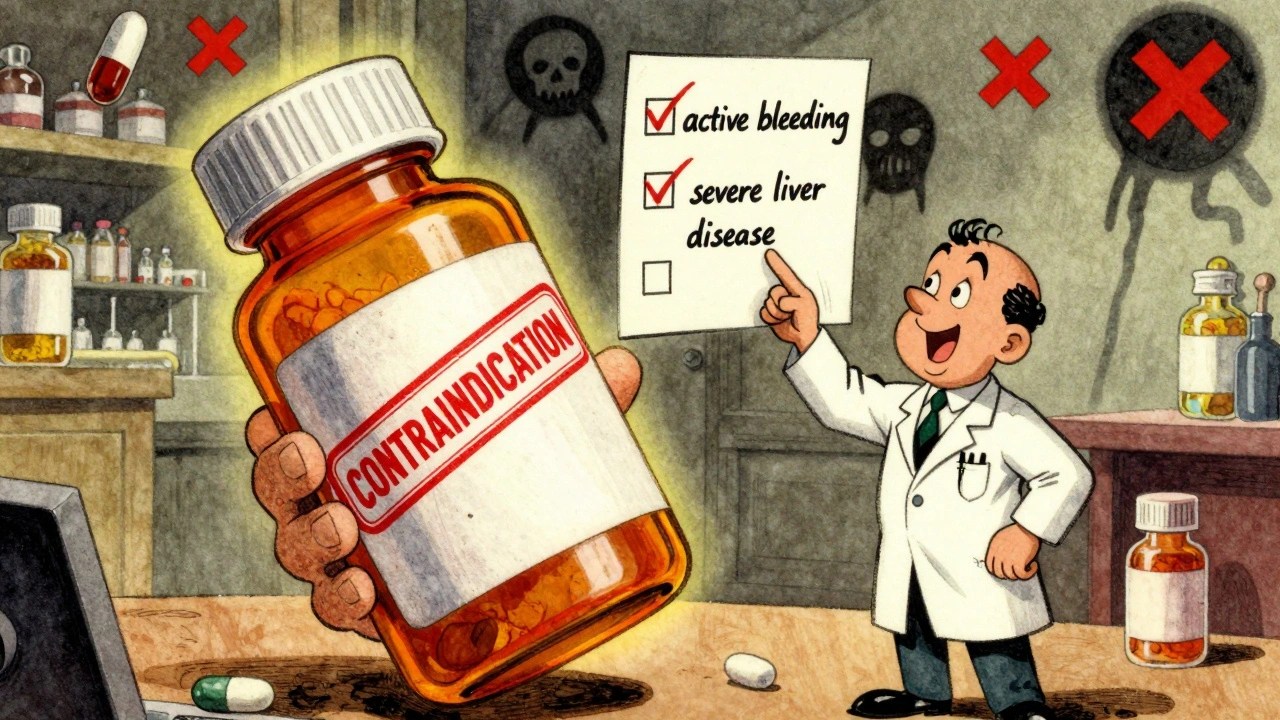
Contraindications and warnings sound similar, but they’re not the same. Think of contraindications as red lights: stop. Warnings are yellow lights: slow down, watch out. A contraindication means you should never take the drug under certain conditions. For example, if you have severe liver disease, you shouldn’t take rivaroxaban (Xarelto). It’s not a guess-it’s backed by clinical data showing the risk of internal bleeding outweighs any benefit. These are absolute. No exceptions. A warning tells you something dangerous could happen, but it’s not a hard no. For instance, Humira (adalimumab) carries a warning that it can cause serious infections like tuberculosis. That doesn’t mean you can’t take it-it means your doctor needs to test you for TB first, monitor you closely, and maybe adjust your dose. Warnings are about managing risk, not avoiding it entirely.Where to Find These Sections on the Label
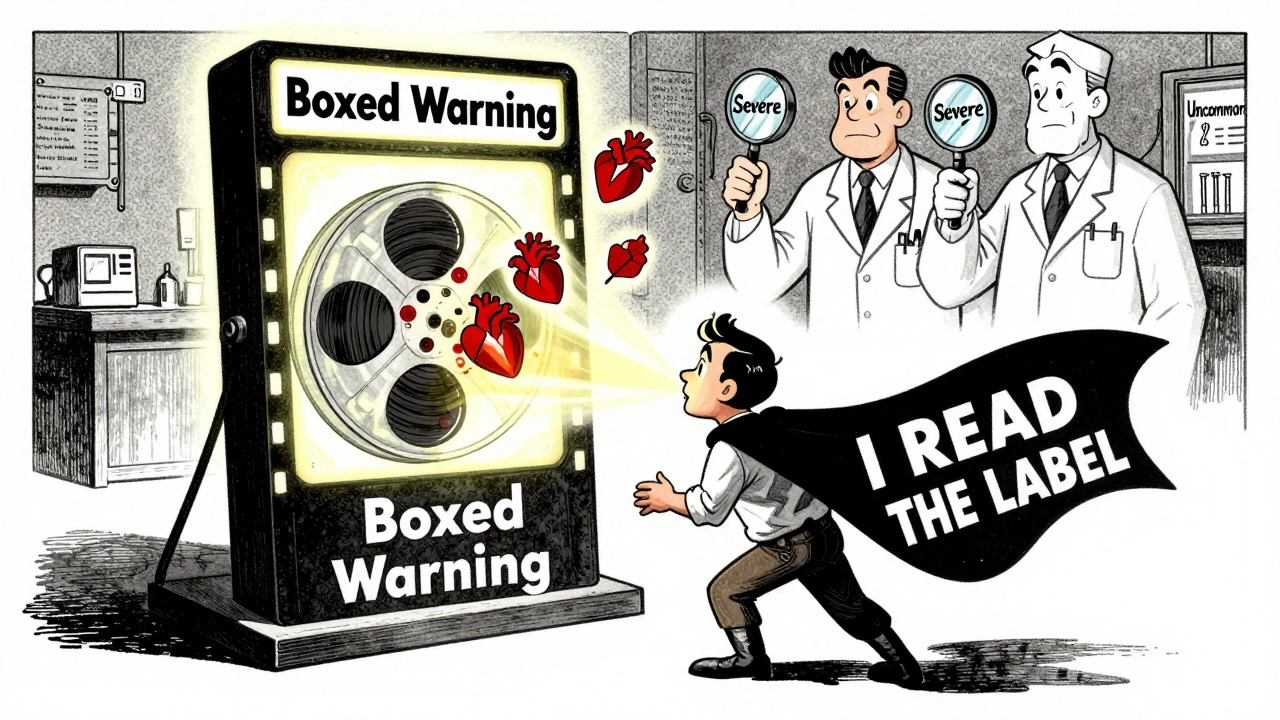
Prescription drug labels follow a strict format set by the FDA. Look for these sections in order:- Boxed Warning (if present): This is the most serious alert. It’s a black border around bold text at the very top of the prescribing information. Warfarin (Coumadin) has one for major bleeding. Bupropion (Wellbutrin) has one for suicidal thoughts in young adults. If you see this, stop and talk to your doctor before taking the drug.
- Section 4: Contraindications: This lists conditions that make the drug unsafe. It’s short and direct. If your condition is listed here, don’t take the drug unless your doctor says otherwise after a full risk review.
- Section 5: Warnings and Precautions: This is the longest section. It includes infections, organ damage, drug interactions, pregnancy risks, and more. It’s detailed because the FDA requires specific data: how often the risk occurs, which patients are most at risk, and what to do if it happens.
Over-the-counter (OTC) drugs are different. There’s no Section 4 or 5. Instead, look under the Warnings section on the Drug Facts label. Two phrases matter most:
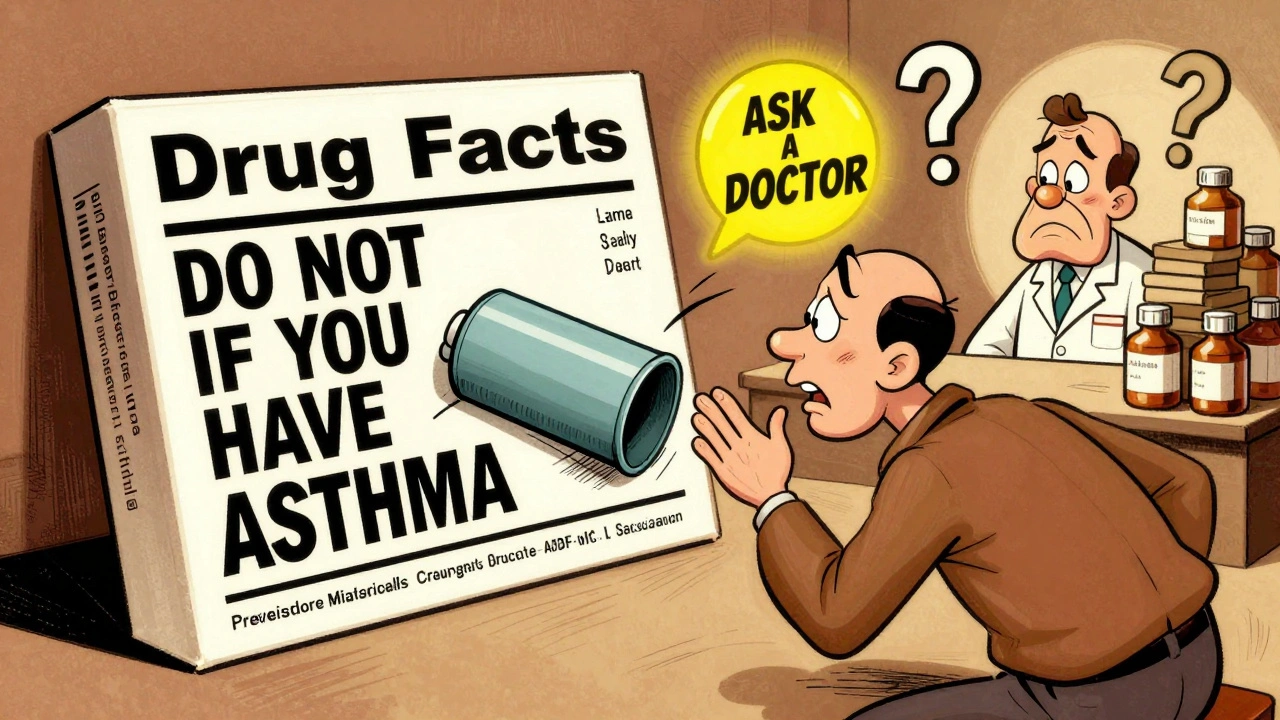
- “Do not use” = contraindication. If you have asthma and the label says “Do not use if you have asthma,” then don’t.
- “Ask a doctor before use if…” = warning. This means you need to check in with your provider first. Maybe you have high blood pressure, or you’re pregnant, or you take another medication that could clash.
How to Decode the Language
Drug labels don’t say “maybe” or “sometimes.” They use precise terms. Here’s what they really mean:- Absolute contraindication: “Do not use.” Full stop. Example: “Contraindicated in patients with active bleeding.”
- Relative contraindication: “Use with caution.” Example: “Use with caution in patients with mild kidney disease.” This means the drug might still be okay-but your doctor needs to adjust the dose or monitor you more closely.
- Severe: High risk of death or permanent injury. Example: “Severe liver injury has been reported.”
- Common: Happens in 1 in 10 or more people.
- Uncommon: Happens in 1 in 100 to 1 in 1,000 people.
- Reported: Seen in post-marketing data, not always in clinical trials. Still real.
Don’t assume “rare” means “safe.” A 1 in 1,000 chance of liver failure is still serious. The FDA requires manufacturers to report even rare events if they’re life-threatening.
Why Boxed Warnings Matter More Than You Think
Boxed warnings aren’t just for show. They’re the FDA’s strongest signal that a drug can kill you if used carelessly. About 40% of new drugs approved between 2008 and 2012 got one within five years. That’s not rare-it’s normal for powerful medicines. Take warfarin again. Its boxed warning says: “Risk of major or fatal bleeding.” That’s not vague. It’s specific. And it’s backed by data: 1 in 10 people on warfarin will have a serious bleed over five years. That’s why you need regular blood tests. But here’s the problem: a 2021 study found only 42% of doctors correctly recognized relative contraindications. That means many patients are getting drugs they shouldn’t, or not getting the right monitoring. If your doctor prescribes a drug with a boxed warning, ask: “What’s the biggest risk? How will we watch for it? What do I do if I notice it?”What Patients Get Wrong (And How to Avoid It)
Most people make these mistakes:- They think “I’ve taken it before, so it’s fine.” But your health changes. New kidney problems? New heart condition? That old drug might now be dangerous.
- They ignore warnings because “it’s just a label.” But 1.3 million injuries a year in the U.S. are linked to poor labeling comprehension, according to the Institute of Medicine.
- They assume OTC drugs are “safe.” But acetaminophen (Tylenol) causes over 50,000 ER visits a year from liver damage-mostly because people didn’t realize they were taking it in multiple products.
Here’s what to do instead:
- Always check the label when you get a new prescription-even if it’s the same drug. Manufacturers update warnings regularly.
- Keep a list of all your medications, including supplements and OTCs. Bring it to every appointment.
- Ask: “Is there anything in my medical history that makes this drug risky for me?” Don’t wait for the doctor to ask.
- If you see a warning you don’t understand, call your pharmacist. They’re trained to read these labels.
What’s Changing in Drug Labeling (And Why It Matters)
The FDA is trying to fix a broken system. In 2024, they made it mandatory for new drugs to include a Highlights of Prescribing Information section. This is a one-page summary at the front of the label that pulls out the most critical contraindications and warnings in plain language. They’re also pushing for quantitative risk data. Instead of saying “may increase risk of heart attack,” labels now say “increases risk by 1.8 times in patients over 65.” That’s huge. A 2022 Rand Corporation study found drugs with numbers like this had 23% fewer adverse events. And now, some companies are testing digital labels. If you scan a QR code on your pill bottle, you might get a personalized risk summary based on your age, kidney function, and other meds you take. It’s not everywhere yet-but it’s coming.Your Action Plan: 5 Steps to Read Drug Labels Safely
1. Find the label-whether it’s the paper insert, the pharmacy sticker, or the online PDF from your prescriber. 2. Look for the Boxed Warning first. If it’s there, pause. Read it. Understand it. 3. Check Section 4: Contraindications. Is your condition listed? If yes, ask your doctor: “Is there a safer alternative?” 4. Scan Section 5: Warnings and Precautions. Look for your conditions: liver disease, kidney disease, pregnancy, heart issues, or other meds you take. Don’t skip the “monitoring” advice. 5. Ask three questions before you take the drug:- “What’s the biggest danger I need to watch for?”
- “How likely is it to happen?”
- “What should I do if I notice it?”
These aren’t just questions-they’re your right as a patient. The FDA says only 30% of critical safety info is truly understood. Don’t be in that 70%.
What’s the difference between a contraindication and a warning?
A contraindication means you should not take the drug at all under certain conditions-for example, if you have active bleeding or a known allergy. A warning means the drug can cause serious side effects, but you might still take it if your doctor monitors you closely. Contraindications are absolute; warnings are conditional.
Can I take a drug if I have a listed contraindication?
Generally, no. Contraindications are based on strong evidence that the risks outweigh any benefit. But in rare cases, a doctor may decide the benefit is life-saving and the risk manageable-like using a drug with a liver contraindication in someone with no liver function left. This is never done lightly and requires full discussion and close monitoring.
Why do some drugs have boxed warnings and others don’t?
Boxed warnings are added when a drug has been linked to serious or fatal side effects that are well-documented and preventable with proper use. Not every drug has them because not every drug carries that level of risk. The FDA reviews post-market data and can add a boxed warning years after a drug is approved if new dangers emerge.
Are OTC drug labels less strict than prescription ones?
No, but they’re structured differently. OTC labels follow the Drug Facts format, where warnings include both contraindications (“Do not use”) and precautions (“Ask a doctor if…”). They’re legally required to be clear and complete, but they don’t have the same detailed sections as prescription labels. Still, 52% of consumers can’t correctly identify contraindications on OTC labels without help-so read carefully.
What should I do if I miss a warning and have a bad reaction?
Stop taking the drug immediately and contact your doctor or go to urgent care. Then report the reaction to the FDA’s MedWatch program. You can file a report online or by phone. These reports help the FDA update labels and warn others. Even if you think it was your fault, report it. Your report could prevent someone else from being hurt.
Ben Greening
December 11, 2025 AT 11:07It's fascinating how drug labels have evolved from cryptic legalese to something approaching transparency. I've started keeping a digital log of every prescription I've ever taken, complete with the boxed warnings and contraindications. It’s not just for me-it helps when I switch doctors or get referred to a specialist. Knowledge is power, and in this case, it’s literally life-saving.
Neelam Kumari
December 12, 2025 AT 22:31Oh wow, another feel-good PSA from Big Pharma’s PR department. Let me guess-you also think the FDA is some kind of saintly guardian of public health? They approved OxyContin. They ignored the suicide risk on SSRIs for years. This whole ‘read the label’ nonsense is just a distraction so you don’t ask why the drug exists in the first place.
David Palmer
December 14, 2025 AT 02:30Bro, I read the label once and it said ‘may cause death’ so I just took half the pill and hoped for the best. Works fine. Also, my cousin took this one thing and his liver turned into a raisin. But he’s chill now, so… 🤷♂️
Doris Lee
December 15, 2025 AT 03:27This is exactly the kind of info we need to make health less scary and more empowering. I always tell my mom to read the warnings before she takes her new pills-she used to just swallow them with coffee and hope for the best. Now she asks questions. Small wins matter.
Michaux Hyatt
December 15, 2025 AT 22:10One thing people overlook: the ‘reported’ side effects. Just because it’s rare doesn’t mean it’s not real. I had a patient on metformin who developed lactic acidosis-only 1 in 30,000 cases. But when it hits, it hits hard. Always mention your full history, even if it feels ‘too small’ to matter.
Raj Rsvpraj
December 16, 2025 AT 13:25Ha! Americans think they’re so smart reading labels-but in India, we’ve been reading medicine labels since childhood. We know ‘Do Not Use’ means ‘Do Not Use’-no PhD needed. Why do you need a 10-step guide? Because you’ve outsourced your brain to corporations. Pathetic.
Frank Nouwens
December 18, 2025 AT 10:23It is of considerable note that the FDA’s recent revisions to the Highlights of Prescribing Information represent a paradigmatic shift toward patient-centric communication. The incorporation of quantitative risk metrics, as opposed to qualitative descriptors, constitutes a significant advancement in risk communication efficacy. One must commend the agency’s commitment to evidence-based transparency.
Aileen Ferris
December 19, 2025 AT 14:20box warnings are just for show lol. i saw one for a heart med and it said ‘may cause sudden death’ so i took it anyway. my dog died last week so i figure if it can kill a dog it can kill me too 😎
Rebecca Dong
December 20, 2025 AT 03:38THEY’RE HIDING THE TRUTH. THE FDA KNOWS THESE DRUGS ARE DESIGNED TO MAKE YOU DEPENDENT. THEY DON’T WANT YOU TO KNOW THAT THE ‘WARNINGS’ ARE JUST A COVER SO YOU’LL BLAME YOURSELF WHEN YOU GET SICK. THEY’RE MAKING BILLIONS. I SAW A VIDEO WHERE A PHARM REP SAID ‘IF THEY READ THE LABEL, THEY WON’T BUY IT.’ I’M NOT CRAZY. THE SYSTEM IS.
Nikki Smellie
December 20, 2025 AT 15:11Have you considered that the QR codes on pill bottles might be microchips? I scanned mine and my phone started vibrating. The FDA is tracking us. The ‘personalized risk summary’ is just a front for biometric surveillance. They’re collecting your kidney data to sell to insurers. Don’t scan. Don’t trust. Don’t take the pill.
Queenie Chan
December 20, 2025 AT 23:16I love how labels use words like ‘uncommon’ like it’s some gentle whisper-but ‘uncommon’ could still mean your kidneys turn into dust. I once read a label that said ‘rarely causes hallucinations’ and I thought, ‘cool, like a free trip to the Matrix!’ Then I Googled it and found someone who thought their cat was the President. Now I carry a notepad. Just in case.