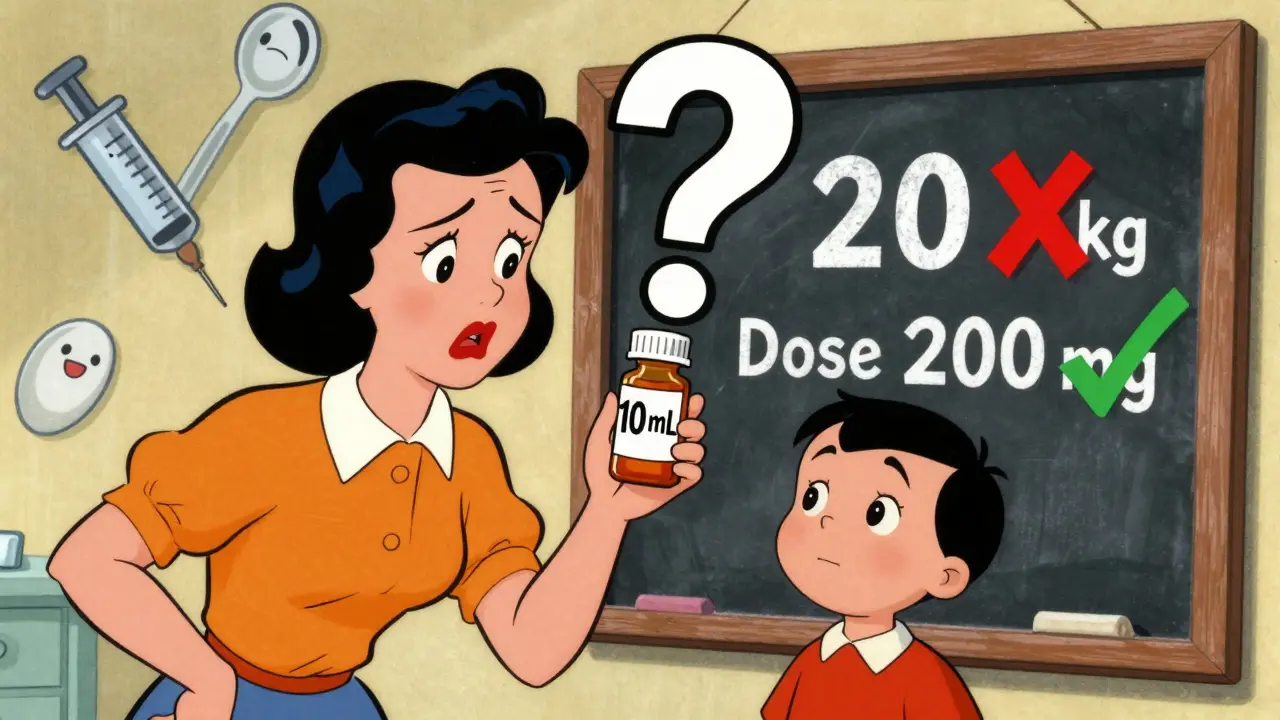
When your child gets a new prescription, the label might say 10 mL - but that’s not the dose. The real dose is 200 mg. Mixing up volume and medication amount is one of the most common - and dangerous - mistakes parents and even some providers make. Pediatric dosing isn’t just a smaller adult dose. It’s calculated precisely based on weight, age, and the drug’s concentration. Getting it wrong can lead to overdose, organ damage, or even death.
Why Pediatric Dosing Is So Different
Children aren’t small adults. Their bodies process medicine differently. A dose that’s safe for a 150-pound teen could be deadly for a 20-pound toddler. According to the Institute for Safe Medication Practices, kids have three times the risk of medication errors compared to adults - and over half of those errors are dosing mistakes. The biggest problem? Prescriptions often list volume (mL) without clearly stating the actual drug amount (mg). A label might say “Give 10 mL,” but if the concentration is 80 mg/mL, that’s 800 mg. If it’s 40 mg/mL, that’s only 400 mg. That’s a 2x difference. One wrong assumption, and you’re giving your child too much - or too little.What to Look for on the Prescription Label
Every pediatric prescription label should include three non-negotiable pieces of information:- The child’s weight in kilograms (kg)
- The dose in milligrams (mg) - not just mL
- The concentration (mg/mL) of the liquid medication
How to Verify the Dose Yourself
You don’t need to be a pharmacist to catch a dangerous error. Here’s how to check it step by step:- Find your child’s weight in kilograms. If the label says 44 lbs, divide by 2.2: 44 ÷ 2.2 = 20 kg. Never guess. Use the exact number on the prescription.
- Find the prescribed dose per kg. The label should say something like “40 mg/kg/day.” Multiply that by your child’s weight in kg: 20 kg × 40 mg/kg = 800 mg total per day.
- Divide by frequency. If it’s given twice a day, divide the total daily dose: 800 mg ÷ 2 = 400 mg per dose.
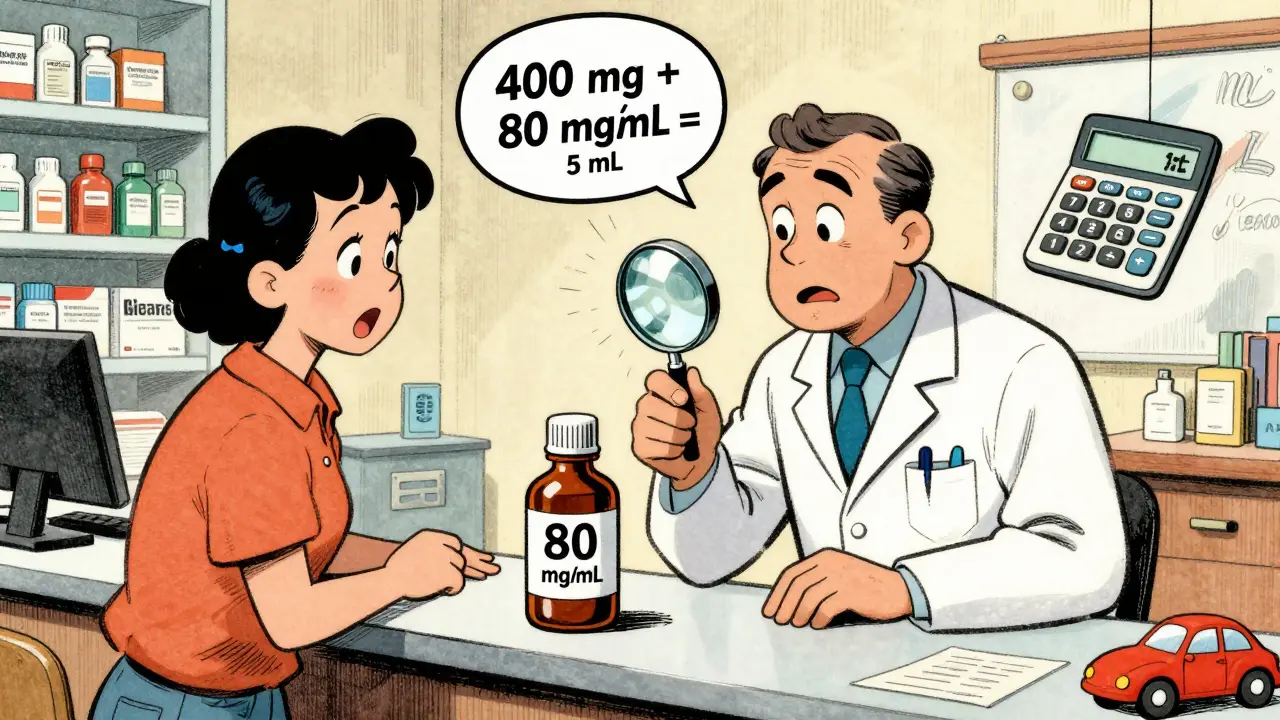
- Check the concentration. Look at the bottle: “Amoxicillin 400 mg/5 mL” means each 5 mL contains 400 mg. So one dose is 5 mL. If the concentration is “80 mg/mL,” then 400 mg = 5 mL (400 ÷ 80 = 5). Always match the mg to the mL.
Common Mistakes That Lead to Overdose
Here are the top three errors parents and providers make - and how to avoid them:- Confusing concentration. Two bottles of amoxicillin might look identical, but one is 40 mg/mL and the other is 80 mg/mL. Giving the same volume from the wrong bottle = double dose. Always check the mg/mL on the bottle and label.
- Using kitchen spoons. A tablespoon is not 5 mL. It’s often closer to 15 mL. Always use the syringe or dosing cup that comes with the medicine.
- Assuming “half a teaspoon” is safe. Dosing instructions like “half tsp” are outdated and dangerous. Modern labels should say “2.5 mL” - precise and measurable.
What Pharmacists Are Required to Do
In hospitals and most pharmacies, pharmacists must verify pediatric doses using a dual-check system. That means two trained professionals independently calculate the dose - using different methods - before it’s dispensed. The standard verification format looks like this:Ordered: 40 mg/kg/day. Reference range: 35-50 mg/kg/day. Weight: 20 kg. Total daily dose: 800 mg. Dose per administration: 400 mg. Concentration: 80 mg/mL. Volume: 5 mL.
If you see this kind of detail on the label or hear it from the pharmacist, you’re in good hands. If not, ask: “Was this dose double-checked?”Technology Is Helping - But You Still Need to Double-Check
Electronic health records like EPIC and Cerner now have built-in safety checks. They flag doses outside the standard range, auto-convert pounds to kilograms, and even alert pharmacists if the concentration doesn’t match the child’s age or weight. New AI tools like DoseSpot’s Pediatric Safety Module cross-reference your child’s weight, age, and diagnosis against 15,000+ evidence-based guidelines. In clinical trials, they caught 99.2% of incorrect doses. But no system is perfect. A 2022 study found that even with these tools, 18.7% of errors came from incorrect weight conversion - like using 1 kg = 2.0 lbs instead of 2.2 lbs. That’s why human verification still matters.
What to Ask the Pharmacist
Don’t be shy. Ask these three questions before leaving the pharmacy:- “What is the exact dose in milligrams, not milliliters?” This forces them to state the actual drug amount.
- “Is this dose appropriate for my child’s current weight?” If they hesitate, ask them to show you the calculation.
- “Can you show me how to measure this with the device that came with it?” Watch them use the syringe. If they reach for a spoon, walk out.
What to Do If You’re Still Unsure
If the math doesn’t make sense, if the concentration seems off, or if you’re just not sure - don’t guess. Call your child’s doctor or pharmacist. Ask for a written copy of the dose calculation. Most providers will be happy to send it to you. You can also check the FDA’s Safe Use of Pediatric Liquid Medicines guide, which lists common medications and their correct concentrations. Or use trusted apps like Medscape’s Dose Calculator - but always cross-check with the label.Final Reminder: Trust Your Instincts
A nurse with 12 years in pediatric ICU once said: “The most dangerous moment is when a parent thinks, ‘This dose looks too small for an adult, but I guess it’s right for my child.’” It’s not too small. It’s exactly right. But if you feel uneasy - you’re right to feel that way. Pediatric dosing is precise. And you are your child’s last line of defense.Always verify weight. Always confirm mg. Always use the right measuring tool. One extra minute of checking can prevent a trip to the ER - or worse.
How do I know if my child’s prescription dose is correct?
Check that the label includes your child’s weight in kilograms (kg), the dose in milligrams (mg), and the concentration (mg/mL). Multiply the weight by the mg/kg dose to get the total daily amount. Then divide by how many times a day it’s given. Finally, divide the dose in mg by the concentration to find out how many mL to give. If any of these numbers are missing, call the pharmacy.
Why is weight in kilograms so important?
All pediatric doses are calculated using mg per kg. If the weight is in pounds and converted incorrectly - like using 1 kg = 2.0 lbs instead of 2.2 lbs - the dose can be off by 10% or more. That’s enough to cause harm. The FDA and American Academy of Pediatrics now require weight in kg on all pediatric prescriptions to prevent this error.
Can I use a kitchen teaspoon to measure liquid medicine?
No. A kitchen teaspoon holds about 15 mL - far more than the 5 mL or 2.5 mL most pediatric doses require. Always use the syringe, dropper, or dosing cup that came with the medicine. These are calibrated to be accurate. Kitchen spoons are not.
What if the pharmacy gives me a different concentration than what the doctor ordered?
If the concentration changes - for example, from 40 mg/mL to 80 mg/mL - the volume you give must change too. A higher concentration means less liquid for the same dose. Always ask the pharmacist to recalculate the mL amount based on the new concentration. Never assume the same volume is correct.
Are there apps or tools to help me verify the dose?
Yes. Apps like Medscape’s Dose Calculator and the FDA’s Safe Use of Pediatric Liquid Medicines guide can help. But always cross-check with the actual prescription label. These tools are backups - not replacements - for verifying the numbers on the bottle.
Kim Hines
December 15, 2025 AT 08:27Just saw this and had to pause. My kid got amoxicillin last month and I totally missed the concentration on the label. Thought 10 mL was 10 mL, no big deal. Turned out it was 80 mg/mL, so I was giving 800 mg instead of 200. Thank you for spelling this out. I’m still shaking thinking about it.
Tiffany Machelski
December 16, 2025 AT 12:27ive been giving my son his med with a kitchen spoon for months and i had no idea it was so off. i thought a tsp was 5ml. i just got the right syringe today. wow. thanks for the wake up call.
SHAMSHEER SHAIKH
December 18, 2025 AT 02:25As a healthcare professional in India, I must commend the clarity and precision of this post. In our clinics, we frequently encounter parents who rely on visual estimation or household utensils to administer medication. The statistics cited here are not surprising; they are a reflection of systemic gaps in patient education. I now print and distribute this guide to every parent who receives a pediatric prescription. The requirement for weight in kilograms and dose in milligrams is not merely bureaucratic-it is life-saving. Thank you for articulating this with such urgency and care.
Souhardya Paul
December 19, 2025 AT 02:35This is exactly why I always ask pharmacists to walk me through the math. Last week, my daughter’s prescription changed concentration, and the pharmacist didn’t adjust the volume. I caught it because I remembered the steps from this post. We need more of this kind of info-not just in hospitals, but in every pharmacy pamphlet, every app, every social media post. It’s not just about safety-it’s about dignity. Parents shouldn’t have to be pharmacists to keep their kids safe.
anthony epps
December 20, 2025 AT 07:54i never knew you had to do math for kids meds. i just gave what the bottle said. now i get it. thanks.
Andrew Sychev
December 21, 2025 AT 14:34THIS IS WHY WE CAN’T HAVE NICE THINGS. PHARMACIES AREN’T EVEN TRYING. MY KID ALMOST DIED BECAUSE THEY GAVE HER THE WRONG CONCENTRATION AND NO ONE CHECKED. I WAS THE ONLY ONE WHO DID THE MATH. THEY ACTED LIKE I WAS BEING HARD TO PLEASE. NO. I WAS BEING A PARENT. AND NOW I’M TERRIFIED TO GIVE HER ANY MEDS AGAIN.
Dan Padgett
December 22, 2025 AT 12:33You know, in my village back home, we used to say, 'A mother’s doubt is the first medicine.' We didn’t have labels or syringes, but we had instinct. Now, with all this science, we still forget that the quiet voice saying 'this doesn’t feel right' is the most accurate tool we have. The numbers matter, yes-but so does the heart that checks them. Thank you for reminding us that being a parent means being the last line, not the last person to ask.
Hadi Santoso
December 22, 2025 AT 22:09as a dad who grew up in indonesia, we never had labeled meds like this. we’d just give a spoonful and hope. now that i’m in the us, this whole system feels overwhelming. but this guide? it’s a lifeline. i printed it out and taped it to the fridge. i even showed my wife’s cousin who just had a baby. we’re all learning together. thank you for making it simple.