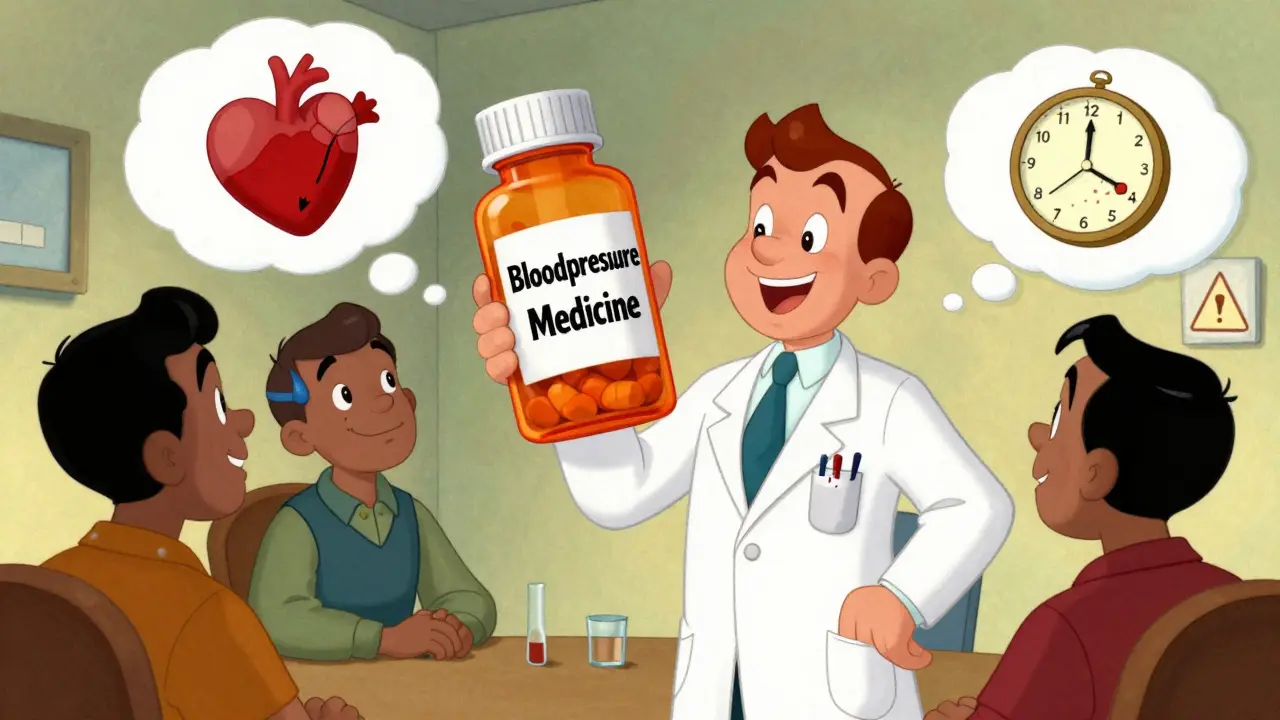
Why Clear Medication Communication Matters
Half of all people taking medication for long-term conditions don’t take it as prescribed. That’s not because they’re careless-it’s because they don’t truly understand what they’re supposed to do. A 2012 World Health Organization report first highlighted this, and since then, studies have only confirmed it: poor communication leads to missed doses, bad side effects, hospital visits, and even death. In the U.S. alone, medication nonadherence costs $300 billion a year. But here’s the good news: it’s fixable. When providers clearly explain medication goals and expectations, adherence jumps. Patients feel heard. They take control. And outcomes improve.
What Patients Need to Know
Patients don’t need a pharmacology lecture. They need to know four things: why they’re taking the medicine, when to take it, what to expect, and what to watch for. Too often, providers say things like, ‘Take this twice a day,’ or ‘Follow the directions.’ That’s not enough. A patient with high blood pressure needs to know: ‘This pill lowers your risk of a stroke. You won’t feel different right away, but in 3 to 4 weeks, your numbers should start dropping. If you feel dizzy or tired at first, that’s normal-it usually passes. If you get a rash or swelling, call us right away.’
Using plain language makes all the difference. Instead of saying ‘take PO BID,’ say ‘take one pill in the morning and one at night.’ Instead of saying ‘reduces your risk by 20%,’ say ‘out of 100 people like you, 10 will have a heart attack in 10 years without this medicine. With it, only 8 will.’ Absolute numbers stick. Percentages confuse.
The Teach-Back Method: Your Most Powerful Tool
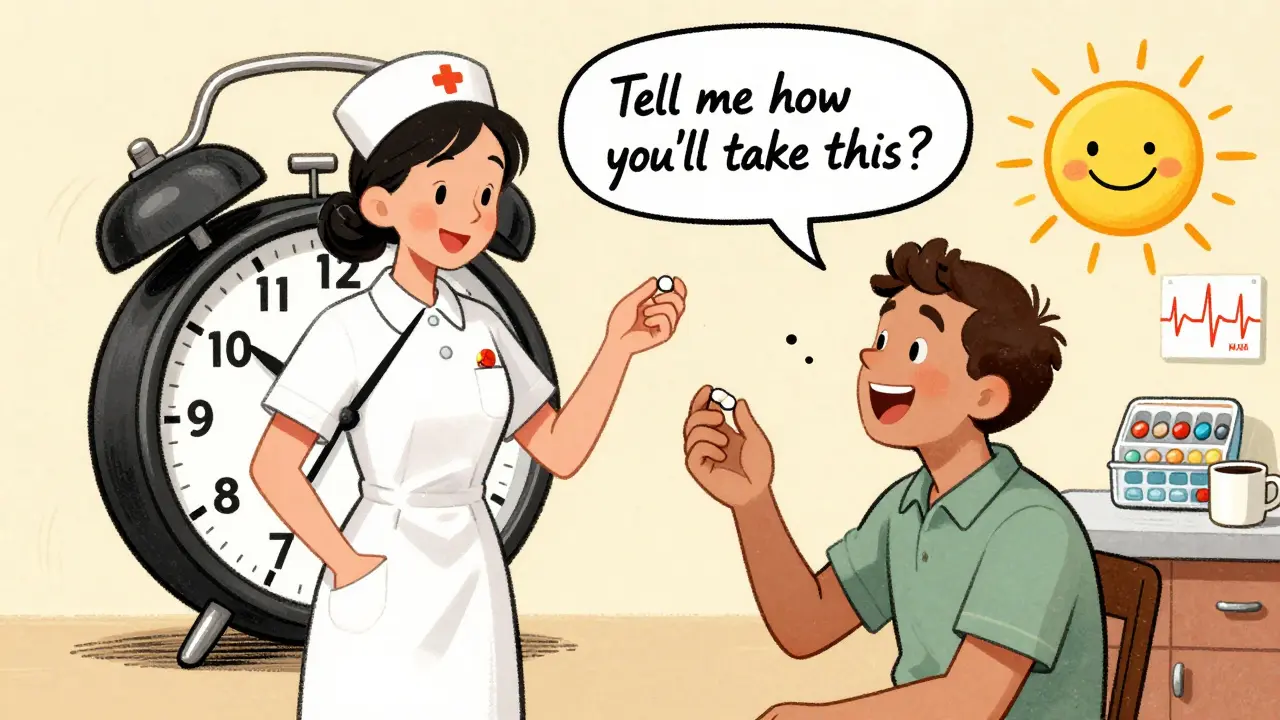
One of the most proven ways to check understanding is called Teach-Back. It’s simple: after you explain something, ask the patient to explain it back to you in their own words. Not ‘Do you understand?’-that’s a yes/no trap. Instead, say: ‘To make sure I explained this clearly, can you tell me how you’ll take this pill each day?’
Studies show this boosts adherence by 23%. The Joint Commission International calls it non-negotiable for high-risk medications. A 2021 study at UCSF found that using Teach-Back increased 30-day adherence from 62% to 84% in patients with diabetes and heart failure. And it doesn’t take extra time. It takes better timing. Say it after you’ve given one or two key points-not at the end of a rushed 10-minute visit.
How to Structure the Conversation
Follow a simple five-step pattern that clinics like Kaiser Permanente use successfully:
- Ask first: ‘What has your doctor told you about this medicine?’ This uncovers misunderstandings before you even speak.
- Explain simply: Use phrases like ‘This works by…’ instead of ‘This inhibits angiotensin-converting enzyme.’
- Give timelines: ‘Most people feel better in 2 to 3 weeks.’ Or ‘It might take 6 weeks to see the full effect.’
- Show, don’t just tell: Hold up the actual pill bottle. Point to the label. Draw a quick clock showing morning and night doses.
- Confirm with Teach-Back: ‘Can you show me how you’ll take this?’
This isn’t extra work-it’s smarter work. It prevents follow-up calls, reduces errors, and builds trust.
Avoid These Common Mistakes
Some phrases sound harmless but cause real harm:
- ‘Take as directed.’ - What does that even mean? Be specific.
- ‘It’s safe.’ - Patients hear ‘safe’ and assume ‘no side effects.’ Say: ‘Most people don’t have issues, but some get dry mouth or dizziness.’
- ‘You must take this.’ - This sounds like an order. Try: ‘Many patients find it helps to take this with breakfast to avoid stomach upset.’
- Using medical terms like ‘hypertension,’ ‘diuretic,’ or ‘compliance.’
The Institute for Safe Medication Practices says 40% of medication errors come from poor communication. Most of them are avoidable.
Time Is Tight-Here’s How to Make It Work
Primary care visits average just 15.7 minutes. You can’t do a 30-minute deep dive. But you don’t need to. Focus on the top 2-3 points per visit. Speak slowly-130 to 150 words per minute. That’s about 20% slower than normal talk. Slower speech improves retention. A 2017 JAMA study found patients remember only 49% of what’s said in a visit. Slow down, chunk the info, and check understanding after each chunk.
Consider scheduling short, dedicated medication review appointments every 3 to 6 months. A 2020 Australian study found this improved communication effectiveness by 37%. If your clinic has pharmacists, use them. Pharmacists-led reviews cut hospitalizations by 22% for patients on five or more medications.

What Patients Really Say
Patients remember how you made them feel. In a 2023 survey, 78% of people who felt they understood their meds said it was because their provider used examples they could relate to. One patient wrote on Reddit: ‘My doctor drew a picture of how the pill worked in my heart. I still remember it.’ Another said on Healthgrades: ‘The nurse had me show how I’d use my inhaler before I left. That’s when I knew I’d get it right.’
On the flip side, 63% of patients said they didn’t feel they could ask questions when the provider was even two minutes over schedule. Rushed communication feels dismissive-even if you’re doing everything else right.
What’s Changing in 2025 and Beyond
Health systems are finally tracking this. Starting in 2025, Medicare will tie bonus payments to how well providers document patient understanding of medications. The Merit-Based Incentive Payment System now includes it. Electronic health records like Epic have built-in templates to prompt providers to record medication goals and patient responses.
Some clinics are testing AI tools that listen to conversations in real time and flag missed Teach-Back moments. Mayo Clinic’s pilot tool caught 92% of communication gaps. That’s not to replace you-it’s to support you. And with 42% of older adults taking at least one unnecessary medication, more providers are now talking about deprescribing: ‘We’re going to try stopping this one and see how you feel.’ That’s a conversation too-and it needs the same clarity.
Final Thought: It’s Not About Compliance. It’s About Partnership.
Medication isn’t a checklist. It’s part of someone’s life. They have jobs, kids, memories of bad side effects, fears of dependency, budgets that don’t stretch. Your job isn’t to make them obey. It’s to help them choose. When you explain clearly, listen openly, and check understanding, you’re not just giving instructions. You’re giving power. And that’s what leads to real, lasting change.
Jay Tejada
January 4, 2026 AT 09:41Allen Ye
January 5, 2026 AT 19:37mark etang
January 6, 2026 AT 03:20josh plum
January 7, 2026 AT 11:53John Ross
January 8, 2026 AT 11:14Brendan F. Cochran
January 9, 2026 AT 10:06Mandy Kowitz
January 9, 2026 AT 22:39Justin Lowans
January 11, 2026 AT 00:40Michael Rudge
January 12, 2026 AT 00:48Ethan Purser
January 12, 2026 AT 18:23Stephen Craig
January 14, 2026 AT 09:55bob bob
January 15, 2026 AT 23:28Joseph Snow
January 16, 2026 AT 17:32