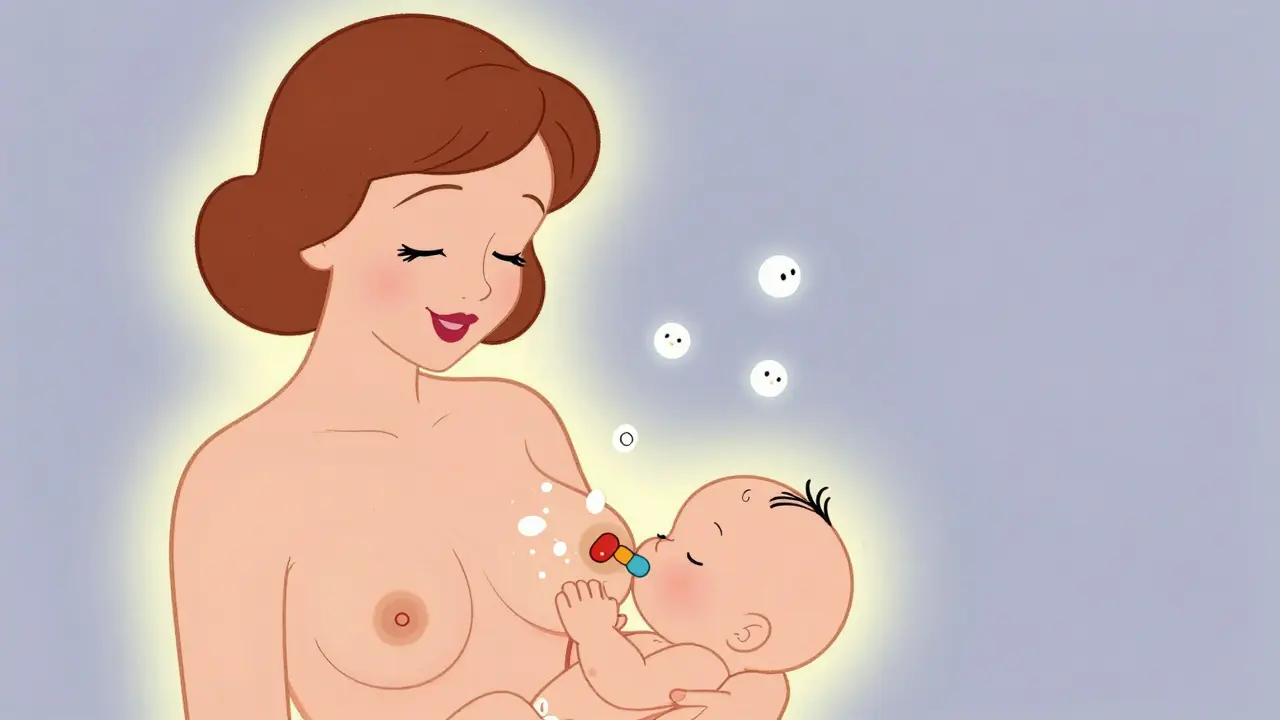
When a breastfeeding mom takes a medication, it doesn’t just stay in her body. It can end up in her breast milk-and then in her baby. This isn’t magic. It’s science. And understanding how it happens can help you make smarter choices without fear or guilt.
How Medications Get Into Breast Milk
Most drugs enter breast milk through a simple process called passive diffusion. Think of it like water seeping through a sponge. When you take a pill, the drug enters your bloodstream. From there, it moves across tiny gaps in the milk-producing cells in your breasts, following the natural flow from higher concentration (your blood) to lower concentration (your milk). About 75% of all medications cross this way.
But not all drugs behave the same. Some use special transport systems in the cells, like a key fitting into a lock. These are called carrier-mediated transport. Drugs like cimetidine and acyclovir use this route, which means their movement isn’t just about concentration-it’s about biology. Then there’s active secretion, where cells literally pump drugs into milk. This happens with about 10% of medications.
The size of the drug matters. If a molecule weighs more than 800 daltons, it usually can’t slip through. Heparin, for example, is huge-15,000 daltons-and barely gets into milk at all. But lithium, at just 74 daltons, slips right through. That’s why small molecules are more likely to reach your baby.
What Makes a Drug More Likely to Transfer
Three big factors determine how much of a drug ends up in your milk: lipid solubility, protein binding, and pH trapping.
Lipid-soluble drugs (those that dissolve in fat) cross membranes easily. Diazepam, for instance, is very fat-friendly and can reach milk concentrations 1.5 to 2 times higher than in your blood. On the flip side, gentamicin is water-soluble and barely makes it into milk-less than 10% of what’s in your blood.
Protein binding is even more important. If a drug sticks tightly to proteins in your blood (like albumin), it can’t float freely to enter milk. Warfarin, which is 99% bound, transfers less than 0.1%. Sertraline is also highly bound (98.5%), but still shows up in milk. Why? Because even 1-2% of free drug can be enough to cross over.
Then there’s pH. Breast milk is slightly less acidic than blood. Weakly basic drugs-like amitriptyline or antidepressants with high pKa values-get trapped in milk. Their molecules change shape in the lower pH and can’t escape back into your blood. This can lead to milk concentrations 2 to 5 times higher than in your bloodstream.
Timing Matters: When You Take the Drug
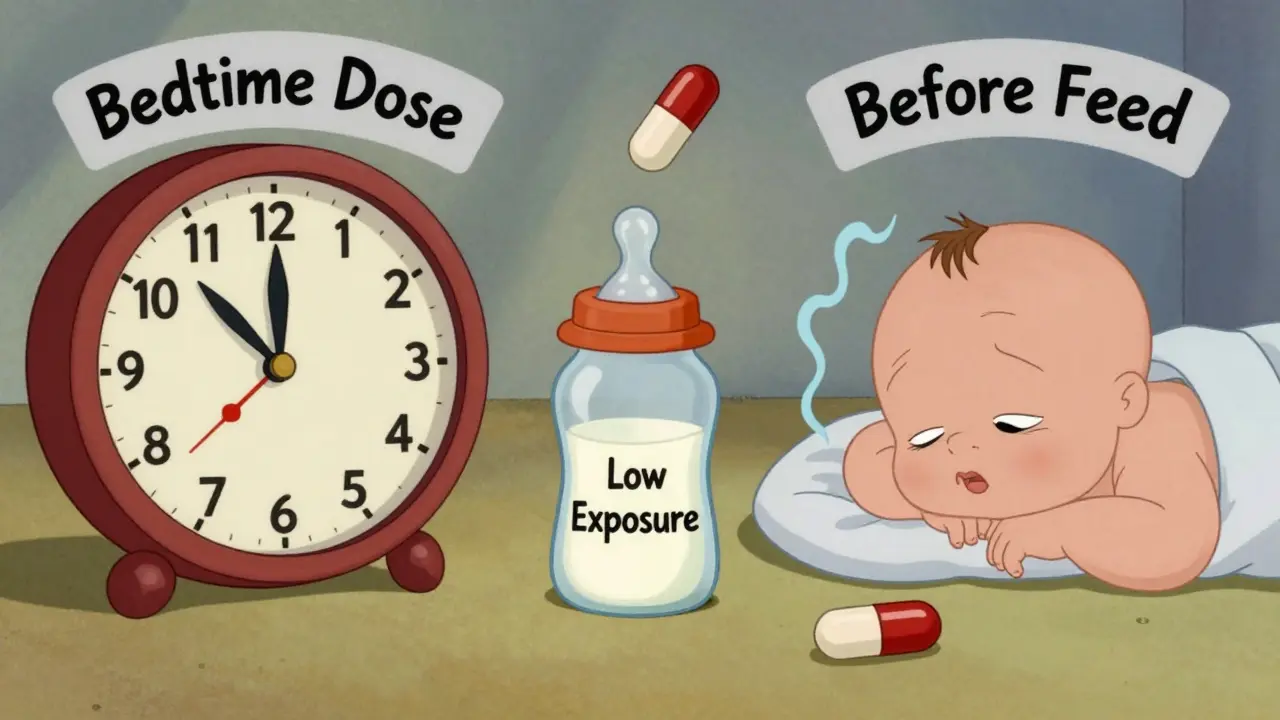
It’s not just about which drug you take-it’s when you take it. Taking your medication right after a feeding gives your body time to break it down before the next feed. If you take it at bedtime, after the last feed of the day, you’re giving yourself 3 to 4 hours of clearance. Studies show this can cut your baby’s exposure by 30-50%.
For drugs with long half-lives-like diazepam, which can linger in a newborn’s system for up to 100 hours-timing becomes critical. A single dose right before a feed could mean your baby gets a heavy hit. Spread it out. Delay it. Space it.
What About Newborns and Premature Babies?
Early postpartum-days 4 to 10-is a unique window. The tight junctions between milk-producing cells are still open. That means even larger molecules, like antibodies or some medications, can slip through more easily. After day 10, those junctions close, and transfer drops by 90%.
Newborns and preemies process drugs differently. Their livers and kidneys aren’t fully developed. A drug that’s harmless in an adult might build up in a baby. That’s why phenobarbital, used for seizures, can accumulate at 15% per week in newborns. For these infants, even small amounts can matter.

Common Medications and What We Know
Let’s look at real-world examples:
- Antibiotics: Amoxicillin transfers at about 1.5% of the maternal dose. Gentamicin? Less than 0.1%. Most antibiotics are considered safe, with no need to stop breastfeeding.
- Antidepressants: Sertraline is the most commonly prescribed. Infant exposure is only 1-2% of the mother’s dose. But some babies show irritability or poor feeding. Monitoring is key. Fluoxetine, on the other hand, has a long half-life and can accumulate, so it’s used more cautiously.
- Pain relievers: Ibuprofen and acetaminophen are low-risk. They transfer minimally and are cleared quickly. Avoid high-dose aspirin-especially in newborns.
- Benzodiazepines: Diazepam transfers at 7.3% of maternal dose. In infants, it can cause drowsiness. If you’re on long-term use, watch for signs of sedation.
- Birth control: Pills with more than 50 mcg of estrogen can cut milk supply by 40-60% within 72 hours. Progesterone-only pills are safer. Don’t use estrogen-heavy options in the first 6 weeks.
What’s Considered Safe?
Most medications are safe. In fact, 87% of commonly used drugs fall into the “usually compatible” category according to the American Academy of Pediatrics. The InfantRisk Center rates drugs on a scale of 1 to 5. Level 1 means no detectable transfer-think insulin, heparin, and most antacids. Level 5 means absolute avoidance-radioactive iodine, for example.
Here’s the truth: fewer than 2% of medications are truly unsafe during breastfeeding. The rest? They just need smart timing, monitoring, or dose adjustment.
One big myth: if a drug is labeled “not recommended” during pregnancy, it’s automatically unsafe in lactation. Not true. The placenta and breast tissue work differently. A drug that crosses the placenta might barely enter milk. Always check the lactation-specific data.
When to Be Concerned
Signs your baby might be affected:
- Unusual sleepiness or difficulty waking to feed
- Poor feeding or decreased weight gain
- Unexplained irritability or crying
- Rash or unusual skin changes
If you notice these, talk to your provider. For SSRIs, some experts recommend checking infant blood levels at 2 weeks if the mother is on a high dose. For benzodiazepines, keep infant serum levels under 50 ng/mL to avoid sedation.
Also, avoid high-dose estrogen contraceptives early on. They’re the #1 known cause of reduced milk supply-not the medication itself, but how it affects your hormones.
What About Nuclear Medicine and Imaging?
Most imaging tests are safe with minor pauses. A VQ scan using Tc-99m MAA? Pause breastfeeding for 12-24 hours. But FDG-PET scans? Only 0.002% of the dose ends up in milk. You can feed right after.
Radioactive iodine (I-131) for thyroid treatment? That’s a Level 5 drug. You must stop breastfeeding completely. There’s no safe threshold.
Why So Many Moms Quit Breastfeeding Over Medication Fears
Here’s the hard truth: 22.4% of mothers stop breastfeeding early because they’re worried about medications. But studies show that 15-30% of those stops are unnecessary. A 2022 study found that most women were told to stop by well-meaning providers who didn’t have updated data.
Doctors aren’t always trained in lactation pharmacology. A 2023 survey showed only 38% of OB-GYNs felt confident advising on breastfeeding and drugs. That’s why apps like the InfantRisk Center’s LactMed (updated January 2023) are so valuable. They use 12 pharmacokinetic factors to give real-time risk assessments.
The CDC says medication concerns are the third most common reason for early breastfeeding cessation-after nipple pain and perceived low supply. That’s tragic. Because in most cases, you don’t have to choose between your health and your baby’s.
The Bottom Line
You don’t need to stop breastfeeding just because you need medication. Most drugs are safe. Most are low-risk. Most can be timed to minimize exposure.
Work with your doctor. Use reliable resources like the InfantRisk Center or LactMed. Don’t rely on outdated pamphlets or Google searches. And if you’re unsure, ask for a lactation consultant or a pharmacist who specializes in breastfeeding.
Remember: your health matters too. Treating depression, infection, or pain doesn’t make you a bad mom. It makes you a smart one. And a healthy mom is better for her baby than a stressed, untreated one.
Chris Dwyer
March 20, 2026 AT 22:06Timing your meds after a feed? Game changer. I started doing that and noticed my little one was way more alert during daytime feeds. Seriously, this post should be mandatory reading.
Thomas Jensen
March 22, 2026 AT 19:49My cousin's baby got jaundice after she took ibuprofen - they said it was 'coincidence' but I'm not buying it. Who funds these studies again?
matthew runcie
March 23, 2026 AT 22:37Most of what I read online is either 'avoid everything' or 'take anything'. This is the middle ground I needed. I'm keeping this for my next pregnancy.
Shaun Wakashige
March 24, 2026 AT 10:56Paul Cuccurullo
March 25, 2026 AT 11:09It is imperative that healthcare providers receive continuing education in lactation pharmacology. The current gap in knowledge is not merely an oversight - it is a systemic failure.
Solomon Kindie
March 27, 2026 AT 06:55everything you put in you're putting out and the science is just corporate spin i mean how many times have we been told something was safe then it got pulled 5 years later
Natali Shevchenko
March 27, 2026 AT 19:30It’s not about whether a drug is 'safe' or 'unsafe'. It’s about the window of exposure. A baby’s metabolism changes every week. A drug that’s fine at 6 weeks might be risky at 3 days.
We treat breastfeeding like it’s a static system. But it’s not. It’s dynamic. And we need to stop treating it like a switch - on or off - and start treating it like a dial.
Johny Prayogi
March 28, 2026 AT 14:40My OB told me to stop nursing on sertraline. I went to a pharmacist who specializes in lactation. She laughed and said 'he clearly hasn't opened LactMed since 2010'.
Nicole James
March 29, 2026 AT 03:55And what about the fact that 90% of pediatricians aren't trained in pharmacokinetics?
Who is really protecting our babies? Or is this just another way to guilt moms into staying 'natural' while Big Pharma profits?
Nishan Basnet
March 31, 2026 AT 00:49I remember my sister being told to stop breastfeeding because she took antibiotics for a UTI. She switched to formula - and regretted it for months.
Knowledge is power. And this is power given with compassion. Thank you.
Allison Priole
March 31, 2026 AT 11:23Turned out my supply dropped like a rock. And my baby cried nonstop. We didn’t get back to full nursing until I found a lactation consultant who knew what she was talking about.
Don’t let fear make you quit. Talk to someone who actually gets it. And if you’re unsure? Reach out. You’re not alone. I’m here if you need to vent. 💛