
Heartburn during pregnancy isn’t just annoying-it’s common. Up to 80% of pregnant people experience it, especially in the second and third trimesters. Your stomach is getting squeezed, hormones are relaxing the valve between your esophagus and stomach, and acid is backing up where it shouldn’t be. It’s not a sign you’re doing anything wrong. But when it hits hard, you start looking for relief-and that’s where things get tricky. Not all heartburn meds are safe during pregnancy. Some can wait. Others? You need to know exactly when and how to use them.
First-Line Defense: Antacids Like Tums
If you’re only just starting to feel the burn, start with antacids. They’re the first thing most doctors recommend. Calcium carbonate, the main ingredient in Tums, works fast. It neutralizes stomach acid right where it is, giving you relief in minutes. And here’s the bonus: you’re not just treating heartburn-you’re also giving your body extra calcium. Your baby needs calcium to build bones, and your body pulls it from your own stores if you don’t get enough. Tums helps both.
Other safe antacids include Rolaids and Mylanta. These usually combine calcium carbonate with magnesium hydroxide. Magnesium helps balance out the constipation that calcium can cause. But watch out for antacids that contain aluminum or magnesium trisilicate. They’re not recommended during pregnancy. Aluminum can build up in your system, and trisilicate has unclear safety data.
How much is too much? Stick to the label: 500-1500 mg of calcium carbonate every 4 to 6 hours as needed. Don’t go over 7,500 mg in a day. Long-term, high-dose use can lead to kidney stones or electrolyte imbalances. And if you’re already taking iron supplements, take antacids at least two hours apart-they can block iron absorption.
When Antacids Aren’t Enough: H2 Blockers
If you’re still burning after a few days of antacids, it’s time to think about H2 blockers. These don’t neutralize acid-they reduce how much your stomach makes. The most commonly used and safest option is famotidine, sold as Pepcid. It starts working in about an hour and lasts up to 12 hours. That means you can take it once at night and sleep through the burn.
Don’t use ranitidine (Zantac). It was pulled from the U.S. market in 2020 because of a cancer-causing contaminant called NDMA. Even if you find it on a shelf somewhere, don’t take it. Famotidine is the new standard.
Other H2 blockers like cimetidine (Tagamet) are also considered safe in pregnancy, but famotidine is preferred because it has more data backing it up. Side effects are rare but can include headaches or dizziness in about 3-5% of users. If you feel off after taking it, talk to your provider. It’s not dangerous, but you should still be monitored.
For Persistent Heartburn: PPIs Like Omeprazole
If you’ve tried antacids and H2 blockers and you’re still struggling-especially if you’re waking up at night with burning or have trouble swallowing-your doctor might suggest a proton pump inhibitor (PPI). Omeprazole (Prilosec) is the most studied PPI in pregnancy. It’s powerful. It shuts down acid production at the source, and its effects last over 24 hours.
Other PPIs like lansoprazole (Prevacid) and pantoprazole (Protonix) are also used, but omeprazole has the most safety data. That doesn’t mean it’s risk-free. A 2019 study in JAMA Pediatrics found a possible link between first-trimester PPI use and childhood asthma, but it didn’t prove cause and effect. Still, doctors are cautious. PPIs are not first or second-line. They’re third-line. Only if you’ve tried everything else and you’re suffering.
Long-term PPI use during pregnancy might affect how well your body absorbs calcium and magnesium. That’s why your provider will monitor you and likely recommend a prenatal vitamin with extra calcium. They’ll also want to make sure you’re not taking it longer than needed.

What to Avoid Completely
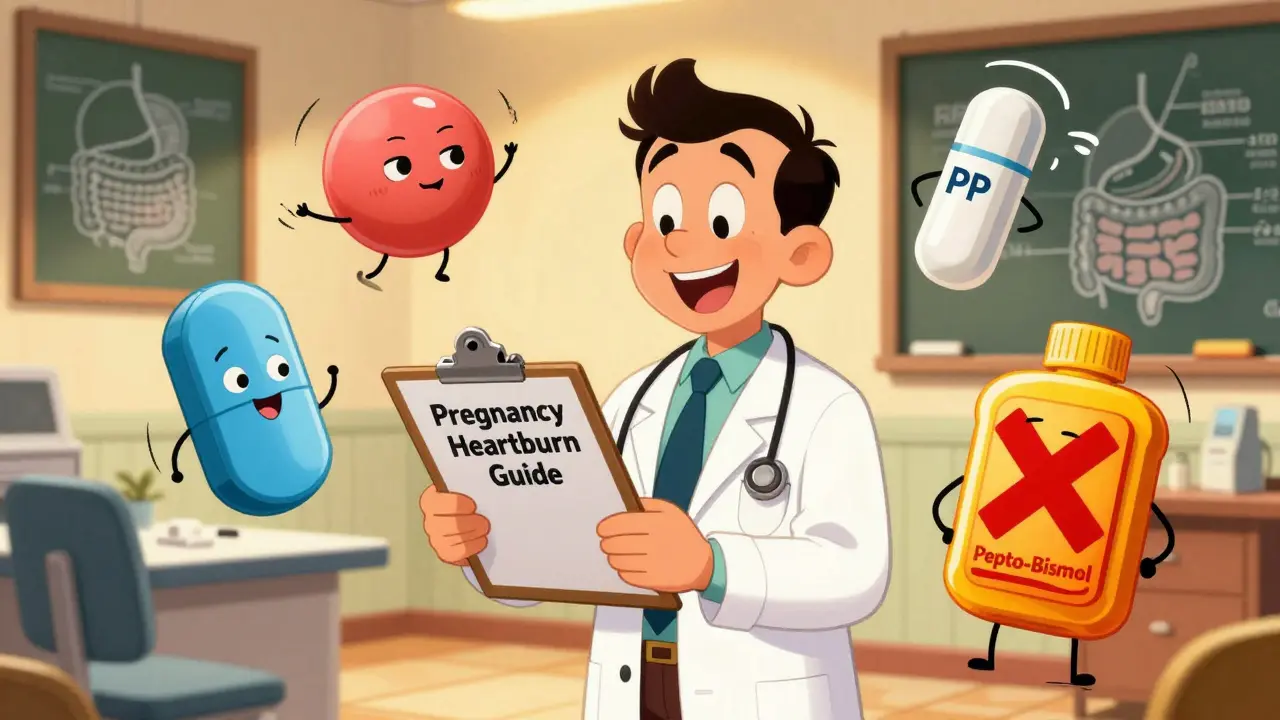
Some heartburn remedies are off-limits during pregnancy. Pepto-Bismol? Don’t touch it. It contains bismuth subsalicylate, which turns into aspirin in your body. Aspirin during pregnancy can cause bleeding problems, low birth weight, or even premature labor. Same goes for any product with salicylates.
Also skip any medication that says “for indigestion” but doesn’t list its ingredients. If you’re unsure, don’t guess. Call your provider or pharmacist. And remember: just because something is sold over the counter doesn’t mean it’s safe for you right now.
Timing Matters: First Trimester Caution
The first 14 weeks of pregnancy are the most sensitive. That’s when your baby’s organs are forming. Even safe medications should be avoided if possible during this time. If your heartburn is mild, stick to lifestyle changes. Eat smaller meals. Don’t lie down for three hours after eating. Avoid spicy, fatty, or acidic foods like citrus, coffee, or chocolate. Sleep with your head slightly elevated. These aren’t just tips-they’re proven ways to reduce symptoms without any medication.
If you’re in your second or third trimester and you need help, the options open up. That’s when antacids, H2 blockers, and even PPIs become reasonable choices under medical supervision. But even then, the goal is to use the least amount for the shortest time.
When to Call Your Provider
Heartburn is normal. Pain that won’t quit? Not always. If you’re having trouble swallowing, vomiting blood, losing weight without trying, or feeling chest pain that radiates to your arm or jaw-get checked. These aren’t typical heartburn signs. They could point to something more serious like a hiatal hernia, GERD complications, or even heart issues.
Also, if you’ve been using antacids daily for more than two weeks and you’re not getting relief, talk to your doctor. You might need a different approach. Or you might need testing. Don’t keep pushing through discomfort thinking it’s just “pregnancy stuff.”
Non-Medication Strategies That Actually Work
Medications help, but they’re not the whole story. Many women find that changing how they eat and live makes the biggest difference.
- Eat five or six small meals instead of three big ones.
- Wait at least three hours after eating before lying down or going to bed.
- Wear loose clothes. Tight waistbands put pressure on your stomach.
- Stay upright after meals. Don’t slouch.
- Drink fluids between meals, not during. Too much liquid during meals can overfill your stomach.
- Try chewing gum after meals. It increases saliva, which helps neutralize acid.
- Keep a food diary. What triggers your heartburn? It’s often different for everyone.
These steps don’t require a prescription. But they can cut your need for meds by half-or more.
Final Thought: It’s Personal
There’s no one-size-fits-all answer. What works for your friend might not work for you. Your body, your pregnancy, your history-all of it matters. That’s why talking to your provider before taking anything is non-negotiable. Even something as simple as Tums should be discussed if you have kidney issues, high blood pressure, or are on other medications.
The goal isn’t to eliminate heartburn completely. It’s to manage it safely so you can rest, eat, and feel like yourself again. You’re not alone in this. Millions of people have been here. And with the right info, you can get through it without putting your baby at risk.
Andrea Di Candia
December 24, 2025 AT 00:42So many of us are told to just 'deal with it' during pregnancy, but this breakdown is actually life-changing. I didn’t realize Tums could help with calcium too-I thought it was just a quick fix. Now I’m taking them after every meal and actually sleeping through the night. Thank you for writing this with so much care.
Also, the part about chewing gum? Genius. I started doing that after dinner and it’s like magic. No meds needed for half the day now.
Dan Gaytan
December 24, 2025 AT 17:25This is the kind of post that makes me believe in Reddit again. 🙏
My wife went from crying at 2 a.m. to actually enjoying meals again after switching to famotidine. We were terrified of meds until we read this. You saved her sanity-and mine.
Also, the food diary tip? We started one and found out pineapple was her trigger. Who knew? Now we just skip it. Small wins, right?
claire davies
December 26, 2025 AT 11:25As someone who’s been through three pregnancies across three continents, I’ve seen everything from traditional Ayurvedic remedies to Western pharmaceuticals-and honestly? This guide nails it. No fluff, no fearmongering, just clear, evidence-based info.
In the UK, we’re taught to avoid PPIs unless absolutely necessary, but here in the States, it feels like doctors reach for them too fast. I’m glad you emphasized the third-line status. So many women don’t know they can try lifestyle tweaks first-and they work better than you’d think.
Also, the ‘don’t lie down for three hours’ rule? My mum swore by it in the 70s. Turns out, she was onto something. Old wisdom + modern science = unstoppable combo.
And please, for the love of all that’s holy, stop telling pregnant people to ‘just eat less’. Your stomach isn’t a vending machine. It’s a sacred space right now. Treat it like one.
Chris Buchanan
December 26, 2025 AT 23:20Oh wow, so now we’re recommending chewing gum as a medical intervention? Next they’ll say laughing yoga cures GERD.
Jk. Actually, this is shockingly good. I didn’t expect a medical guide to be this readable. Props. I’m forwarding this to my sister-in-law who’s 32 weeks and screaming into pillows at 3 a.m. She’ll thank me later.
Diana Alime
December 27, 2025 AT 00:47why is no one talking about how big pharma is pushing these meds? Tums is just a fancy chalk pill and they want you to buy it every day. I took zantac for years before it got pulled and I’m fine. They just want to scare you so you keep buying stuff. Also, why is omeprazole even allowed? It’s basically a chemical shutdown. I’d rather eat ginger and suffer.
also i think they’re lying about the calcium thing. my mom had 4 kids on just milk and lime juice. we all turned out fine.
Joe Jeter
December 28, 2025 AT 07:40Let me guess-this was written by a pharmaceutical rep with a side hustle in maternal health blogging. Tums ‘helps with calcium’? So does eating dirt. And you’re telling people to take PPIs like they’re vitamin gummies? No wonder infant reflux is through the roof. You’re normalizing chemical dependency in pregnancy like it’s a yoga retreat.
Also, ‘don’t use Zantac’? Funny, because the real reason it was pulled was because the FDA was pressured to replace it with pricier alternatives. Wake up.
And chewing gum? That’s not medicine, that’s a distraction tactic. You’re not healing anything-you’re just numbing it. Pathetic.
bharath vinay
December 28, 2025 AT 15:10you know what they dont tell you? all these meds are linked to the 5g rollout. the same companies that make ppi's also make cell tower tech. they want you to be constantly stressed so your body produces more acid so you keep buying their pills. tums? made by the same people who invented 5g. its all connected. i read it on a forum. my cousin's neighbor's dog got sick after a new router was installed. coincidence? i think not.
also why is calcium carbonate safe but magnesium hydroxide is not? because the government controls magnesium. they dont want you to sleep better. wake up.
Bhargav Patel
December 28, 2025 AT 23:08One must approach the matter of pharmacological intervention during gestation with the utmost circumspection, for the developing organism is exquisitely sensitive to exogenous chemical agents. While antacids such as calcium carbonate may appear innocuous, their chronic use may precipitate metabolic alkalosis, particularly in the context of altered renal physiology inherent to pregnancy.
The recommendation of famotidine as a preferred H2 blocker is empirically sound, given its favorable pharmacokinetic profile and minimal placental transfer, as documented in multiple cohort studies from the 1990s onward. However, one must remain vigilant against the creeping normalization of pharmacotherapy in conditions that are, at their core, physiological adaptations.
Proton pump inhibitors, while efficacious, disrupt the gastric acid barrier-a natural defense mechanism that has evolved over millennia. To suppress it for convenience, particularly in the first trimester, is to risk unintended consequences on fetal microbiome seeding and nutrient absorption pathways that remain incompletely understood.
It is worth noting that the majority of heartburn symptoms in pregnancy are attributable to mechanical displacement and hormonal modulation, not pathological hypersecretion. Hence, non-pharmacological interventions-postural adjustment, meal fractioning, avoidance of trigger foods-should be rigorously prioritized before any pharmacological step is taken.
The suggestion to chew gum is not merely anecdotal; it is neurophysiologically grounded. Salivary stimulation enhances esophageal clearance and buffers residual acid, a mechanism as elegant as it is underutilized. One might even posit that this simple act constitutes a form of biofeedback, restoring autonomic equilibrium.
Moreover, the demonization of Pepto-Bismol is entirely justified, given its salicylate content. Aspirin’s teratogenic potential in early gestation is well-documented in the literature of obstetric toxicology. To conflate it with benign over-the-counter remedies is a dangerous rhetorical error.
Ultimately, the goal is not the eradication of discomfort, but the preservation of physiological integrity. We must not mistake symptom suppression for healing. The body is not malfunctioning-it is adapting. Our role is not to override it, but to support it with wisdom, restraint, and reverence.
And yes, I have read every word of this post. And I approve.
siddharth tiwari
December 29, 2025 AT 21:51omg i just found out tums has calicum?? i thought it was just chalk?? wait but what if its laced with microchips?? i heard the gov is putting them in all prenatal stuff now so they can track the baby before birth. i asked my pharmacist and he just laughed. that means he knows. i’m only taking ginger tea now. and sleeping with a magnet under my pillow. it blocks the 5g signals. trust me i read it on a blog.
Usha Sundar
December 30, 2025 AT 02:28I took Tums for 6 months straight. My kid was born with a full head of hair. Coincidence? I think not.
Jeffrey Frye
December 31, 2025 AT 16:58Let’s be real-this entire post reads like a sponsored blog post disguised as medical advice. Antacids are fine, sure, but you’re glossing over the fact that calcium carbonate can interfere with thyroid meds, iron, and even antibiotics. And you didn’t mention that PPIs are linked to increased risk of C. diff infections in neonates? Or that famotidine has been associated with transient fetal bradycardia in rare case reports? You’re not educating-you’re sanitizing risk. And for that, you’re doing a disservice. Next time, include the *real* trade-offs. Not just the marketing-friendly bullet points.