Green Tea & Warfarin Calculator
Enter your green tea consumption to see your risk level
If you're taking warfarin, your doctor checks your INR regularly to make sure your blood isn't clotting too easily-or too slowly. But what you drink, especially green tea, can throw that balance off. It’s not about cutting out tea completely. It’s about understanding how much, how often, and what kind you’re drinking.
How Warfarin Works-and Why Vitamin K Matters
Warfarin, sold under brands like Coumadin and Jantoven, keeps your blood from clotting too fast. It does this by blocking vitamin K, which your body needs to make clotting factors. Without enough vitamin K, your blood takes longer to clot. That’s good if you have atrial fibrillation, a mechanical heart valve, or a history of blood clots. But if your vitamin K intake jumps up suddenly, warfarin can’t do its job as well. Your INR drops. And that raises your risk of stroke or a dangerous clot.
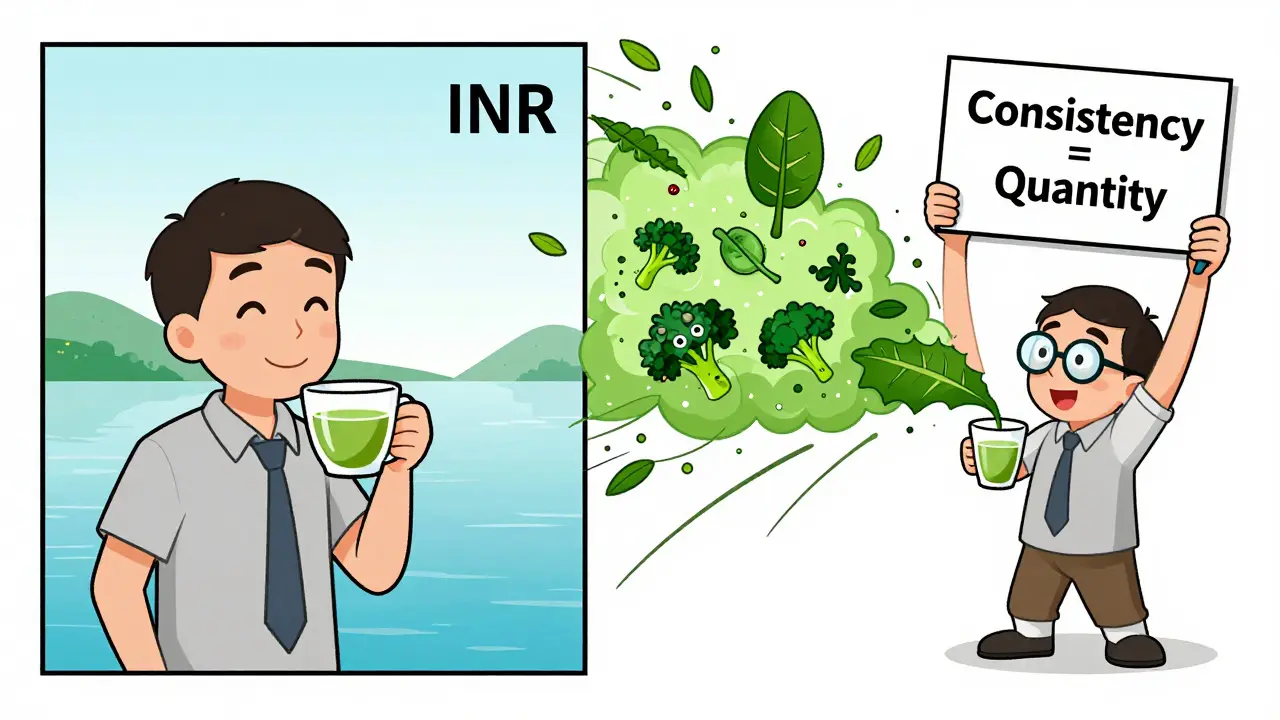
The key isn’t avoiding vitamin K entirely. It’s keeping it consistent. The American Heart Association says patients on warfarin should aim for the same amount of vitamin K every day-not zero, not a lot, not random. That’s why spinach, kale, and broccoli are often mentioned. But green tea? It’s different.
Green Tea Has Vitamin K-but Not Much in a Cup
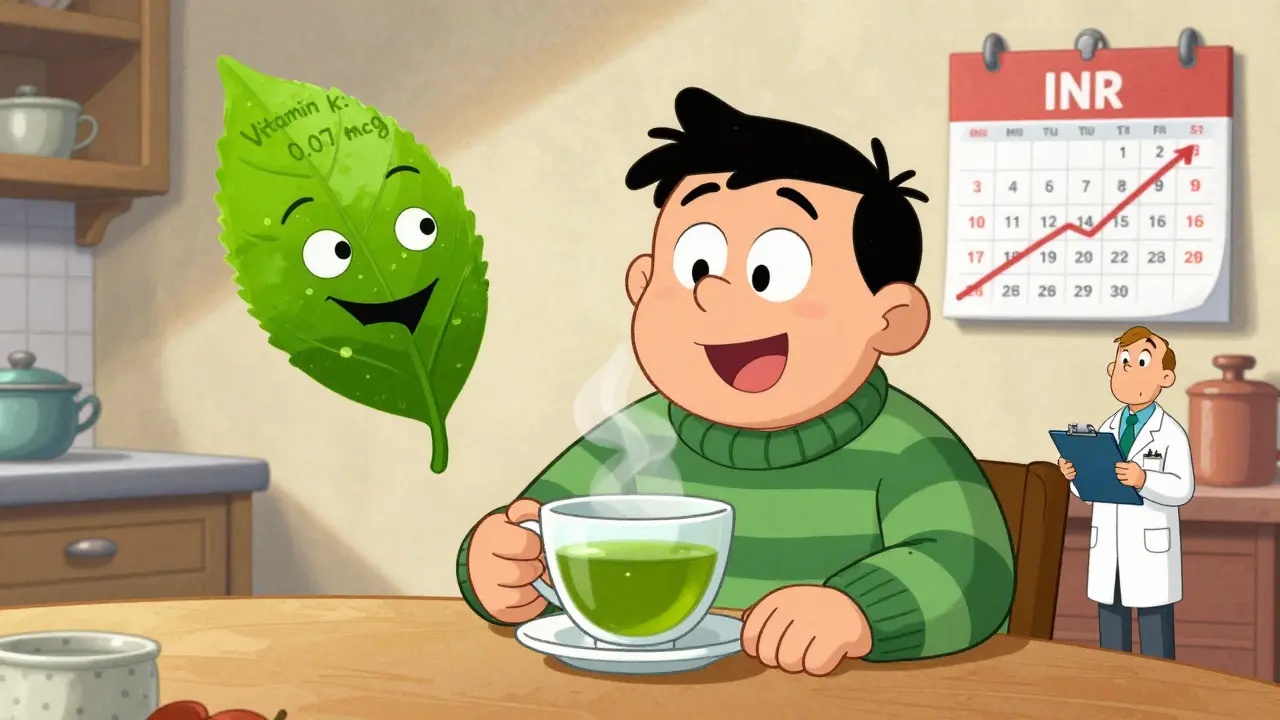
Here’s the twist: dried green tea leaves are packed with vitamin K-over 1,400 micrograms per 100 grams. But when you brew tea, most of that stays in the leaves. A typical cup of brewed green tea (240 mL) contains only about 0.07 micrograms of vitamin K. That’s less than 1% of the daily requirement for adults.
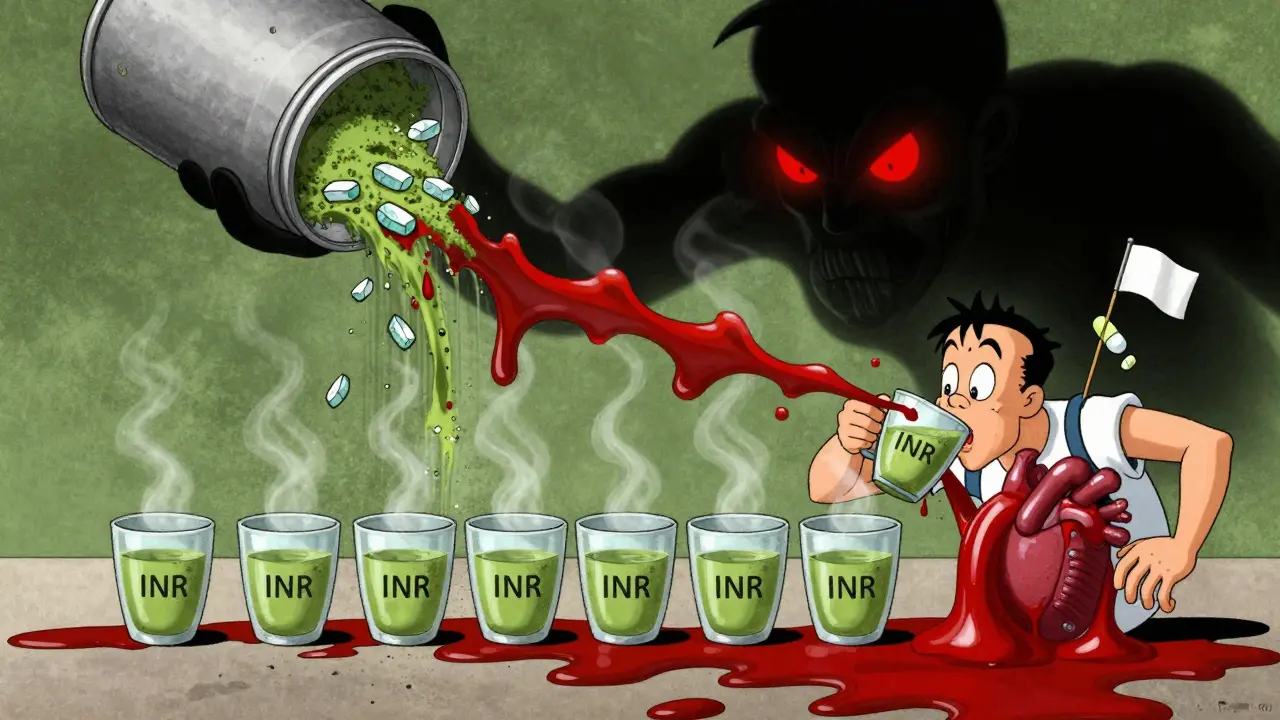
So why do people on warfarin have trouble with it? Because some people drink a lot of it. One documented case involved a man who drank half a gallon to a full gallon of green tea every day. His INR crashed from 3.79 to 1.37 in weeks. That’s not a fluke. It’s the vitamin K adding up.
Compare that to spinach: 100 grams of raw spinach has 483 micrograms of vitamin K. One cup of cooked spinach has more vitamin K than 100 cups of green tea. But people don’t drink 100 cups of tea daily. They do drink 5, 6, or even 10 cups. And that’s where the problem starts.
Matcha Is the Real Risk
If you’re drinking matcha, you’re not just drinking tea-you’re eating the whole leaf. Matcha is powdered green tea. You’re consuming the leaf directly, not steeping it. That means you’re getting nearly all the vitamin K that’s in the leaves.
Research shows matcha has 10 to 20 times more vitamin K than regular brewed green tea. A single teaspoon of matcha powder (about 2 grams) can contain up to 10-20 micrograms of vitamin K. That’s the same as eating a small serving of broccoli. If you have two matcha lattes a day, you’re adding 20-40 micrograms of vitamin K to your diet. That’s enough to interfere with warfarin, especially if you’re on a low dose.
One patient on Reddit reported his INR dropped from 2.8 to 1.9 after drinking four matcha cups daily for two weeks. His doctor had to increase his warfarin dose by 15%. That’s not rare. Doctors at Mayo Clinic say 15% of patients switching to matcha need dose adjustments.
It’s Not Just Vitamin K-Catechins and Caffeine Play a Role Too
Green tea doesn’t just have vitamin K. It’s full of catechins-antioxidants that may actually thin your blood by stopping platelets from sticking together. That’s the opposite of vitamin K. So why don’t these effects cancel out?
Because they don’t work the same way or at the same time. Vitamin K works in the liver to activate clotting factors. Catechins affect platelets in your bloodstream. Warfarin’s effect lasts 20 to 60 hours. Vitamin K from tea gets absorbed in 3 to 6 hours. So if you drink a big cup of green tea in the morning, your vitamin K spikes while warfarin is still active. The vitamin K wins.
Caffeine? It doesn’t directly affect INR. But it can make you feel jittery, and if you start drinking more tea to stay alert, you might end up drinking more than you realize.
How Much Is Safe? The Numbers That Matter
There’s no magic number that works for everyone. But based on guidelines from Mayo Clinic, UC San Diego, and the American Heart Association, here’s what the data says:
- 1-3 cups per day (240-720 mL): Generally safe. Most people on warfarin can drink this without INR changes. Stick to regular brewed tea, not matcha.
- 4-5 cups per day (960-1,200 mL): Monitor closely. Your doctor may want to check your INR more often, especially if you’re new to this amount.
- More than 5 cups or 1,000 mL per day: High risk. This is when vitamin K starts to noticeably reduce warfarin’s effect. Your dose may need adjustment.
- Matcha daily: Treat it like a vitamin K-rich food. Even one teaspoon a day can affect INR. Track it like you would spinach or kale.
Also, don’t suddenly stop drinking tea if you’ve been having it regularly. One woman stopped drinking black tea after years of daily consumption. Within a week, her INR jumped from 1.7 to 5.0-dangerously high. Stopping a consistent habit can be just as risky as starting it.
What About Other Teas and Herbal Drinks?
Not all teas are the same.
- Black tea: Similar to green tea in vitamin K content. Safe in moderation. No major interaction reported.
- Cranberry juice: This one is different. It doesn’t have vitamin K. Instead, it interferes with how your liver breaks down warfarin. That can make your INR go up. Avoid it.
- Ginkgo, ginseng, goji berry tea: These can increase bleeding risk on their own. They don’t affect vitamin K, but they can make you bleed more easily. Use caution.
- Grapefruit juice: Doesn’t interact with warfarin, but it’s dangerous with statins. Don’t confuse the two.
Green tea is unique because it has two opposing effects: vitamin K (thickens blood) and catechins (thins blood). But in real life, the vitamin K effect wins when you drink a lot. That’s why doctors focus on quantity, not the tea itself.
What Should You Do?
You don’t need to give up green tea. But you do need to be smart about it.
- Know your type: Are you drinking brewed green tea or matcha? Matcha is riskier.
- Stick to a consistent amount: If you drink two cups a day, keep doing it. Don’t skip for a week, then drink five on the weekend.
- Track your intake: Use a journal or an app like WarfarinWise. Log how much you drink and when. Many patients who track their intake have 22% fewer INR swings.
- Tell your doctor: Don’t wait until your INR is off. Mention your tea habits at every appointment.
- Don’t panic if your INR changes: A small fluctuation doesn’t mean you have to quit tea. Your doctor can adjust your dose. But if you’ve recently increased your tea intake, that’s likely the cause.
Most warfarin users who drink 1-3 cups of brewed green tea daily have no issues. The problem isn’t tea. It’s inconsistency and overconsumption.
Why So Many People Are Confused
A 2022 survey by the National Blood Clot Alliance found that 62% of warfarin users didn’t know green tea could affect their INR until they had a problem. Another 38% stopped drinking it entirely-just to be safe. That’s unnecessary. You’re not supposed to live in fear of your favorite drink.
Doctors and pharmacists report that 42% of dietary questions from warfarin patients involve green tea. Most of those cases only needed simple advice: “Keep it to three cups a day. Avoid matcha unless you’re tracking it.”
The real danger isn’t the tea. It’s the silence. People don’t tell their doctors. They assume it’s harmless. Or they think they’re being careful by drinking less, but then they switch to matcha without realizing the difference.
Looking Ahead: What’s Changing
Researchers are working on genetically modified tea plants with lower vitamin K. It’s early, but it could mean safer tea for people on blood thinners in the future.
Meanwhile, newer anticoagulants like apixaban and rivaroxaban don’t interact with vitamin K at all. But they’re not right for everyone. People with mechanical heart valves still need warfarin. So this interaction isn’t going away.
For now, the best advice is simple: Be consistent. Be aware. And don’t assume tea is harmless just because it’s natural.
Doreen Pachificus
January 6, 2026 AT 06:15Just drank my third cup of green tea this morning and now I’m second-guessing everything. I thought it was harmless. Guess I’m one of those 62% who didn’t know.
bob bob
January 7, 2026 AT 13:48My grandma drank 6 cups a day and lived to 94. She never checked her INR either. Maybe the real issue is doctors overcomplicating things?
Vicki Yuan
January 8, 2026 AT 07:27Consistency is everything. I switched from black tea to green tea last year and kept it at exactly two cups daily. My INR has been rock-stable since. No drama, no panic. Just routine.
Uzoamaka Nwankpa
January 9, 2026 AT 06:03They say matcha is dangerous but never mention that most commercial matcha lattes are 90% sugar and powdered milk. Who even knows how much actual tea is in those?
Abhishek Mondal
January 9, 2026 AT 22:53Let’s be honest: the entire premise is flawed. Vitamin K in tea is negligible, and catechins are not bioavailable in the quantities consumed. This is fear-mongering disguised as medical advice. The real risk? Overmedication.
Terri Gladden
January 10, 2026 AT 11:33i switched to matcha last month and my inr went from 2.1 to 1.4 and i didnt even know why until my dr screamed at me lol
Jennifer Glass
January 10, 2026 AT 21:53It’s fascinating how something so simple-tea-can have such layered effects on the body. The fact that vitamin K and catechins oppose each other but vitamin K wins? That’s biology in action. No magic, just chemistry.
I’ve started logging my tea intake in a little notebook. It’s weirdly calming. Like a ritual. And now I know why.
Also, I used to think herbal teas were safe. Turns out ginkgo and ginseng are sneaky. I’m switching to chamomile now. No vitamin K, no bleeding risk. Just peace.
Ethan Purser
January 12, 2026 AT 11:30YOU’RE ALL MISSING THE POINT. This isn’t about tea. It’s about control. The medical industry wants you dependent. They don’t want you to know that nature-real, unprocessed, ancient things like tea-can be trusted. You’re being manipulated into fear. Your INR is a number, not your soul.
I stopped warfarin last year. Started drinking 10 cups of green tea daily. I feel better than I have in decades. My doctor panicked. I didn’t. I chose my body over their charts.
They’ll never tell you this, but warfarin was originally developed as rat poison. Who are you really trusting here?
Joseph Snow
January 13, 2026 AT 10:27There is no peer-reviewed evidence that moderate green tea consumption significantly alters INR in a clinically meaningful way. The case studies cited are anecdotal, and the sample sizes are negligible. This article reads like a marketing pamphlet for pharmaceutical companies pushing expensive alternatives like apixaban.
Also, the claim that 15% of matcha users require dose adjustments? Where is the citation? This is pseudoscience dressed in lab coats.
melissa cucic
January 13, 2026 AT 15:09I appreciate the thoroughness of this post, and I agree with the emphasis on consistency-this is critical for all anticoagulant therapy, not just warfarin. However, I would like to see more explicit reference to the FDA’s guidance on dietary vitamin K and INR variability.
Additionally, the distinction between brewed tea and matcha is well-made, but it should be clarified that vitamin K content varies significantly based on soil, season, and processing-so even matcha isn’t a monolith.
Finally, I’d urge readers to consider that INR fluctuations are multifactorial: antibiotics, alcohol, sleep, even stress can alter results. Tea is one variable among many. Don’t fixate on it to the exclusion of the bigger picture.
That said, logging intake? Brilliant. I’ve started doing that too. It’s empowering, not frightening.