How many times have you heard that you need to drink eight glasses of water a day? Or that chewing gum stays in your stomach for seven years? These aren’t just harmless jokes-they’re myths that shape how people care for their health. And when those myths stick, they can lead to bad decisions, wasted money, and even real harm. The truth is, most of the health advice we’ve grown up with isn’t backed by science. It’s been passed down like a family recipe-wrong ingredients and all.
Myth: You Lose 70-80% of Your Body Heat Through Your Head
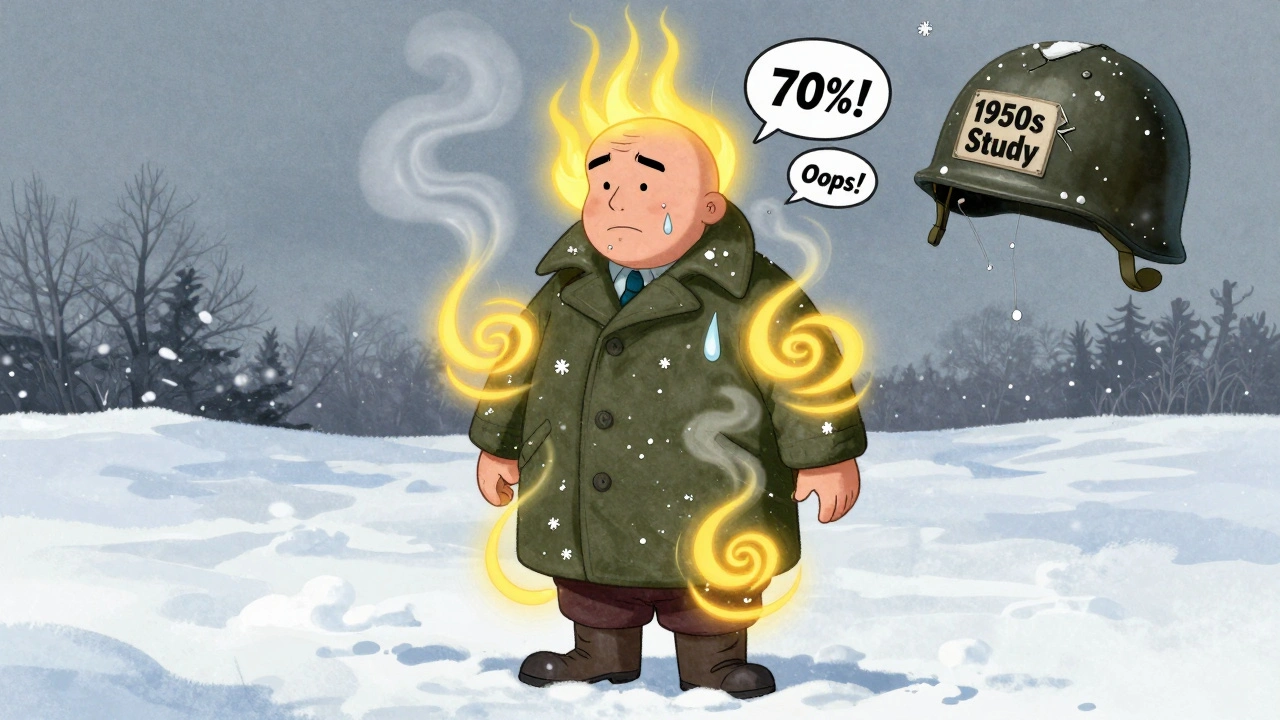
This one’s been around for decades, often repeated in winter safety tips. The idea is simple: if you don’t wear a hat, you’ll freeze. But here’s the reality-your head doesn’t lose heat any faster than any other uncovered part of your body. A 2023 study in BBC Science Focus Magazine showed the head makes up only about 7% of your total body surface area. So if you’re cold and your head is bare, yes, you’ll lose heat from your head. But you’ll lose just as much from your arms, legs, or torso if they’re exposed too. The myth started from a flawed military study in the 1950s where subjects wore Arctic gear but left their heads uncovered. No surprise-they got cold fast. But that didn’t mean the head was special. It just meant it was the only thing left out.
Myth: You Need Eight Glasses of Water a Day
Drink eight glasses. That’s the rule, right? Wrong. There’s no scientific study that ever proved this number. In fact, Dr. Heinz Valtin from Dartmouth Medical School reviewed decades of research in 2002 and found zero evidence supporting the claim. Your body gets water from food, coffee, tea, milk-even fruits and vegetables. The real signal? Thirst. If you’re not thirsty and your urine is pale yellow, you’re likely hydrated. Forcing down eight glasses a day might just mean you’re peeing more than you need to. And for people with certain health conditions, too much water can be dangerous.
Myth: We Only Use 10% of Our Brain
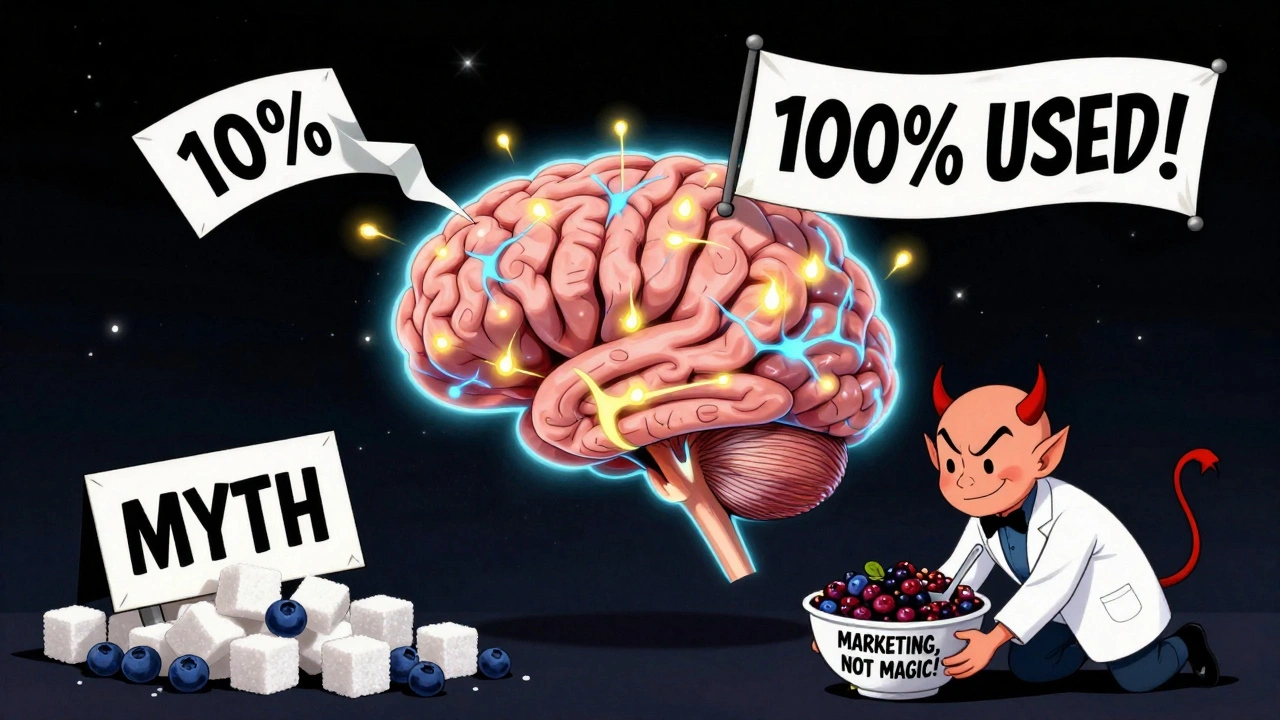
This myth shows up in movies all the time-someone takes a drug and suddenly unlocks 100% of their brain power. It sounds cool. But it’s nonsense. Modern brain imaging, like fMRI scans, shows activity across the entire brain-even during simple tasks like blinking or sipping coffee. Every part has a function. The 10% myth comes from a misreading of psychologist William James’ writings in the 1920s. He talked about untapped potential, not unused brain tissue. Neuroscientists at the University of Alabama at Birmingham confirmed in 2022 that there’s no dormant 90% waiting to be activated. Your brain burns 20% of your body’s energy-even when you’re resting. Evolution doesn’t waste that much energy on useless tissue.
Myth: Sugar Makes Kids Hyperactive
Party time. Cake. Candy. Kids go wild. It’s obvious, right? Wrong. Over 23 double-blind studies have looked at this, including a major 2021 meta-analysis in JAMA Pediatrics. None found a link between sugar and hyperactivity. So why do parents swear it’s true? Because they expect it to happen. When parents believe sugar causes chaos, they see chaos-even when the child had no sugar. The real issue? The context. Birthday parties are exciting. Kids are running around, loud music, lots of attention. That’s what’s driving the energy, not the cupcakes. And here’s the kicker: the sugar industry spent decades funding research and lobbying to keep this myth alive. Internal Medicine Archives documented efforts dating back to the 1990s to deflect blame from processed foods.
Myth: Chewing Gum Stays in Your Stomach for Seven Years
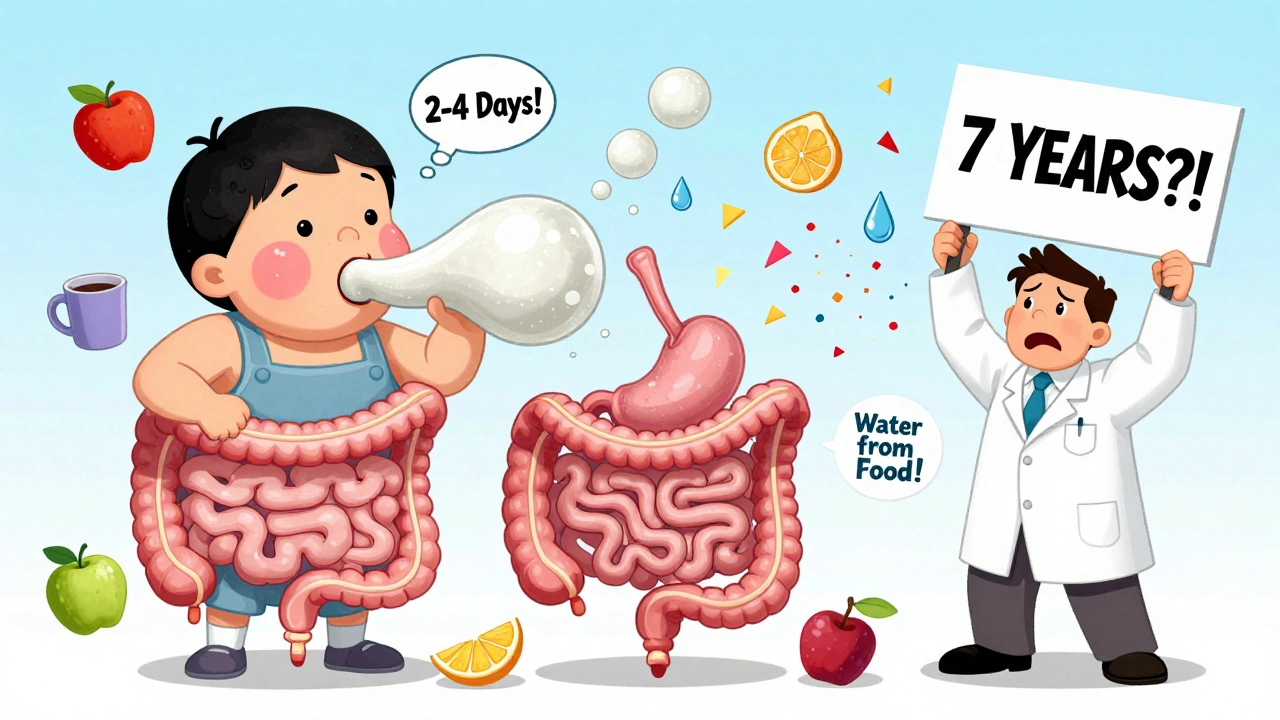
Parents use this one to scare kids into spitting out gum. But it’s a lie. Chewing gum doesn’t digest-but it doesn’t stick around either. Dr. Ian Tullberg, a family medicine specialist at UCHealth, confirmed in 2022 that gum passes through your digestive system in two to four days, just like any other food. It doesn’t get absorbed, but it doesn’t get stuck. Your intestines move it along. The myth persists because it’s vivid and scary. But if gum really stayed in your stomach for seven years, we’d see a lot more hospital cases. We don’t.
Myth: Superfoods Like Acai or Goji Berries Are Miracle Cures
They’re expensive. They’re trendy. And they’re marketed as health powerhouses. But according to the European Food Information Council, “superfood” isn’t a scientific term. It’s a marketing label. Goji berries have antioxidants? So do blueberries. Acai has more polyphenols than strawberries? So what-strawberries are cheaper and just as good. Nutritional science doesn’t support the idea that one food can fix your health. What works is balance: vegetables, whole grains, lean protein, healthy fats. No single food is magic. And if a product claims to be a “superfood,” check the price tag. You’re paying for the label, not the science.
Why Do These Myths Stick Around?
It’s not that people are stupid. It’s that myths are easier to remember than facts. They’re simple, emotional, and often tied to culture or tradition. The brain prefers stories over statistics. A myth like “sugar causes hyperactivity” fits a familiar narrative: kids get wild after candy. It feels true. And once you believe it, correcting it is hard. Studies show that just repeating the myth-even to debunk it-can make people remember it better. That’s called the familiarity backfire effect. The more you hear “sugar makes kids hyper,” even in a correction, the more you might believe it.
How to Debunk Myths Without Making Them Worse
There’s a better way. Experts like Professor Stephan Lewandowsky from the University of Bristol recommend prebunking. That means teaching people how to spot false claims before they see them. For example: “Many websites claim one food can cure everything. But real health comes from variety, not miracle products.” This builds immunity. Another proven method is the truth sandwich: start with the fact, briefly mention the myth with clear labeling (like “Some people think… but that’s not true”), then end with the truth again. This reduces confusion. And it works. A 2023 study by the American Association for the Advancement of Science found this method improved retention by 47% compared to just saying “that’s false.”
What Works in Real Life?
Healthcare providers are starting to catch on. UCHealth’s article on common myths got over 1.2 million views in one month. Reddit’s r/DebunkThis community has 147,000 members, mostly sharing health corrections. YouTube videos like Veritasium’s “The Surprising Truth About Body Heat” got 4.7 million views because they show, not just tell. Visuals help. So do stories. One parent on Reddit wrote: “I told my kids the gum myth for 15 years. I’m glad I finally have the right info.” That’s the power of correction-not just facts, but relief.
What’s Changing Now?
Technology is helping. Google’s “About This Result” feature now adds context to search results, showing you if a claim has been fact-checked. The World Health Organization’s Myth Busters initiative has corrected over 2,300 myths in 187 countries. And new AI tools like MIT’s TruthGuard can predict emerging myths before they go viral. But tech alone won’t fix this. People still need trusted sources-doctors, nurses, educators-who can explain why the myth is wrong in a way that doesn’t make them feel stupid.
What You Can Do
Don’t just believe what you hear. Ask: Where’s the evidence? Who said this? Is this a study, or a blog post? Look for peer-reviewed sources. If a claim sounds too good (or too scary) to be true, it probably is. And if you’re a parent, teacher, or caregiver-correct the myths gently. Say: “I used to think that too. But here’s what science actually says.” You’re not just sharing facts. You’re helping someone make smarter choices about their health.
Is it true that you lose most body heat through your head?
No. This is a myth. Your head makes up about 7-10% of your body’s surface area, so it loses a similar percentage of heat when exposed-not 70-80%. Any uncovered body part will lose heat proportionally to its surface area. Wearing a hat helps, but so does covering your hands or neck.
Do I really need to drink eight glasses of water every day?
No. There’s no scientific basis for the eight-glass rule. Your water needs depend on your body size, activity level, climate, and diet. Most people get enough fluids from food and drinks like tea, coffee, and milk. Thirst and urine color are better guides: if you’re not thirsty and your urine is pale yellow, you’re likely well-hydrated.
Does sugar make children hyperactive?
No. More than 20 controlled studies, including a 2021 meta-analysis in JAMA Pediatrics, found no link between sugar intake and hyperactivity in children. The perceived link is often due to context-birthdays, parties, excitement-not the sugar itself. The myth has been kept alive by marketing and cultural expectations, not science.
Is it true that we only use 10% of our brain?
No. Modern brain imaging shows all parts of the brain are active, even during rest. The 10% myth comes from a misunderstanding of early 20th-century psychology. The brain uses 20% of your body’s energy-evolution wouldn’t support such a wasteful organ. You use 100% of your brain, just not all at once.
Are superfoods like acai or goji berries really better than regular fruits?
No. “Superfood” is a marketing term, not a scientific one. Acai and goji berries have antioxidants, but so do blueberries, strawberries, and spinach. There’s no evidence they offer unique health benefits beyond what a balanced diet provides. They’re often overpriced because of their label, not their science.
Can chewing gum really stay in your stomach for years?
No. While your body can’t digest gum, it doesn’t stick around. It passes through your digestive system in two to four days, just like other indigestible materials. You’ll pass it naturally. The seven-year myth is a scare tactic with no medical basis.
What to Watch Out For
Be careful with claims that sound too simple. If something promises a miracle cure, a quick fix, or a secret your doctor isn’t telling you-it’s probably false. Real science is messy. It takes years. It changes. It doesn’t sell supplements. If you’re unsure, check with a trusted source: your doctor, a university website, or a health agency like the CDC or WHO. Don’t rely on TikTok, Instagram, or a friend’s cousin who “read something online.”
Final Thought
Myths aren’t just annoying-they’re dangerous when they replace real care. Believing you need eight glasses of water might make you ignore real signs of dehydration. Thinking sugar causes hyperactivity might make you blame your child’s behavior instead of looking at sleep, stress, or routine. The goal isn’t to be a myth-busting expert. It’s to be a smart consumer of health information. Ask questions. Look for evidence. And when you find the truth-share it. Not to correct someone. But to help them feel better, safer, and more in control of their own health.
Elliot Barrett
December 7, 2025 AT 19:21Ugh. Another one of these ‘debunk’ articles. I swear, half the people writing these have never met a real doctor. I’ve seen kids go nuts after candy-my niece turned into a demon at her 5th birthday. Don’t tell me it’s ‘context.’ I was there. 😒
Nikhil Pattni
December 9, 2025 AT 01:17Let me break this down for you like you’re 5, because clearly someone didn’t read past the headline. The ‘8 glasses’ myth? Originated from a 1945 FDA report that said ‘approximately 1 ml of water per calorie consumed’-which for a 2000-calorie diet is about 2 liters. But then people forgot the part that said ‘including water from food.’ So now we’re all chugging Gatorade like it’s holy water. And the head heat thing? I’m from Delhi. I’ve worn a hat in 45°C heat and still sweated through my shirt. Your head isn’t a radiator-it’s just skin. Also, if you think sugar doesn’t make kids hyper, you’ve never been to a birthday party where the cake was homemade and the parents were drunk on wine. 🤷♂️
Tejas Bubane
December 9, 2025 AT 03:07Wow. Another ‘science says’ post written by someone who thinks PubMed is a coffee shop. You cite a 2023 BBC article like it’s peer-reviewed. It’s not. BBC Science Focus is basically National Geographic for people who think ‘study’ means ‘blog post with a graph.’ And the ‘superfood’ thing? Of course they’re not magic-but neither is your kale smoothie. You’re just replacing one marketing scam with another. Also, ‘truth sandwich’? That’s not a method. That’s a sandwich. I’m hungry now. 🥪
Lisa Whitesel
December 10, 2025 AT 16:00It’s not about the myths. It’s about the people who keep repeating them. You think parents believe sugar causes hyperactivity because they’re stupid? No. They believe it because they’re exhausted. And you just told them their child’s behavior is ‘just context.’ That’s not helpful. That’s dismissal. The real myth is that science always fixes things. It doesn’t. It just gives you more words to feel worse with.
Larry Lieberman
December 11, 2025 AT 15:36Okay but like… 🤯 the 10% brain thing is STILL around?! I saw a TikTok last week where some guy said he unlocked 100% by doing yoga in a sauna while listening to binaural beats. I cried. Not because I believed it… but because I knew someone did. 😭 We’re all just one algorithm away from becoming cult leaders.
Sabrina Thurn
December 13, 2025 AT 12:13There’s a critical nuance here that’s being overlooked: cognitive load. The reason myths persist isn’t just because they’re simple-it’s because correcting them requires mental bandwidth most people don’t have. When you’re working two jobs, raising kids, and dealing with healthcare bureaucracy, you don’t have time to parse peer-reviewed meta-analyses. You want a heuristic. ‘Drink 8 glasses’ is a heuristic. ‘Eat more veggies’ is a heuristic. The problem isn’t the myth-it’s the lack of accessible, actionable, non-shaming alternatives. We need health communicators who speak in stories, not citations. And yes, that includes using emojis. They’re not frivolous-they’re emotional anchors.
Courtney Black
December 14, 2025 AT 10:27Truth is a burden. Myths are comfort. We don’t want to know the science. We want to believe the story. The head myth? It’s not wrong because it’s false. It’s wrong because it makes us feel safe. If we wear a hat, we’re doing something. If we drink eight glasses, we’re in control. The real danger isn’t the myth. It’s the silence that follows when someone finally learns the truth-and realizes they were never in control at all.
iswarya bala
December 15, 2025 AT 08:59i just relized i told my lil bro the gum thing for 10 years 😭 he still thinks its true. i feel so bad. but now i know better so i’ll tell him the truth next time he chews gum. thx for the post!! 🌈
Ajit Kumar Singh
December 16, 2025 AT 13:14Look at this. American privilege dressed as science. You think your 2023 study changes anything in India? We don’t have clean water. We don’t have time to check if our food is a ‘superfood.’ We eat what’s cheap. We drink what’s available. You’re not debunking myths-you’re mocking survival. And now you want us to stop believing in gum staying in our stomachs? We’ve got bigger problems than chewing gum. You think your ‘truth sandwich’ helps a mother who feeds her kid rice and lentils because that’s all she can afford? Go back to your lab. We’re still here. Trying to live. Not to debate.