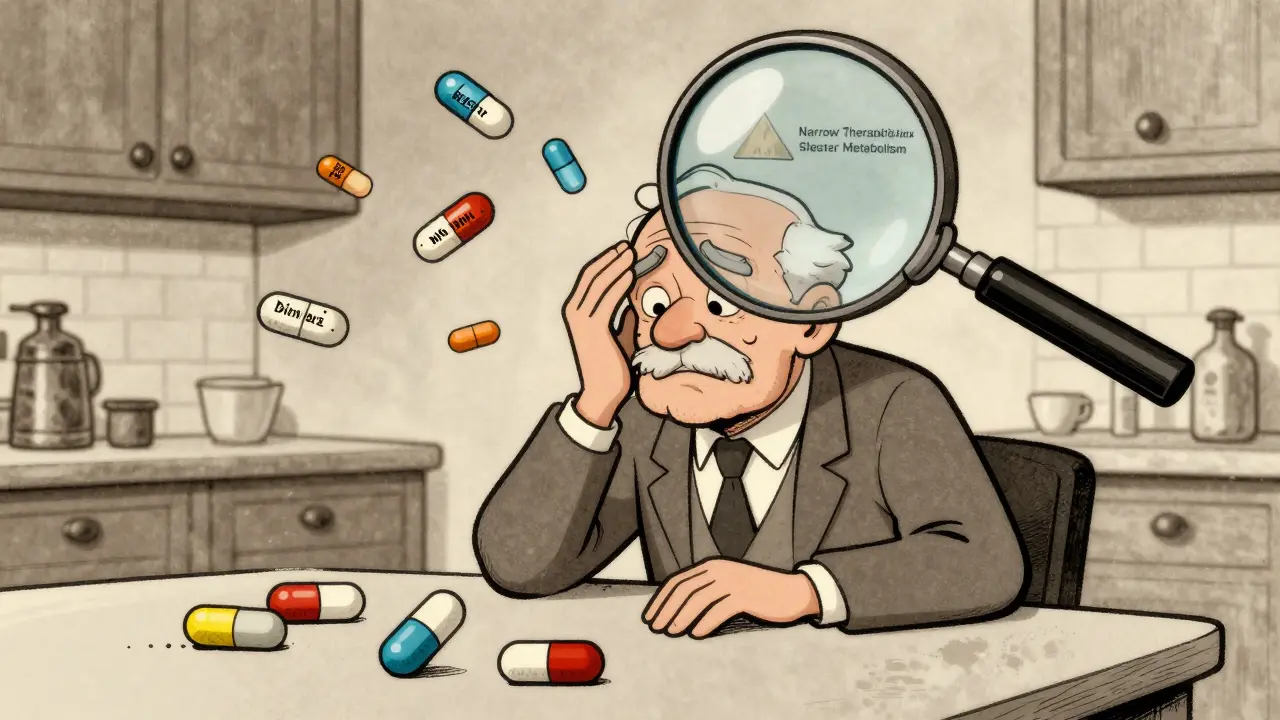
When you’re over 65, taking medication isn’t just about treating a condition-it’s about staying safe. Generic drugs make up nearly 9 out of 10 prescriptions filled by older adults in the U.S., and for good reason: they cost far less than brand-name versions. But here’s the thing many don’t talk about: generic drug safety in older adults isn’t just about whether the active ingredient matches. It’s about how your body changes with age-and how those changes can turn a perfectly normal dose into a dangerous one.
Why Older Adults Are More Sensitive to Medications
Your body doesn’t process drugs the same way at 75 as it did at 45. By the time you hit 75, your liver may be metabolizing medications up to 30% slower. Your kidneys, which flush out drug waste, also lose efficiency. At the same time, body fat increases and water content drops. That means drugs that dissolve in fat stick around longer, and those that need water to spread out? They build up in your system. A dose that was safe at 60 can become an overdose at 80.This isn’t theory. A 2023 study in MedShadow.org tracked 1,200 seniors on common medications and found that 41% had symptoms-dizziness, confusion, falls-that cleared up only after their dosages were lowered. These aren’t side effects you can ignore. They’re warning signs your body is overwhelmed.
Drugs That Pose the Highest Risk
Not all medications are created equal when it comes to age. The American Geriatrics Society’s 2023 Beers Criteria, updated every few years, lists the most dangerous drugs for older adults. Some stand out:- Beta blockers can drop your heart rate too low-up to 30% of seniors on these drugs develop bradycardia.
- Digoxin, used for heart rhythm issues, causes arrhythmias in 10-15% of older users.
- Insulin and sulfonylureas for diabetes? They’re responsible for 20-25% of falls in seniors due to low blood sugar.
- Cyclobenzaprine (Flexeril), a muscle relaxant, increases fall risk by 50% in people over 70.
- SNRIs like venlafaxine raise fall risk by 37% due to dizziness and low blood pressure.
And here’s the kicker: it doesn’t matter if it’s brand-name or generic. A generic version of venlafaxine carries the same risk as the brand. The problem isn’t the label-it’s the drug itself.
When Generic ≠ Safe
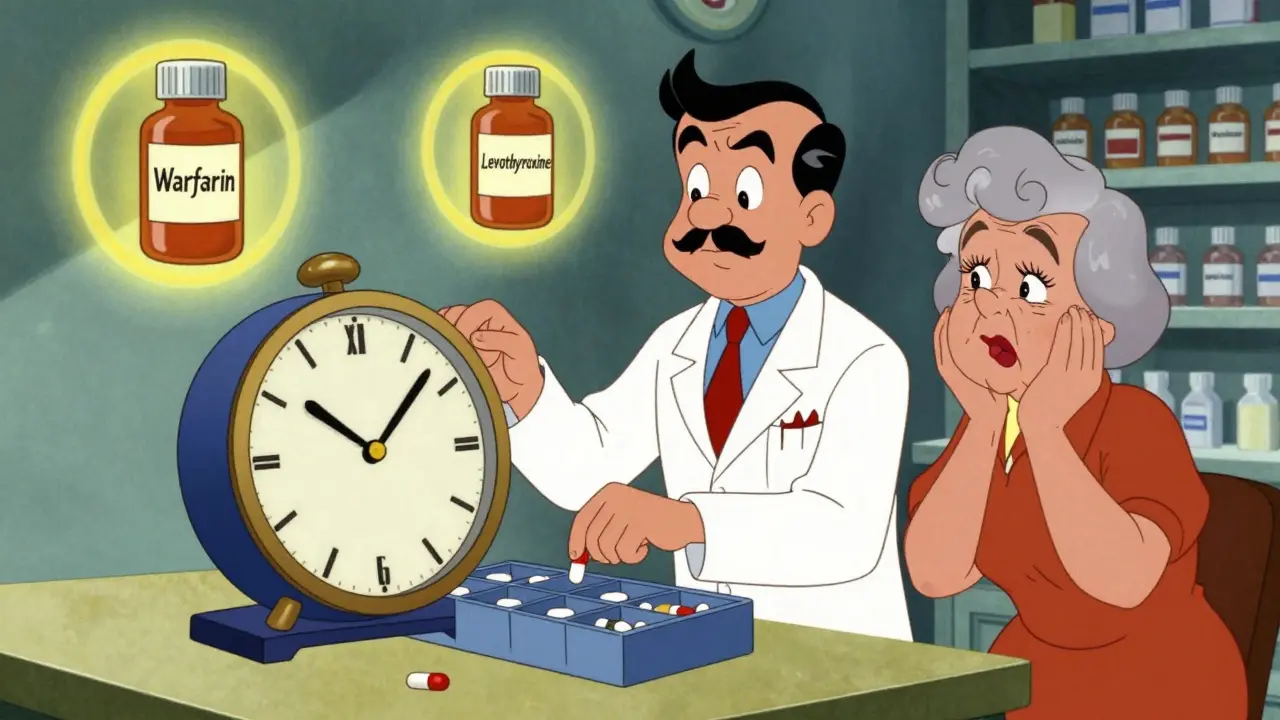
The FDA says generics are bioequivalent to brand-name drugs. That means they deliver the same active ingredient at the same rate. But for drugs with a narrow therapeutic index-where the difference between a helpful dose and a toxic one is tiny-small variations matter.Take warfarin, a blood thinner. Even though generic warfarin meets FDA standards and shows 98.7% equivalence to Coumadin in clinical trials, a 2023 study found 42% of seniors believed the generic was riskier. Why? Because small changes in blood levels can cause clots or dangerous bleeding. One 82-year-old woman switched from brand-name Synthroid to generic levothyroxine and spent six months with unstable TSH levels-three dosage changes later, she stabilized. Her story isn’t rare.
Another concern? Packaging. A 2023 MedShadow analysis of 500 medication errors found 28% of incidents involved confusion between similar-looking generic pills. Brand-name drugs often have unique colors and shapes. Generics? Sometimes they look almost identical. If you’re taking five different pills and your vision isn’t what it used to be, that’s a recipe for mix-ups.
Polypharmacy: The Silent Killer
Taking five or more medications? You’re in the danger zone. A 2023 study in the PMC journal showed that the chance of a serious adverse drug reaction jumps from 13% with two drugs to 58% with five, and hits 82% with seven or more. Older adults average 48 prescriptions a year. Most are generics. That’s not just common-it’s a ticking time bomb.It’s not the drugs themselves. It’s the combination. An opioid plus a benzodiazepine? Overdose risk jumps 154%. Opioid plus gabapentin? Respiratory depression risk rises 70%. And no one’s telling you this when you pick up your prescription at the pharmacy. Each doctor treats one condition. Few look at the whole picture.
What Actually Works to Stay Safe
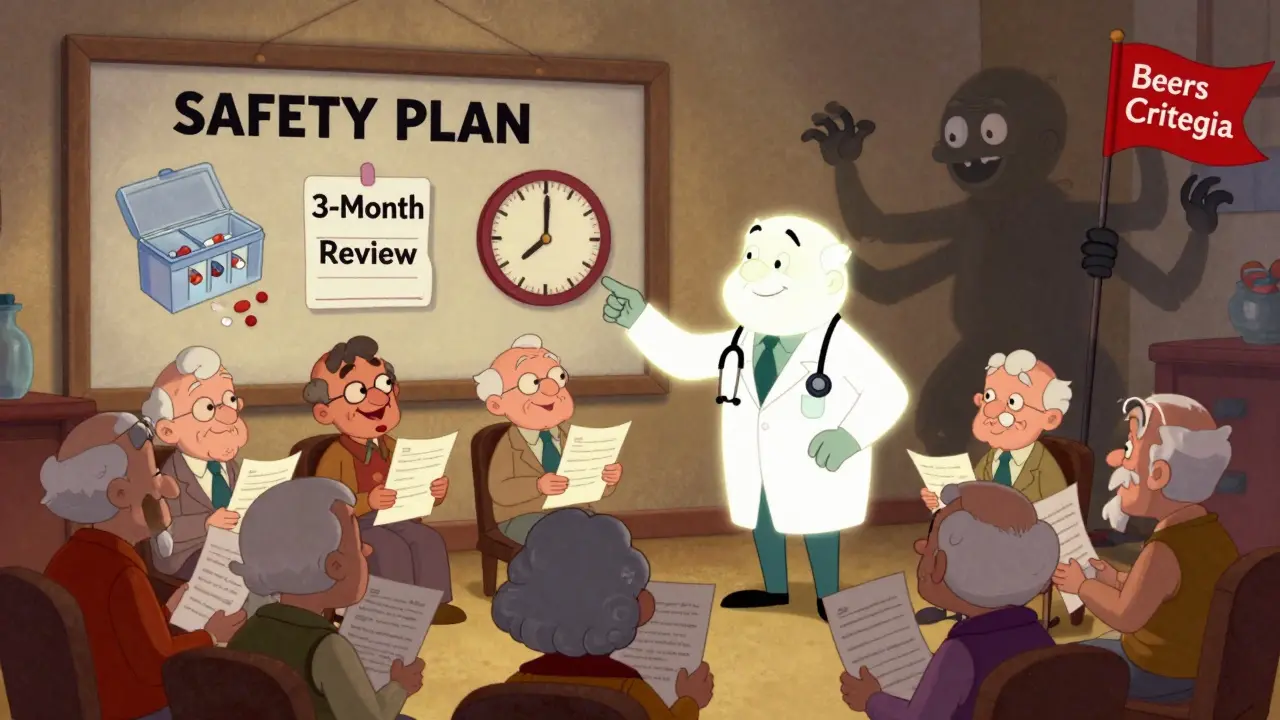
There are real, practical steps you can take right now:- Get a full medication review every three months. A pharmacist can spot duplicates, interactions, and unnecessary drugs. One 2022 study found this cuts adverse events by 27%.
- Use a pill organizer. Color-coded, time-labeled dispensers reduce errors by 34%, according to the Journal of the American Geriatrics Society.
- Ask for large-print labels. The National Eye Institute says 65% of seniors over 65 have trouble reading small print. If you can’t read the label, you can’t take it safely.
- Keep a written list. Bring it to every appointment. It cuts duplicate prescriptions by 41% in Medicare patients.
- Check expiration dates. 22% of medication errors in seniors come from expired or improperly stored drugs.
And if you’re switching from a brand-name drug to a generic? Talk to your pharmacist. Ask: Is this a narrow therapeutic index drug? Has anyone else had issues after switching? Most pharmacists will tell you the truth.
What Experts Really Think
Dr. Dima Qato, who led a major 2023 study on seniors’ beliefs about generics, found that just 10 minutes of counseling raised acceptance of generics by 37%. People aren’t against generics-they’re afraid of being treated like a number.Dr. Michael Steinman from UCSF put it bluntly: “The issue isn’t generic versus brand. It’s whether the right drug is being used at the right dose for this person’s age and health.”
The FDA agrees. Janet Woodcock, former head of the FDA’s drug division, said in 2021: “Generic drugs are just as safe and effective.” But she also added that older adults need special attention-not because generics are unsafe, but because aging changes everything.
And here’s what no one says out loud: if you’re over 70, you probably don’t need aspirin every day for “heart protection.” A 2016 review found no benefit for primary prevention in this group-and a 2.3 times higher risk of bleeding. Yet it’s still prescribed.
The Bigger Picture
The U.S. spends $132.7 billion a year on generic drugs. Older adults account for 89% of those prescriptions. But the system isn’t built for them. Pharmacies aren’t trained to catch interactions. Doctors don’t have time to review 10 medications. And seniors? They’re told to take what’s given, even if they’re scared.But change is coming. The FDA’s 2024 pilot program will require enhanced labeling on high-risk generics-bigger text, clearer warnings. The National Institute on Aging is investing $27 million to study how age affects drug absorption. And the Beers Criteria now specifically warn against rivaroxaban in those over 75 due to 28% higher bleeding risk.
The message isn’t to avoid generics. It’s to use them wisely. The savings are real. The safety risks? They’re manageable-if you know what to look for.
Are generic drugs as safe as brand-name drugs for older adults?
Yes, for most medications, generic drugs are just as safe and effective as brand-name versions. The FDA requires them to deliver the same active ingredient at the same rate. But for drugs with a narrow therapeutic index-like warfarin, levothyroxine, or phenytoin-small differences in absorption can matter more in older adults due to slower metabolism. Always talk to your pharmacist before switching.
Why do older adults have more side effects from medications?
As we age, our liver and kidneys slow down, meaning drugs stay in the body longer. Body fat increases and water decreases, changing how drugs are absorbed and stored. The brain also becomes more sensitive to sedatives, painkillers, and antidepressants. A dose that was fine at 50 can be too strong at 75. What’s normal for younger people isn’t normal for seniors.
Which medications should older adults avoid?
According to the 2023 Beers Criteria, seniors should avoid or use extreme caution with: cyclobenzaprine (Flexeril), diphenhydramine (Benadryl), NSAIDs like ibuprofen for long-term use, benzodiazepines (Valium, Xanax), opioid painkillers, and certain anticholinergics like oxybutynin. Even if they’re generic, these drugs carry higher risks of falls, confusion, kidney damage, and overdose in older adults.
Is it safe to switch from a brand-name drug to a generic?
For most drugs, yes. But if you’re on warfarin, levothyroxine, or seizure meds like phenytoin, switching can cause instability. Talk to your doctor and pharmacist first. If you do switch, monitor closely for symptoms-dizziness, fatigue, mood changes-and ask for blood tests if needed. Many seniors do fine with generics; others need time to adjust.
How can I reduce my risk of a bad reaction to my meds?
Do four things: 1) Get a full medication review with your pharmacist every 3 months. 2) Keep a written list of every drug, supplement, and dose. 3) Use a pill organizer with clear labels. 4) Ask your doctor every time: “Is this still necessary?” You’d be surprised how many drugs can be stopped safely.
Mariah Carle
March 5, 2026 AT 20:24Justin Rodriguez
March 7, 2026 AT 03:17Raman Kapri
March 8, 2026 AT 08:09Megan Nayak
March 9, 2026 AT 05:41Tildi Fletes
March 9, 2026 AT 19:24Siri Elena
March 11, 2026 AT 04:37Levi Viloria
March 11, 2026 AT 05:48Zacharia Reda
March 12, 2026 AT 09:24Matt Alexander
March 14, 2026 AT 07:15Gretchen Rivas
March 14, 2026 AT 11:33Stephen Vassilev
March 15, 2026 AT 04:15Mike Dubes
March 15, 2026 AT 11:35