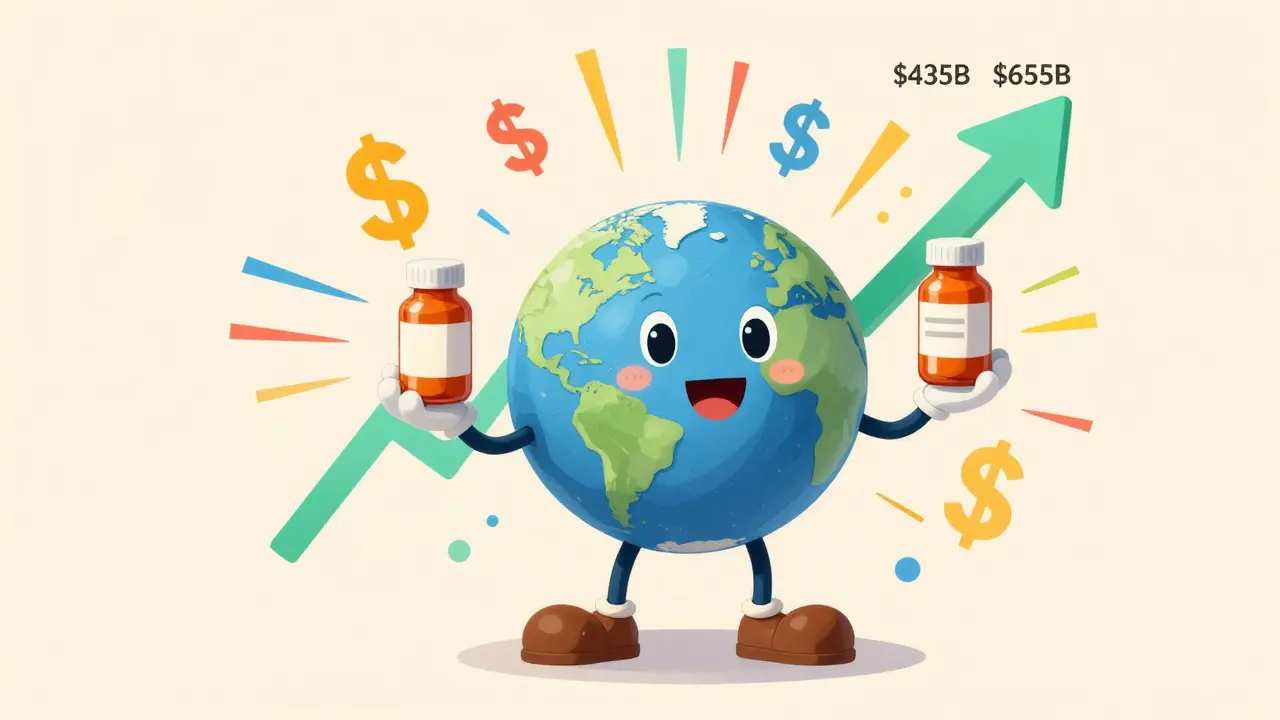
Global generic drugs market is the segment of pharmaceuticals that provides cost-effective alternatives to branded drugs after patents expire. In 2023, the generic drugs market was valued at $435.3 billion and is projected to reach $655.8 billion by 2028. Despite making up 90% of prescriptions in the US, generics account for only 23% of total drug spending - proving their critical role in keeping healthcare costs down.
Current Market Size and Growth Projections
According to BCC Research (2023), the global generic drug market was worth $435.3 billion in 2023 and is expected to hit $655.8 billion by 2028. That’s an 8.5% annual growth rate. But not all analysts agree. ForInsights Consultancy (2025) forecasts slower growth: from $423.78 billion in 2025 to $689.56 billion by 2034 at just 5.68% CAGR. Why the difference? It comes down to how you view future challenges like regulatory hurdles and supply chain risks. Still, all major reports confirm one thing: the market is expanding because people worldwide need affordable medicines.
Key Drivers Fueling Expansion
Several factors are pushing the generic drug market forward. Chronic diseases like diabetes, heart disease, and cancer now affect 41% of the global population (CDC 2024). Managing these conditions requires long-term medication, making generics essential. Patent expirations of major branded drugs are also creating opportunities. In 2024 alone, approximately $70 billion in branded drug revenues faced patent loss, opening doors for generic manufacturers. Governments worldwide are promoting generics through policies too. India’s Production Linked Incentive (PLI) scheme allocated $1.34 billion in 2024 to boost domestic manufacturing. China’s "Healthy China 2030" initiative also prioritizes affordable healthcare access. Finally, pharmerging markets in Asia-Pacific, Africa, and the Middle East are driving growth. IQVIA estimates these regions will contribute $140 billion in increased spending by 2025.
Major Challenges Ahead
Despite growth opportunities, the generic drug market faces serious hurdles. Regulatory complexities are a big issue. With 78 distinct regulatory frameworks globally (WHO 2024), getting approval for generics can be slow and expensive. Quality control is another concern. The FDA issued 187 warning letters to foreign generic manufacturers in 2023, highlighting safety issues. Supply chain dependencies also pose risks. China supplies 65% of global active pharmaceutical ingredients (APIs) for generics, creating vulnerabilities. Profit margins are shrinking too - from 18% in 2020 to 12% in 2024 (KPMG analysis). This makes it harder for smaller manufacturers to compete.
Emerging Trends Shaping the Future
Biosimilars are the fastest-growing segment within generics. Unlike traditional small-molecule generics, biosimilars mimic complex biologic drugs. They require 10-20 times more manufacturing steps and cost $100-250 million to develop. However, they offer higher pricing power - typically 15-30% below reference biologics. Mordor Intelligence projects a 12.3% CAGR for biosimilars from 2025-2030. Regulatory harmonization is also helping. The International Council for Harmonisation (ICH) has added 15 new countries to its guidelines in 2024, streamlining approvals. Strategic partnerships are rising too, with 37 major collaborations announced in 2024 alone (Evaluate Pharma data). Companies are teaming up to share costs and expertise, especially for complex biosimilars.
Regional Market Dynamics
Asia-Pacific dominates the generic market, with China and India producing about 35% of global manufacturing capacity. India alone makes over 60,000 generic medicines and supplies 20% of the world’s generic drug volume. China manufactures roughly 40% of global APIs. In the Middle East, Saudi Arabia’s Vision 2030 is creating new opportunities. The GCC pharmaceutical market is expected to reach $9.89 billion by 2025 (Statista). Meanwhile, Western Europe and North America show slower growth (2-5% CAGR) due to strict price controls. In the US, generics cover 90% of prescriptions but only 23% of spending. Europe varies widely - Germany has 72% generic use, while Italy lags at 28% due to different reimbursement rules.
What’s Next for Generic Pharmaceuticals?
The future of generic drugs looks mixed. While biologics and specialty drugs are gaining market share, generics will remain essential for affordable healthcare. Grand View Research predicts the global pharmaceutical market will hit $2.35 trillion by 2030, with generics continuing as the backbone. However, generic market share within the total pharmaceutical market is projected to drop from 57.56% in 2024 to 53% by 2030. To stay competitive, manufacturers must innovate. Strategies include vertical integration, reducing middlemen, and developing new service models. Dr. Sarah Thompson of KPMG emphasized that "becoming bigger, eliminating middlemen, and developing innovative service models" will be key. Despite challenges, the demand for affordable medications ensures generics will play a vital role in global healthcare for years to come.
What are biosimilars and how do they differ from traditional generics?
Biosimilars are generic versions of biologic drugs, which are complex molecules made from living cells. Unlike traditional small-molecule generics (which are chemically identical to their branded counterparts), biosimilars are highly similar but not identical due to the complexity of biological processes. They require 10-20 times more manufacturing steps and cost $100-250 million to develop, compared to $1-5 million for conventional generics. However, they typically sell for 15-30% less than the original biologic, making them a crucial part of affordable healthcare for conditions like cancer and autoimmune diseases.
How does the FDA ensure quality in generic drug manufacturing?
The FDA conducts rigorous inspections of manufacturing facilities worldwide. In 2023 alone, it issued 187 warning letters to foreign generic manufacturers for quality issues like contamination or data integrity problems. Companies must prove their products are bioequivalent to branded drugs through clinical testing. The FDA also monitors adverse event reports and can recall unsafe products. Despite these efforts, quality control remains a challenge - especially for drugs made in countries with weaker regulatory oversight.
Why is China’s role in API production a concern?
China supplies 65% of global active pharmaceutical ingredients (APIs) for generics. This creates vulnerability because any disruption - like trade restrictions, natural disasters, or quality issues - could impact drug supplies worldwide. For example, during the pandemic, factory shutdowns in China caused shortages of critical medications. The US and EU are now pushing for "reshoring" of API production to reduce this risk. India is also expanding its API manufacturing capacity to compete with China.
How do government policies affect generic drug availability?
Government policies directly shape the generic market. In the US, the Hatch-Waxman Act (1984) created the modern generic approval pathway, speeding up market entry. India’s PLI scheme provides subsidies for domestic manufacturing, while China’s "Healthy China 2030" initiative prioritizes affordable drugs. In Europe, countries like Germany have strong generic substitution rules, but Italy has weaker policies, leading to lower generic use. Price controls also play a role - in some countries, governments set maximum prices for generics, which can make production unprofitable for manufacturers.
Which regions are leading in generic drug manufacturing?
Asia-Pacific is the dominant region, with India and China accounting for 35% of global manufacturing capacity. India produces over 60,000 generic medicines and supplies 20% of the world’s generic drug volume by volume. China manufactures 40% of global APIs. The Middle East is emerging too - Saudi Arabia and UAE are investing in local production to meet Vision 2030 goals. Africa and Latin America are also growing, but they still rely heavily on imports from Asia.
Albert Lua
February 6, 2026 AT 08:49Generics are the unsung heroes of global healthcare. From India's massive production to China's API supply chain, they ensure medicines reach people everywhere. It's fascinating how different regions contribute uniquely to this ecosystem.
The US relies heavily on imports but also has its own robust generic industry. The key is maintaining quality while expanding access.
I'm excited to see how biosimilars will transform treatment options in the next decade. Collaboration across borders is crucial here.
We need to avoid protectionism and work together on regulatory standards. The data shows clear growth potential despite challenges. Let's keep pushing for innovation and affordability.
Cullen Bausman
February 7, 2026 AT 16:17Global collaboration is overrated the US needs to focus on domestic manufacturing
Foreign suppliers for medications pose national security risks
China controls too much of the API supply
We must bring production home
Government should incentivize US production immediately
Phoebe Norman
February 9, 2026 AT 15:34Market growth driven by chronic diseases and patent expirations FDA issued 187 warning letters in 2023 for quality issues China supplies 65% of APIs creating vulnerability Profit margins down from 18% to 12% making small manufacturers struggle Biosimilars growing fast but require more complex manufacturing
Samantha Beye
February 10, 2026 AT 02:10Quality control and supply chain issues need attention
Supporting domestic manufacturing could help but international cooperation is key
Let's focus on solutions that keep medicines affordable and accessible for everyone
one hamzah
February 10, 2026 AT 15:29Indi is key player in generics! We produce over 60k meds and 20% of global supply 🌍
PLI scheme boost local manufacturing 💪
Let's hope for more collaborations to make healthcare affordable for all 🌱
#GenericDrugs #HealthcareForAll
Diana Phe
February 12, 2026 AT 10:23China's control over APIs is intentional to manipulate global health
We need to cut ties with China immediately
The FDA is complicit in allowing unsafe imports
This is why we have shortages
Carol Woulfe
February 12, 2026 AT 11:05Biosimilars are a scam.
Andre Shaw
February 14, 2026 AT 10:05Nonsense the market is actually shrinking
All these growth projections are based on flawed data
Real experts know generics are losing market share to biologics
The affordable healthcare narrative is a myth
People don't want cheap drugs they want effective ones
Kieran Griffiths
February 14, 2026 AT 19:19Biologics are growing but generics still cover 90% of US prescriptions
The key is balancing innovation with affordability
Let's focus on improving supply chains rather than dismissing the sector
Rene Krikhaar
February 14, 2026 AT 20:34The data shows generics are crucial for healthcare access
With chronic diseases rising affordable meds are more important than ever
We need better quality control and diversified supply chains
The FDA's warning letters highlight areas for improvement
Let's work together to address these issues