
Feverfew Interaction Safety Planner
Calculates when to stop Feverfew safely before procedures and tracks symptoms associated with blood thinning interactions.
Pre-Surgical Washout Calculator
Enter your scheduled procedure date below to see recommended discontinuation timelines for Feverfew.
Bleeding Risk Symptom Monitor
Track these warning signs if you are currently combining Feverfew with anticoagulants (Warfarin, Aspirin, etc.):
Withdrawal Watch (Post-Feverfew Syndrome)
If stopping after long-term use (>6 months), taper slowly to avoid rebound effects.
- Recurring Headaches (41% of cases)
- Joint Discomfort
- Insomnia & Anxiety
Many people assume that because something comes from a plant, it must be harmless when mixed with prescription drugs. That assumption can cost you your health. There is a specific, documented danger where Feverfew is a perennial herb used traditionally for migraine prevention and inflammatory conditions. When you combine this herb with blood-thinning medications like warfarin, you aren't just adding two treatments together-you might be turning up the dial on how much your blood bleeds.
You need to understand exactly what is happening inside your body. Feverfew contains active compounds, most notably Parthenolide is the primary bioactive compound in feverfew responsible for its anti-inflammatory and antiplatelet effects. This substance interferes with how your platelets work. Specifically, it stops them from clumping together in response to serotonin. While that sounds helpful for preventing migraines, it also makes it harder for your body to stop bleeding if you get cut or if you are already taking a drug designed to thin your blood.
The Science Behind the Bleeding Risk
To see why this matters, you have to look at the mechanics of clotting. Your blood relies on a complex system to form scabs when vessels are damaged. Drugs like warfarin disrupt this system intentionally to prevent strokes or heart attacks. Feverfew does something similar, though less predictably. Research from the Memorial Sloan Kettering Cancer Center notes that parthenolide inhibits platelet aggregation. This means your blood cells become "slippery."
The issue becomes severe when you stack these effects. If you take a standard dose of an anticoagulant, your blood is already thinner than normal. Adding feverfew pushes that thinness further. You might experience prolonged bleeding from minor cuts, bruise much easier than usual, or even develop internal bleeding without an obvious cause. Medical literature refers to a group of herbs that behave this way. These are often remembered by the mnemonic the "Few Gs"-feverfew, ginger, ginkgo biloba, garlic, and ginseng.
While garlic and ginger clear from your system relatively quickly (often within 72 hours), feverfew has a longer half-life and more complex interactions. For example, it can block enzymes in the liver known as cytochrome P450. These enzymes are responsible for breaking down many drugs, including warfarin. When feverfew blocks them, levels of warfarin in your blood can spike, leading to an International Normalized Ratio (INR) that goes dangerously high.
Clinical Evidence and Real-World Cases
This isn't just theoretical chemistry. We have real cases proving the danger exists. A detailed report published by the National Institutes of Health (NIH) in 2021 highlighted a 36-year-old woman who developed significant coagulation issues after combining feverfew supplements with her regular medication. Her prothrombin time (PT), a measure of how long it takes your blood to clot, was recorded at 27.3 seconds. To put that in perspective, the normal range is typically between 11 and 16 seconds. That is a massive increase in clotting time.
Beyond just lab numbers, she had a hemoglobin level of 10 g/dL, indicating she was losing blood somewhere in her body. After she stopped taking the herbal supplement, her numbers slowly returned to normal over four months. This highlights a critical point: these interactions can linger. It's not always immediate reversal once you stop the pill.
Data collected by the FDA Adverse Event Reporting System shows a pattern, too. Between 2000 and 2015, there were 12 documented cases of increased INR linked specifically to ginkgo biloba, but feverfew sits in a middle ground. It has fewer reported cases than ginkgo, perhaps because it is less popular, but the mechanism of injury is identical. Dr. Donald Abrams from Zuckerberg San Francisco General Hospital has stated that while the clinical relevance varies by person, the risk is real enough that caution is mandatory.
| Herb | Primary Mechanism | Clinical Evidence Level | Stopping Period Before Surgery |
|---|---|---|---|
| Feverfew | Serotonin pathway inhibition | Moderate (Limited human cases) | 14-21 days |
| Ginkgo Biloba | Potent platelet activation inhibition | High (Many documented cases) | 14 days |
| Dong Quai | Coumarin derivatives | High (Direct prolongation) | 2 weeks |
| Garlic/Ginger | General antiplatelet activity | Variable | 72 hours |

Symptoms You Cannot Ignore
It is easy to brush off small signs of trouble until they become emergencies. You need to know what symptoms indicate your anticoagulation is out of control. If you are on blood thinners and start using feverfew, you are entering a zone where vigilance matters.
- Unusual Bruising: Check for large bruises appearing without any memory of hitting your arm or leg against something.
- Nosebleeds: Frequent epistaxis that lasts longer than ten minutes, especially if you haven't picked your nose recently.
- Gum Bleeding: Spontaneous bleeding while brushing teeth, or excessive blood loss from minor tooth irritation.
- Menstrual Changes: Heavier bleeding than usual for women, or unexpected spotting between periods.
- Fatigue and Dizziness: Often signs of anemia resulting from chronic, slow internal bleeding.
A survey of users found that approximately 11.3% experienced mouth sores from chewing fresh leaves, but encapsulated forms remove that specific physical irritation risk without removing the chemical risk to your blood clotting time.
Safe Discontinuation and Surgical Planning
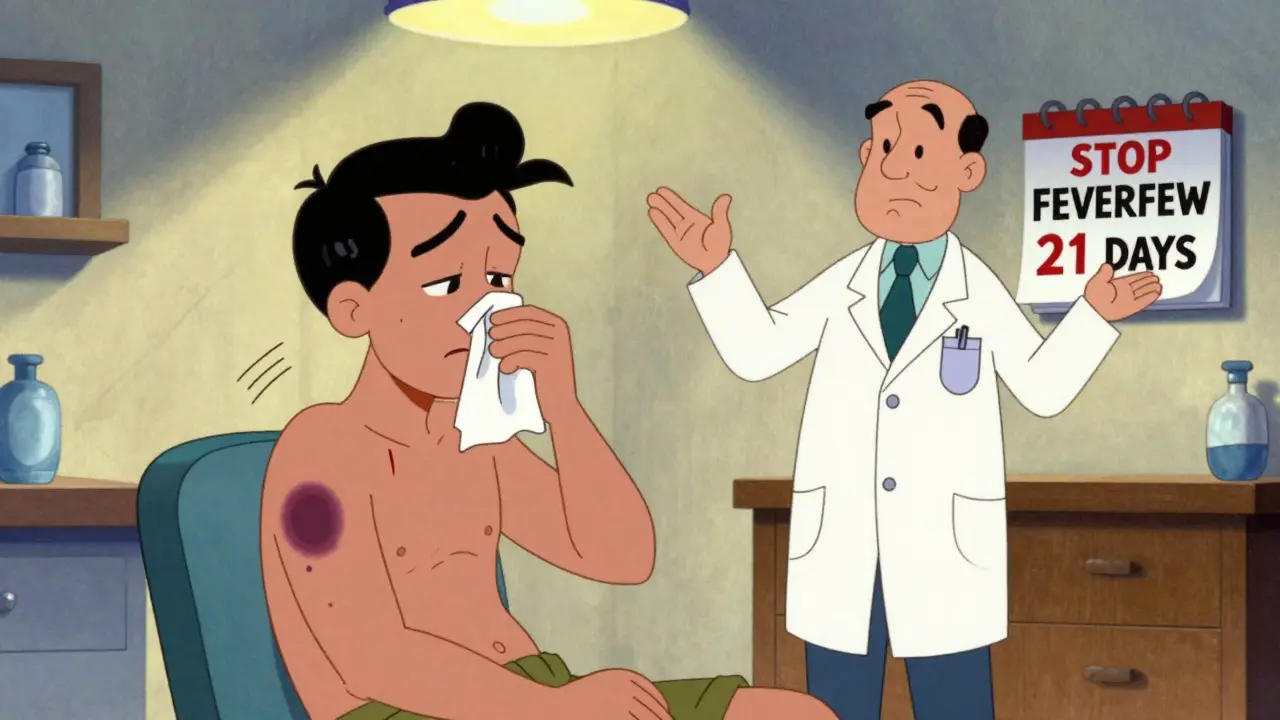
If you plan on having surgery, the stakes rise significantly. Surgeons cannot afford unpredictable bleeding. Standard guidelines suggest stopping any herbal supplement at least two weeks before the procedure. However, with feverfew, experts recommend extending that window to three weeks. Why the extra time?
Because stopping feverfew can cause its own set of problems known as "post-feverfew syndrome." Users who quit cold turkey after long-term use (over six months) often face a rebound effect. Studies show that quitting abruptly can lead to headaches returning, joint pain, insomnia, and anxiety. About 41% of people who stop suddenly report headache recurrence, and nearly a third report joint discomfort. Doctors advise tapering off slowly rather than stopping instantly, provided you are not in a surgical emergency.
The American Society of Health-System Pharmacists suggests a 14-day gap minimum. For procedures with high bleeding risks, such as major abdominal or cardiac surgery, waiting 21 days ensures the enzyme pathways in your liver have reset and the herb has cleared from your tissues completely.
Monitoring and Management Protocols
You don't have to choose between managing your migraines and staying safe on blood thinners, but you do need a protocol. Dr. David Brady from Whole Body Medicine notes that concomitant use requires careful assessment. If your doctor agrees to let you continue both, monitoring is non-negotiable.
- Baseline Testing: Get your Prothrombin Time (PT) and Partial Thromboplastin Time (PTT) checked immediately before starting the herb.
- Regular INR Checks: If on warfarin, check your INR weekly for the first month of adding the herb. Normal ranges are usually 2.0 to 3.0, but every slight shift matters.
- Medication Adjustments: Your doctor may need to lower your warfarin dose temporarily. Sometimes reducing the synthetic drug allows you to manage the condition safely without overdosing on blood thinning agents.
- Review New Medications: Always cross-reference new prescriptions. Many drugs metabolize through CYP2C9. Since feverfew inhibits this pathway, you could overdose on other meds, not just blood thinners.
Current developments show researchers are actively looking into newer blood thinners like apixaban. As of early 2026, multicenter trials are concluding their analysis on how direct oral anticoagulants interact with standardized parthenolide extracts. Until those final reports are fully integrated into guidelines, treating apixaban and rivaroxaban with the same caution as warfarin regarding herbal interactions is the safer bet.
Conclusion on Safety Practices
Weighing the benefits of reduced migraines against the risk of spontaneous bleeding is a personal choice guided by data. The "Few Gs" mnemonic remains a critical tool for patients and pharmacists alike. Feverfew offers relief for many, but its interaction profile demands respect. Never hide your supplement use from your specialist. Open communication about your dosage, timing, and brand formulation ensures you stay on the right side of safety. By adhering to strict washout periods and monitoring schedules, you can minimize the danger while keeping your treatment options open.
Is it safe to take feverfew if I am already on warfarin?
It carries a moderate risk. While not every patient experiences bleeding complications, feverfew contains parthenolide which inhibits platelet function. Combining it with warfarin increases the likelihood of a high INR. You should consult your hematologist before combining them.
How long should I stop taking feverfew before surgery?
Most guidelines recommend discontinuing at least 14 days before surgery. Because of potential withdrawal symptoms, a gradual taper over 21 days is often preferred if not under urgent care.
Does feverfew interact with aspirin?
Yes, although evidence is stronger for blood thinners, users report prolonged bleeding and nosebleeds when combining low-dose aspirin with feverfew supplements.
What is post-feverfew syndrome?
This occurs when someone stops the herb abruptly after long use. Symptoms include recurring headaches, muscle stiffness, anxiety, and insomnia. Tapering slowly helps avoid these effects.
Can I chew fresh feverfew leaves instead of pills?
Fresh leaves pose additional risks like mouth ulcers and contain higher, unstandardized amounts of parthenolide. Capsules provide a more controlled dose, though the bleeding risk remains regardless of the form.
Tony Yorke
March 28, 2026 AT 14:40natural does not mean harmless its a dangerous assumption many people make
Rohan Kumar
March 29, 2026 AT 19:13big pharma loves telling you plants kill you while pills fix everything 💖🌯💀
Rachael Hammond
March 30, 2026 AT 13:54i was thinking the same thing but science says wait on combining meds
Sabrina Herciu
March 31, 2026 AT 20:29The mechanism involves cytochrome P450 enzymes which metabolize warfarin!! When feverfew blocks these pathways the drug stays in blood longer!! This leads to toxic accumulation levels!! You also get platelet inhibition which makes clots impossible!! Imagine cutting skin and never stopping bleeding!! It is not just theoretical risk anymore!! We see INR spikes in clinical records daily!! The half life of parthenolide extends beyond standard washout periods!! Liver function tests often show elevated markers during interaction!! Patients ignore symptoms until damage is done!! Bruising happens without any trauma occurring!! Internal hemorrhage is silent until emergency room arrival!! Always check supplement lists with your doctor!! Never hide herbal intake from specialists!! Safety protocols exist for a reason!! Follow the guidelines!!
tyler lamarre
March 31, 2026 AT 22:04This oversimplifies complex pharmacokinetics but still conveys necessary warning signs accurately
kendra 0712
April 2, 2026 AT 21:30I am so glad someone wrote this down clearly!! The Few Gs list is super helpful!! I knew about ginkgo not the others!!
Devon Riley
April 3, 2026 AT 10:17It is really good to learn these things early on ❤️😎 health comes first always
Sophie Hallam
April 4, 2026 AT 03:09Balancing migraine relief with anticoagulant safety requires professional supervision consistently
Shawn Sauve
April 4, 2026 AT 06:29People take responsibility for their own choices though :) health is priority over profit
Philip Wynkoop
April 5, 2026 AT 19:27surgery prep rules are strict for good reasons :)
Tommy Nguyen
April 5, 2026 AT 23:46stopping beforehand keeps operations smooth and safe
Poppy Jackson
April 7, 2026 AT 18:12imagine waking up in hospital with uncontrolled bleeding due to leafy greens
Kameron Hacker
April 9, 2026 AT 14:03The negligence displayed by patients ignoring pharmaceutical interactions creates significant legal liabilities for medical practitioners everywhere