
LDL Reduction Estimator: Non-Statin Alternatives
Estimated Outcome
Disclaimer: This tool is for educational purposes based on clinical averages (15-23% for monotherapy, 35-40% for combination). Actual results vary per individual. Always consult your healthcare provider before changing medications.
If you've been told you're "statin intolerant," you've likely heard of Ezetimibe is a medication that lowers cholesterol by stopping the absorption of dietary cholesterol in the small intestine. Also known by the brand name Zetia, it doesn't interfere with how your liver produces cholesterol, which is why it's often tolerated better than traditional drugs. On the other hand, Bempedoic Acid is a newer class of drug called an ATP citrate lyase (ACL) inhibitor that blocks cholesterol production further upstream in the liver than statins do. Sold as Nexletol, it's specifically designed to avoid the muscle tissue entirely.
How These Alternatives Actually Work
To understand why these drugs are a lifesaver for some, you have to look at where they hit the cholesterol process. Statins block an enzyme called HMG-CoA reductase. While effective, this process happens in almost every cell in your body, including your muscles, which can lead to the dreaded muscle soreness (myalgia). Bempedoic Acid is a "prodrug." This means it's inactive when you swallow it and only becomes active when it hits an enzyme called ACSVL1. Here's the catch: that enzyme is found in the liver but is virtually nonexistent in skeletal muscle. Because the drug never "turns on" in your muscles, it doesn't cause the same pain that statins do.
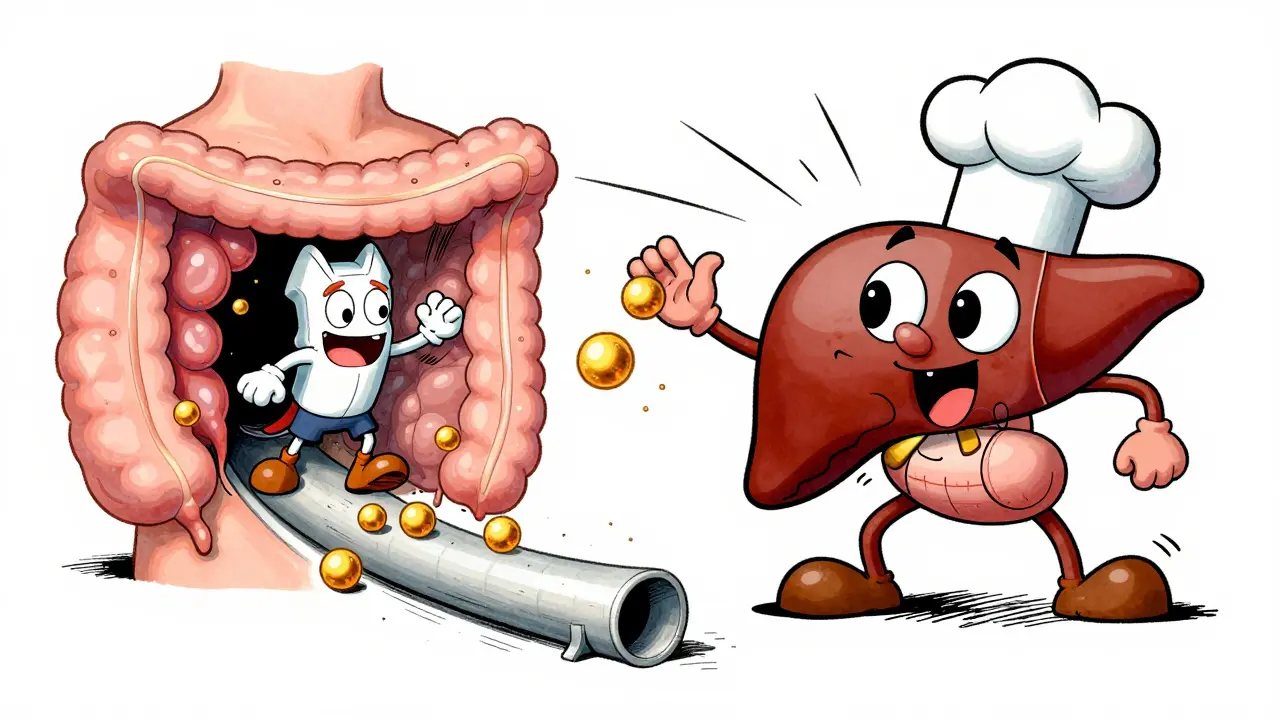
Ezetimibe takes a completely different route. Instead of stopping the liver from making cholesterol, it targets the NPC1L1 protein in your gut. Think of it as a gatekeeper that prevents cholesterol from the food you eat from entering your bloodstream. By blocking this gate, it reduces the amount of cholesterol your body absorbs by roughly 50% to 60%.
Breaking Down the Numbers: Efficacy and Costs
Let's be honest: these drugs aren't as potent as high-intensity statins. If you're taking a heavy dose of atorvastatin, you might see an LDL drop of over 50%. Ezetimibe and Bempedoic Acid are more like "fine-tuning" tools. As monotherapies, they usually lower LDL by 15% to 23%. However, when used together, or added to a low-dose statin, the results are impressive. The combination pill Nexlizet (Bempedoic Acid and Ezetimibe) can slash LDL levels by 35% to 40%.
| Feature | Ezetimibe (Zetia) | Bempedoic Acid (Nexletol) |
|---|---|---|
| Primary Mechanism | Blocks gut absorption | Blocks liver synthesis (ACL inhibitor) |
| Typical LDL Reduction | 15-22% | 17-23% |
| Muscle Pain Risk | Very Low | Very Low (Muscle-selective) |
| Typical Monthly Cost | Very Cheap (Generic available) | Higher (Brand name) |
| Administration | 10mg daily tablet | 180mg daily tablet |
The Proof is in the Outcomes
A drug is only as good as its ability to prevent heart attacks. For years, we only had the "statin data." But the 2023 CLEAR Outcomes trial changed the game for Bempedoic Acid. This massive study followed nearly 14,000 people who couldn't take statins. The results? A 13% reduction in major adverse cardiovascular events (MACE). Essentially, the trial proved that if you lower LDL using Bempedoic Acid, you get a similar heart-protection benefit as you would with a statin for the same amount of LDL reduction.
Ezetimibe also has a strong track record, though it's often viewed as a supporting actor. It's frequently the first choice for doctors because it's incredibly cheap and has been around since 2002. For many, adding it to a low-dose statin is the "sweet spot"-getting the benefit of the statin without the dose being high enough to cause pain.
Real-World Experiences: What Patients Say
Clinical trials are great, but real life is different. On patient forums like Reddit, you'll see two distinct camps. Some users rave about the transition to Bempedoic Acid, reporting that their LDL dropped significantly (e.g., from 142 to 101 mg/dL) without a single muscle cramp. Others, however, struggle with the cost. Since Bempedoic Acid is newer and more expensive, some patients feel the trade-off isn't worth it if they only see a small dip in their numbers.
Interestingly, real-world data from platforms like PatientsLikeMe suggests a slightly higher rate of joint pain (around 12%) with Bempedoic Acid than what was seen in controlled trials. This is a reminder that every body reacts differently. Ezetimibe tends to have higher general satisfaction scores, largely because it's affordable and doesn't have a long list of complex side effects.
Practical Guide: How to Start and What to Watch For
You shouldn't just jump from a statin to these alternatives overnight. Most doctors follow a "rechallenge protocol." This means they might try two or three different statins at different doses to make sure you're truly intolerant before moving to second-line therapies.
If you do start Bempedoic Acid, there are a few crucial warnings to keep in mind:
- Drug Interactions: Bempedoic Acid can increase the levels of certain statins (like simvastatin) in your blood, which could actually trigger the muscle pain you're trying to avoid. Your doctor will need to adjust those doses.
- Kidney Health: If you have severe renal impairment (eGFR below 30), Bempedoic Acid is generally contraindicated.
- Tendon Warning: There is a small risk (about 0.5%) of tendon rupture. While rare, it's something to monitor.
- Monitoring: Expect a lipid panel 4 to 12 weeks after starting. If your LDL doesn't drop by at least 10-15%, the medication might not be working for you.

The Future of Non-Statin Therapy
The landscape is shifting. We're moving away from a "one size fits all" approach to cholesterol. While PCSK9 inhibitors like evolocumab are more powerful, they require subcutaneous injections and cost a fortune. For the average person, a daily pill is much more sustainable.
With the 2024 approval of Nexlizet, we now have a high-potency oral option that combines both Ezetimibe and Bempedoic Acid. This removes the hassle of taking two separate pills and maximizes the LDL-lowering effect. As we get more data from studies like the CLEAR CardioTrack trial, we'll likely see these drugs move from "last resort" to a standard part of the toolkit for anyone struggling with statin side effects.
Are these medications as effective as statins?
Generally, no. High-intensity statins can lower LDL by over 50%, whereas Ezetimibe and Bempedoic Acid typically offer reductions in the 15-23% range as standalone treatments. However, using them in combination can achieve results closer to 40%, and they provide a critical alternative for those who cannot tolerate statins.
Do Ezetimibe and Bempedoic Acid cause muscle pain?
One of the main reasons these drugs are prescribed is that they do NOT cause the same muscle pain associated with statins. Bempedoic Acid is a prodrug that is only activated in the liver, not in muscle cells, making it a safe choice for statin-intolerant patients.
Can I take Ezetimibe and Bempedoic Acid together?
Yes. In fact, there is a fixed-dose combination pill called Nexlizet that combines both. Using them together typically results in a much greater LDL reduction (around 35-40%) than using either drug alone.
What are the main side effects of Bempedoic Acid?
The most notable side effect mentioned in the FDA label is a small risk of tendon rupture (about 0.5%). Some real-world users also report joint pain. It is also important to note that it can increase the concentration of certain statins in your system, requiring dose adjustments.
Which is more affordable: Ezetimibe or Bempedoic Acid?
Ezetimibe is significantly more affordable because it is available as a generic. Bempedoic Acid (Nexletol) is a newer, brand-name medication and is considerably more expensive, often requiring insurance or discount coupons to be accessible.
Next Steps for Patients
If you're currently experiencing muscle pain on a statin, don't just stop the medication-this can cause your cholesterol to spike and increase your risk of a cardiac event. Instead, schedule a visit with your doctor to discuss a "statin trial" to confirm intolerance. If confirmed, ask if a combination of a low-dose statin and Ezetimibe is right for you, or if you are a candidate for Bempedoic Acid based on your kidney function and insurance coverage.