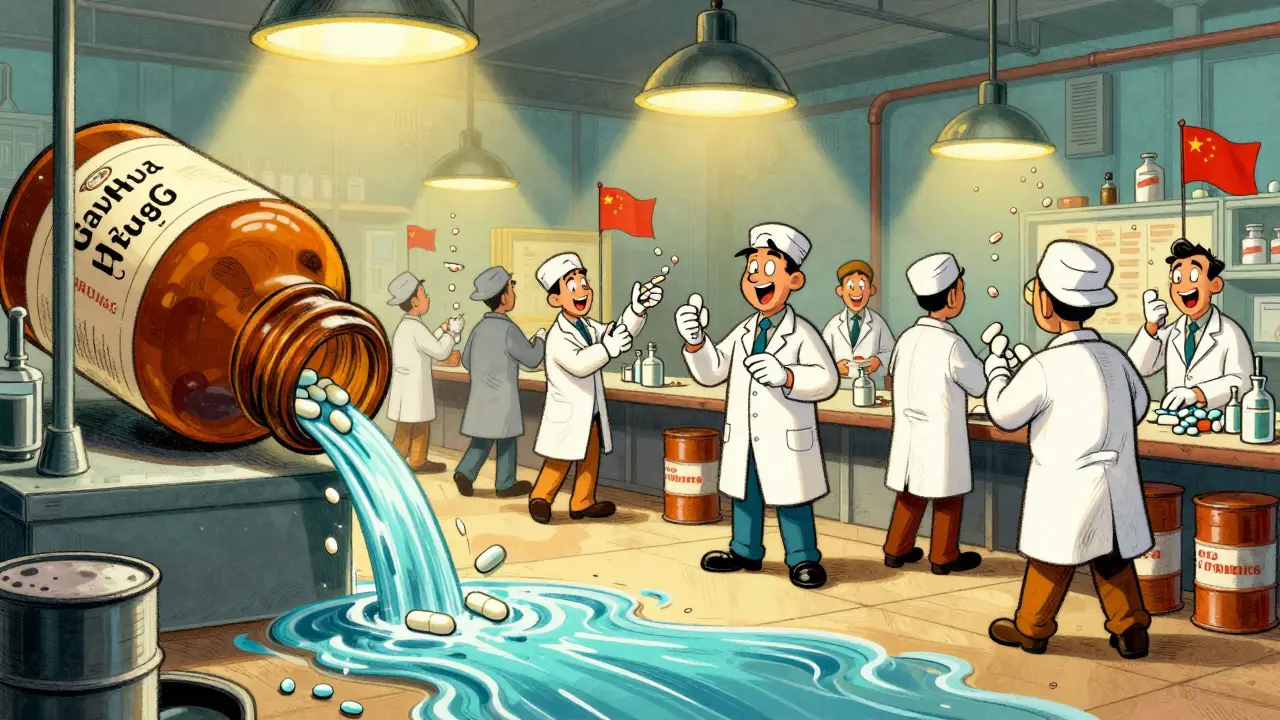
The global fight for affordable medicine doesn’t happen in New York or London-it happens in Gujarat and Jiangsu. When you take a generic pill for blood pressure, antibiotics, or diabetes, there’s a high chance it came from Asia. India and China together produce more than half of the world’s generic drugs, and countries like Vietnam and Cambodia are quietly stepping into the spotlight. This isn’t just about cheap prices. It’s about who controls the supply, who’s innovating, and who’s falling behind.
India: The Volume King with a Quality Gap
India is the pharmacy of the world for a reason. It supplies over 60% of global generic vaccines and 40% of all generic drugs used in the U.S. That’s not a coincidence. Back in the 1970s, India changed its patent laws to let companies copy drug formulas as long as they used a different manufacturing process. This opened the floodgates for affordable medicines. Today, India’s pharmaceutical market is worth $61.36 billion, with 75% of that coming from simple, low-cost generics.
What makes India special isn’t just volume-it’s speed. If you need a custom formulation of a cancer drug, Indian manufacturers can often deliver within 14 days. U.S. pharmacy chains say their customer service calls get answered 24/7, cutting operational headaches by 60%. And with over 3,000 FDA-approved manufacturing sites, India has more regulatory clearance than almost any other country.
But here’s the catch: India still depends on China for 68% of its active pharmaceutical ingredients (APIs)-the actual chemical building blocks of drugs. That’s a massive vulnerability. Despite spending billions on the ‘Pharma Vision 2020’ and now ‘Pharma 2047’ initiatives, India only produces 18% of its own API needs. The rest comes from China. And while Indian factories churn out millions of pills, only 1.2% of their exports are novel drugs. Most are copies of older, off-patent medicines.
Quality is another issue. Indian manufacturers received 87 FDA warning letters in 2024. That’s fewer than China, but still too many. Some factories cut corners. One procurement manager from Germany told a forum: “We saved 35% on costs sourcing from India, but we had to triple our batch testing because quality varied so much.”
China: The Value Leader with a Quality Problem
China’s pharmaceutical market is bigger-$80.4 billion in 2024-and it’s moving up the value chain fast. While India makes pills, China makes the chemicals inside them. China controls about 70% of the global API market. If you’re making generic drugs anywhere in the world, you’re probably using a Chinese-made ingredient.
China’s shift isn’t just about volume. It’s about complexity. Between 2020 and 2024, 45% of all new pharma facilities built in China were for biologics-complex, high-value drugs like insulin or cancer antibodies. China’s 14th Five-Year Plan poured $150 billion into R&D, with 40% going to biologics. That’s why 8.5% of China’s pharmaceutical exports are novel drugs, compared to India’s 1.2%.
But quality control remains shaky. In 2024, the U.S. FDA issued 142 warning letters to Chinese manufacturers-more than double India’s 87. One German healthcare company said it had to double its supply chain costs after a major Chinese API supplier failed inspection. “We switched to dual-sourcing,” the manager said. “Now we buy from both India and China, but it’s eating into our margins.”
China’s regulatory system is more centralized than India’s, which helps. Approval times have dropped from 24 months in 2018 to just 9 months in 2024. But foreign companies must own at least 51% of their distribution business in China-something that scares off many Western firms.

The Hidden Players: Vietnam, Cambodia, and the New Frontiers
While India and China fight over scale and value, smaller economies are carving out niches. Vietnam’s pharmaceutical market grew 12.3% annually from 2020 to 2024. Why? It’s become the go-to source for antibiotic intermediates-raw materials that go into antibiotics. It’s cheaper, faster, and politically neutral.
Cambodia, meanwhile, is building a quiet empire in medical devices. Its assembly sector grew 32% in 2024, thanks to ASEAN trade deals that let it export low-cost syringes, IV bags, and thermometers duty-free. These aren’t high-tech products, but they’re essential. And they’re not made in China or India.
These countries aren’t trying to replace giants. They’re becoming specialized suppliers. Think of them as the subcontractors in a global supply chain. When a U.S. pharmacy chain needs 10 million antibiotic vials fast, they don’t go to a 10,000-person factory in Gujarat. They go to a 300-person plant in Ho Chi Minh City.
Who Wins? Volume vs. Value
India leads in volume. It produces more generic pills than anyone else. But it’s stuck in low-margin territory. Its exports are mostly cheap drugs. China leads in value. It makes more expensive biologics, controls the supply of APIs, and has better access to innovation funding.
Here’s the data that tells the real story:
| Factor | India | China |
|---|---|---|
| Market Size | $61.36 billion | $80.4 billion |
| API Production Share | 20% of global | 70% of global |
| U.S. Generic Drug Supply | 40% | 25% |
| Biologics in Exports | 3% | 10% |
| API Self-Sufficiency | 18% | 85% |
| U.S. FDA Warning Letters (2024) | 87 | 142 |
| Approval Time (Foreign Firms) | 18-24 months | 12-18 months |
India’s strength? Speed, flexibility, and customer service. China’s strength? Scale, innovation funding, and control over raw materials. Neither is perfect. India can’t make its own APIs. China can’t shake its quality reputation.
What’s Next? The Race for Self-Sufficiency
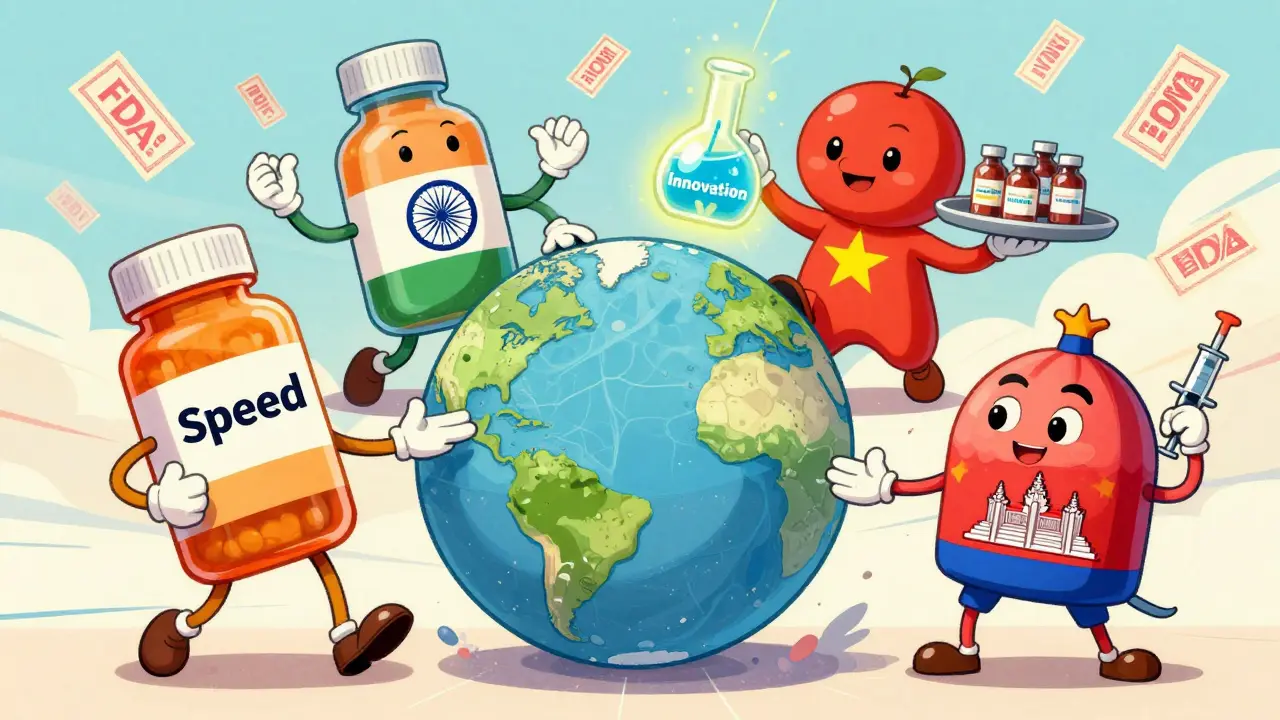
Both countries are trying to become independent. India’s ‘Pharma 2047’ plan is building 12 new API parks to cut its dependence on China from 68% to 30% by 2030. China’s ‘Healthy China 2030’ is pouring $22.8 billion into biologics, aiming to make 25% of its exports high-value drugs by 2030.
But here’s the twist: when both try to be self-sufficient, they flood the market. S&P Global Ratings warns this could trigger a 15-20% price drop in APIs by 2027. That’s bad news for investors and good news for hospitals buying drugs.
Meanwhile, Western buyers are adapting. Sixty-eight percent of major U.S. pharmacy chains now split their sourcing-40-60% from India, 25-35% from China. Why? To avoid being stuck if one country has a regulatory crackdown or a factory shutdown.
And it’s working. India scores higher on communication (4.3/5 vs. China’s 3.7/5). China scores higher on price (4.5/5 vs. India’s 4.0/5). The best strategy? Use both.
Why This Matters to You
If you take generic medicine, this affects you. When India’s supply chain slows down, prices rise. When China’s factories get shut down by the FDA, shortages happen. The next pandemic won’t be stopped by vaccines alone-it’ll be stopped by how fast we can make and ship pills.
Right now, the world depends on two countries with very different strengths-and serious weaknesses. India gives us volume and speed. China gives us ingredients and innovation. Neither can do it alone. And as emerging economies like Vietnam and Cambodia step in, the game is changing. The future of affordable medicine isn’t about one country. It’s about a network.
Why does India supply so many generic drugs but still import APIs from China?
India has focused on manufacturing finished drugs, not the raw chemicals inside them. Building API production facilities is expensive and technically complex. Despite spending billions on self-sufficiency, India only produces 18% of its own APIs. China dominates this space because it invested early in chemical manufacturing and controls the supply of key raw materials like penicillin and paracetamol precursors.
Is China’s pharmaceutical quality really worse than India’s?
In 2024, China received 142 FDA warning letters compared to 87 for India-so yes, the data shows more quality issues. But China’s regulatory system is more centralized, meaning changes are implemented faster. India’s problem is inconsistency: 17 different state agencies enforce rules differently. One factory in Gujarat might be flawless, while another 200 miles away fails inspection. Both have issues, but they’re different kinds of problems.
Can emerging economies like Vietnam replace India and China?
Not as replacements, but as complements. Vietnam doesn’t make 10 million pills a day-it makes the key ingredients for antibiotics. Cambodia doesn’t produce insulin-it assembles syringes. These countries fill gaps in the supply chain. They’re not trying to compete on scale. They’re becoming specialized, low-cost suppliers for niche products that big players don’t want to handle.
Why are biologics so important in China’s strategy?
Biologics-like insulin, cancer antibodies, and vaccines-are complex drugs that can’t be easily copied. They’re expensive to make, but they’re also expensive to sell. China is moving from making cheap pills to making high-margin biologics. That’s how it escapes the race to the bottom on price. India still lags here because it lacks the R&D funding and infrastructure. China’s $150 billion investment in biologics R&D is its long-term play.
What’s the biggest risk to the global generic drug supply?
Overcapacity. Both India and China are building more API plants than the world needs. S&P Global predicts a 15-20% price crash in APIs by 2027 as supply outpaces demand. That could force factories to shut down, trigger layoffs, and reduce quality control budgets. The result? Shortages of critical drugs. The system is designed for efficiency, not resilience-and that’s the real danger.
Bridget Verwey
March 7, 2026 AT 01:03So let me get this straight-India makes the pills, China makes the pills’ DNA, and we’re all just sitting here hoping neither one has a bad hair day? 🤦♀️
I mean, I take my blood pressure meds like clockwork, but now I’m terrified to open the bottle. What if today’s batch was made on a Tuesday in Gujarat and yesterday’s was made during a monsoon in Jiangsu?
And don’t even get me started on the FDA warning letters. It’s like a drug version of ‘The Office’-only the characters are chemists and the pranks are lethal.
Meanwhile, Vietnam’s out here quietly making antibiotic intermediates like it’s no big deal. Meanwhile, we’re panicking because our pharmacy ran out of metformin. Who’s the real MVP here?
Also, why does every article about this sound like a TED Talk from a McKinsey consultant? Can we just say: ‘We’re all screwed unless we stop treating drug supply like a game of Jenga’?
And yes, I’m still mad we let China control 70% of APIs. That’s like letting your ex control your Wi-Fi password. You know it’s dangerous, but you’re too lazy to change it.
Also-biologics? China’s going full Tony Stark while India’s still making aspirin from scratch. We need a pharmaceutical Avengers. Someone call Dr. Strange.
And to the guy who said ‘use both’? Yeah, that’s great. Until one of them gets shut down by a regulator and suddenly your insulin is a mystery box. Thanks, globalization.
TL;DR: We’re one bad factory inspection away from a global panic. And we’re all just scrolling through Reddit pretending we didn’t just read a 2000-word warning label.
Ian Kiplagat
March 8, 2026 AT 07:10Interesting. 🇮🇳+🇨🇳 = global pharma backbone. 🇻🇳+🇰🇭 = quiet specialists.
APIs are the unsung heroes. No one talks about them. Until they’re gone.
And yes-dual-sourcing is smart. Like having two umbrellas in a storm.
Amina Aminkhuslen
March 9, 2026 AT 16:49India’s like that one friend who shows up to every party with a six-pack but can’t remember your name. China’s the one who brought the expensive wine but left you a voicemail saying your couch is ‘structurally unsound.’
Both are indispensable. Neither is trustworthy. And we’re all just hoping the FDA doesn’t have a coffee break tomorrow.
Also-142 warning letters? That’s not a quality issue. That’s a full-blown corporate identity crisis.
And let’s be real: no one’s buying ‘Made in Cambodia’ syringes because they’re fancy. They’re buying them because they’re cheap, reliable, and not made by a company that got fined for ‘accidentally’ dumping mercury into a river.
Meanwhile, Pharma 2047? More like Pharma 2047: The Sequel We Didn’t Ask For.
And don’t even get me started on ‘Pharma Vision 2020.’ That was a marketing brochure with a map and a prayer.
At this point, I’d trust a 1998 generic from a flea market in Bangkok more than half of these ‘FDA-approved’ factories.
Also, biologics? China’s not innovating. They’re just playing 4D chess while we’re still trying to figure out if aspirin is a drug or a mood ring.
And yes-I’m terrified. But also… kinda impressed?
amber carrillo
March 10, 2026 AT 03:44It’s remarkable how much of modern healthcare depends on infrastructure we never see.
Generic medicine is the quiet hero of global health.
India and China are not perfect, but they are essential.
Our reliance on them is not a flaw-it’s a testament to what global cooperation can achieve.
When we talk about access, we’re not talking about politics.
We’re talking about mothers, elders, children-people who need their medicine to live.
Let’s not forget that.
Tim Hnatko
March 10, 2026 AT 06:10I’ve worked in pharmacy logistics for 12 years.
India’s customer service? Unreal.
China’s price? Unbeatable.
But neither can be trusted alone.
Our company splits sourcing 50/50.
It’s the only way to sleep at night.
And yes-Vietnam’s doing something quietly brilliant.
They’re not trying to be the biggest.
They’re trying to be the most reliable.
That’s the future.
Aaron Pace
March 11, 2026 AT 08:57Bro, did you know that 70% of your insulin’s backbone comes from a factory in Zhejiang that might be shut down next week? 😱
And India? They’re basically making pills out of hope and duct tape. 🤭
Why aren’t we building API plants in Ohio? Why? WHY?
Also-FDA warning letters? That’s just corporate graffiti. Like someone wrote ‘I ❤️ Toxic Waste’ on the wall and called it ‘innovation.’
And Cambodia? They’re making syringes while we’re arguing about TikTok dances. 🥲
Someone call Elon. Tell him to build a drug factory on Mars.
Also-I’m 32 and I take 5 pills a day. This is terrifying.
And yes, I’m texting my mom right now to ask if she’s got hers.
Adebayo Muhammad
March 12, 2026 AT 04:58Let’s be brutally honest: the entire global generic drug supply chain is a Ponzi scheme built on regulatory arbitrage, wage suppression, and environmental negligence.
India? A nation of 1.4 billion people, 70% of whom live on less than $3/day, is now the world’s pharmacy? That’s not a triumph-it’s a tragedy dressed in white lab coats.
China? They don’t ‘innovate’-they outsource R&D to state-funded labs while poisoning rivers with API waste and calling it ‘economic development.’
And Vietnam? Oh, sweet irony: a country that was bombed into rubble in the 1970s now supplies the antibiotics that keep Western hospitals alive. How poetic. How grotesque.
Meanwhile, the U.S. FDA issues 142 warning letters to China? That’s not oversight-it’s a confession that the system is broken.
And yet-no one dares to say: ‘Let’s nationalize API production.’ Why? Because profit > survival.
Pharma 2047? Healthy China 2030? These are not visions. They are PR brochures for a system that is already collapsing under its own weight.
And the ‘best strategy’? Dual-sourcing? Please. That’s not strategy-that’s a coping mechanism for a civilization that refuses to face its own moral bankruptcy.
We are not managing a supply chain.
We are managing a death sentence.
And we’re all just scrolling, waiting for the next recall.
Joe Prism
March 13, 2026 AT 17:03India gives us speed. China gives us scale.
Vietnam gives us stability.
But no one gives us truth.
The real story isn’t about who makes the pills.
It’s about who decides who gets them.
And that’s not in Gujarat.
Or Jiangsu.
It’s in boardrooms in New York, Zurich, and London.
We call it ‘affordable medicine.’
But affordability isn’t a technical problem.
It’s a moral one.