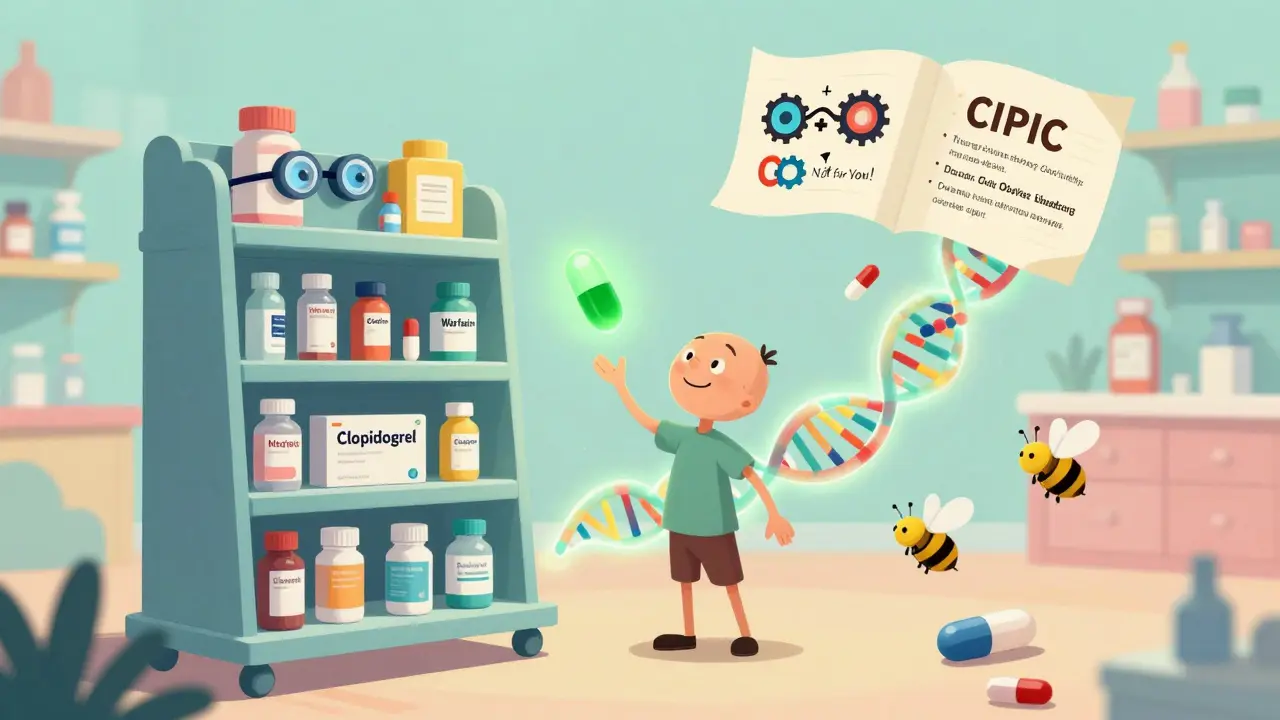
What if your next generic pill was chosen just for your genes?
Right now, when you order a generic version of warfarin or clopidogrel from an online pharmacy, you get the same tablet as everyone else. But your body doesn’t respond the same way as your neighbor’s. That’s because your genes decide how fast you break down drugs, whether a medication will work at all, or if it might cause dangerous side effects. This isn’t science fiction. It’s pharmacogenomics - and AI is making it practical for everyday use.
Since 2023, AI tools have started turning complex genetic data into simple, actionable advice for prescribing medications. These systems don’t just guess. They use decades of clinical research, like the CPIC guidelines, to match your DNA to the right drug and dose. And now, they’re starting to show up behind the scenes in online pharmacies, helping them recommend the safest, most effective generic options - not based on price or availability, but on your biology.
How AI reads your genes to pick the right generic drug
Most people think of generics as interchangeable. But for some, a generic version of a drug can be useless - or even dangerous - because of tiny differences in how their body processes it. That’s where pharmacogenomics comes in. It looks at specific genes, especially those in the CYP450 family, which control how your liver breaks down over 80% of common medications.
AI systems like the one built with GPT-4 and CPIC guidelines can interpret genetic test results in under two minutes. That’s 15 times faster than a pharmacist manually reviewing a report. The AI checks your variants - like whether you’re a poor, intermediate, normal, rapid, or ultrarapid metabolizer of CYP2D6 - and then cross-references them with thousands of drug-gene interactions.
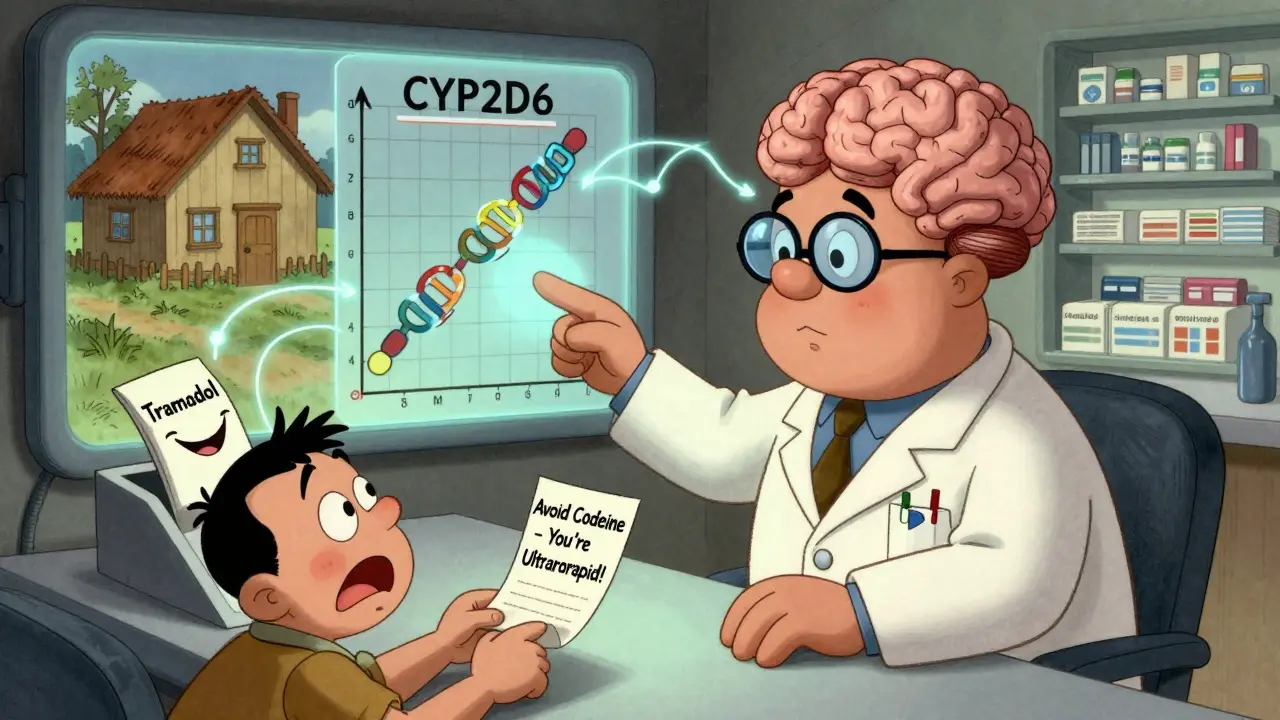
For example: If you’re an ultrarapid metabolizer of CYP2D6, a standard dose of codeine (sometimes used in generic painkillers) turns into too much morphine too fast. That can cause breathing problems, especially in kids. An AI system would flag that and suggest an alternative - like tramadol or acetaminophen - even if the prescription just says "generic pain reliever."
These tools don’t work in a vacuum. They connect to electronic health records through secure APIs. When you upload your genetic test results (from a service like 23andMe or a clinical PGx panel), the AI pulls your data, matches it against known drug interactions, and returns a clear recommendation: "Avoid this generic. Use this one instead. Dose: 50% lower."
Why this matters more for online pharmacies than brick-and-mortar ones
Physical pharmacies still rely on pharmacists to catch drug-gene conflicts - but they’re busy. A pharmacist might see 100 prescriptions a day. They can’t check every patient’s genetic profile. Online pharmacies, however, have a unique advantage: they collect data over time. If you’ve ordered medications from them before, they can ask for your PGx report once and use it for every future order.
Imagine this: You buy a generic statin for cholesterol. A year later, you need a new prescription for a muscle relaxant. The AI system remembers your CYP3A4 poor metabolizer status. It doesn’t just suggest a different drug - it blocks the order if the generic version could cause dangerous muscle damage. It then offers a safer alternative and explains why, in plain language.
This kind of automated safety net is rare in traditional pharmacies. But for online platforms that serve patients across regions - especially those in rural areas with limited access to genetic counselors - it’s life-changing. A 2023 study from the University of Florida found that patients using AI-guided online pharmacy recommendations had 30% fewer emergency visits related to medication side effects.
Accuracy, risks, and what the AI gets wrong
AI systems are good - but not perfect. The GPT-4-based tool in the JAMIA study got 89.7% of PGx interpretations right. That sounds impressive, but that 10.3% gap matters when someone’s life is on the line.
One major risk is hallucination. In rare cases, the AI confidently recommends a drug interaction that doesn’t exist. One Reddit user, a pharmacist, reported that an AI system missed a critical CYP2D6 ultrarapid metabolizer status for codeine in a pediatric patient. The system didn’t flag it because the variant was too rare to be in the training data. That’s a known limitation: AI struggles with variants that affect fewer than 1 in 1,000 people.
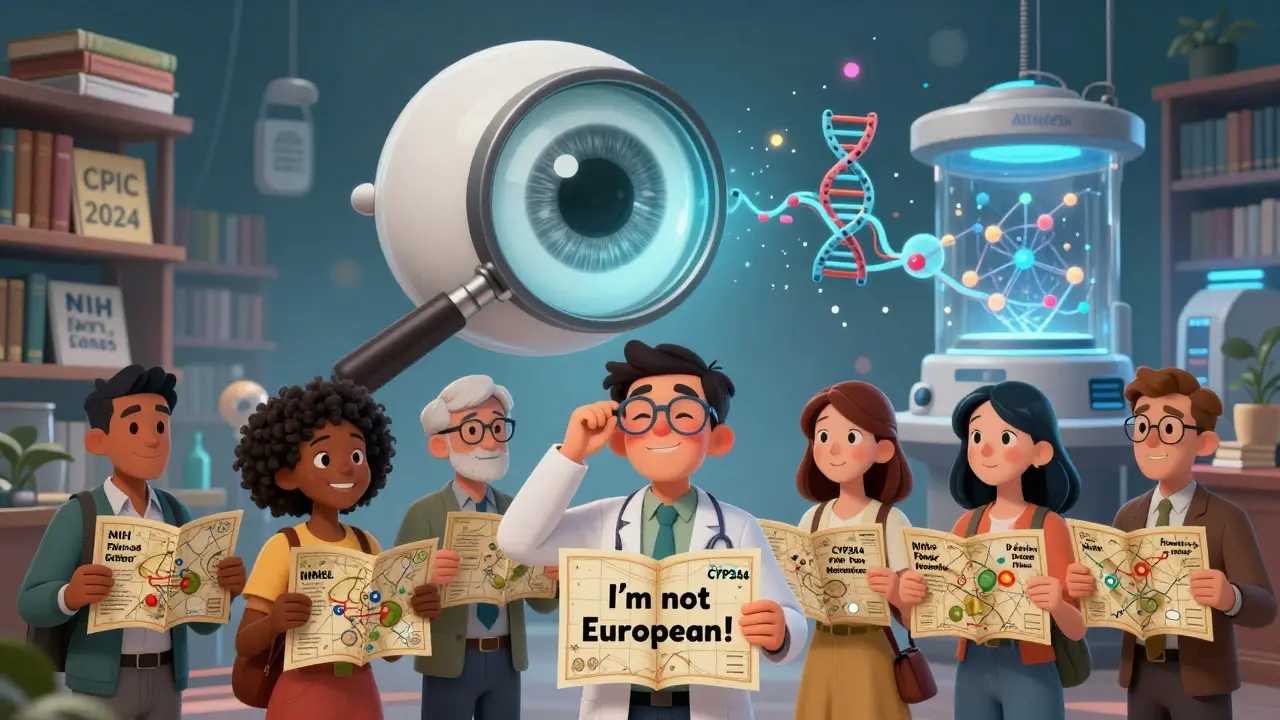
Another issue is bias. Most genetic databases are built from European ancestry populations. If you’re of African, Asian, or Indigenous descent, the AI might misinterpret your results. A 2023 Cell Genomics study found that 78% of PGx data comes from people of European descent - even though they make up only 16% of the global population. That means an AI might wrongly tell you a drug is safe when it’s not, simply because your genes look different from the majority in the training data.
And then there’s the black box problem. If the AI says "avoid this drug," but can’t explain why in a way a doctor or patient understands, trust breaks down. That’s why the best systems don’t just give answers - they show the evidence. They say: "Based on your CYP2C19*2 variant, you metabolize clopidogrel 70% slower than average. This reduces its effectiveness by 50%. Recommended alternative: prasugrel. Source: CPIC Guideline 2024."
Who’s using this right now - and who’s not
Large hospital systems like Mayo Clinic and University of Florida Health have already rolled out AI-PGx tools. They’ve seen adverse drug events drop by 20-22%. But outside those institutions, adoption is slow.
In the U.S., only 12.7% of primary care doctors routinely order PGx tests. Most online pharmacies still don’t ask for genetic data. Why? Because integration is hard. Connecting to EHRs, meeting HIPAA standards, and training staff takes 6-9 months and costs hundreds of thousands of dollars. Smaller online pharmacies don’t have the budget.
But the tide is turning. Google Health partnered with Mayo Clinic in 2022. Deep Genomics, a startup that raised $150 million in early 2024, is building AI models that predict drug response from DNA alone. And in April 2024, the NIH launched a $125 million initiative to build fairer, more transparent AI for pharmacogenomics.
Right now, the most accessible version of this tech is through direct-to-consumer genetic tests. Companies like 23andMe and AncestryDNA now offer optional pharmacogenomics reports. If you’ve bought one, you can upload the data to platforms like GeneSight or MedsCheck - and those platforms can send recommendations directly to your online pharmacy.
What you can do today to get personalized generic recommendations
You don’t need to wait for your pharmacy to adopt AI. Here’s how to start using personalized medication advice now:
- Get a pharmacogenomic test. Look for one that covers CYP2D6, CYP2C19, CYP3A4, and SLCO1B1. Tests from GeneSight, OneOme, or Pharmacogenomics by LabCorp are FDA-cleared.
- Upload your results to a trusted platform like MedsCheck or CPIC’s public tools. These are free and generate plain-language reports.
- Share the report with your doctor or pharmacist. Ask them to note it in your medical record.
- When ordering generics online, attach the report to your prescription request. Some platforms now let you upload it directly during checkout.
- Look for pharmacies that say they use "AI-guided PGx" or "personalized drug matching." They’re still rare, but they’re growing.
Even if your pharmacy doesn’t have AI built in, having this report gives you power. You can ask: "Is this generic safe for me? I’m a CYP2C19 poor metabolizer." That simple question can prevent a bad reaction.
The future: AI that doesn’t just recommend - it predicts
Next year, DeepMind plans to release AlphaPGx - an AI that doesn’t just read your genes, but simulates how drugs interact with your proteins at the atomic level. It’s built on AlphaFold’s protein structure tech. This could predict reactions to drugs that haven’t even been tested on your genetic type yet.
By 2027, experts predict most academic hospitals will combine PGx with polygenic risk scores - meaning your medication plan will also factor in your inherited risk for heart disease, diabetes, or depression. That way, if you’re at high risk for both high cholesterol and liver damage, the AI won’t just pick a safe statin - it’ll pick the one that also lowers inflammation and protects your liver.
This isn’t about replacing doctors. It’s about giving them superpowers. And it’s about giving patients - especially those who rely on affordable generics - a real shot at getting the right medicine, the first time.
Frequently Asked Questions
Can AI really recommend safe generic drugs based on my genes?
Yes - but only if the system is built on verified clinical guidelines like CPIC and trained on diverse genetic data. AI tools like the one developed with GPT-4 and CPIC have shown 89.7% accuracy in matching gene variants to drug responses. They can flag dangerous interactions, suggest safer alternatives, and even adjust dosages. However, they’re not infallible. Always double-check recommendations with a pharmacist or doctor, especially for high-risk medications like blood thinners or antidepressants.
Do I need to get a genetic test to use this?
Yes. AI can’t guess your genes - it needs your actual genetic data. You can get tested through your doctor, or use a direct-to-consumer service like 23andMe or AncestryDNA that offers pharmacogenomics as an add-on. Make sure the test covers key genes like CYP2D6, CYP2C19, and CYP3A4. Once you have your results, you can upload them to platforms like MedsCheck or GeneSight, which generate easy-to-share reports for your pharmacy.
Are online pharmacies legally allowed to use my genetic data?
In the U.S. and UK, yes - but only if they follow strict privacy rules like HIPAA or GDPR. Reputable online pharmacies that offer AI-based PGx services use encrypted, secure systems and never share your raw DNA data. They only use the interpreted results (like "CYP2D6 poor metabolizer"). Always check their privacy policy. If they ask for your full genetic file or don’t mention encryption, walk away.
What if I’m not of European descent? Will the AI still work for me?
This is a major concern. Most AI models are trained on data from people of European ancestry, which makes up 78% of current genetic databases - even though they’re only 16% of the global population. As a result, AI may give inaccurate advice for people of African, Asian, Indigenous, or Hispanic descent. The NIH and other groups are working to fix this, but for now, be cautious. If your AI recommendation seems off, ask for a second opinion from a pharmacist who understands population-specific gene variations.
Can I trust AI to replace my pharmacist?
No. AI is a tool - not a replacement. It can spot risks and suggest alternatives faster than any human, but it can’t assess your full medical history, lifestyle, or other medications you’re taking. Always have a pharmacist or doctor review AI recommendations. The best systems are designed to support, not replace, clinical judgment. Think of AI as a second pair of eyes - one that never sleeps and never forgets a gene variant.
How much does it cost to use AI-powered personalized generic recommendations?
The genetic test itself can cost $100-$300 if paid out-of-pocket, though some insurance plans cover it if ordered by a doctor. Many platforms that interpret the results - like MedsCheck or CPIC’s tools - are free. Online pharmacies that use AI for recommendations typically don’t charge extra; they build the cost into their service. Some even offer discounts on generics that match your profile. The real savings come from avoiding hospital visits due to bad reactions - which can cost thousands.
Chris & Kara Cutler
January 31, 2026 AT 00:02June Richards
January 31, 2026 AT 12:18Aditya Gupta
February 1, 2026 AT 23:51Nidhi Rajpara
February 2, 2026 AT 18:09Bob Cohen
February 3, 2026 AT 20:04Nancy Nino
February 5, 2026 AT 12:31Lu Gao
February 6, 2026 AT 16:58Ishmael brown
February 6, 2026 AT 22:15Jaden Green
February 7, 2026 AT 18:52